Archives

Using Glyphs

I posted this yesterday and thought more explaining was needed in order for you to try and incorporate this idea into your homeschool classroom. Have fun! 🙂

“Glyphs? What are they?” you ask.  If you thought it sounded similar to hieroglyphics you would be right as that form of written language is associated with pictures. Glyphs are a nonstandard way of collecting data through either coloring or creating pictures. I have found them to be helpful with students for a variety of reasons. Each glyph ask questions about a certain topic and the reader then follows the directions based upon the response they gave. You can have your student do a glyph involving general questions or you can pick a specific subject. Students then either create a picture or color one that you have chosen. This happens by answering a series of questions you have written or you can find ones already done for you. Some questions could include, ” If it is Spring, draw a tulip and color it red. If it is Summer, draw a daisy and color it pink.” Another choice could be, “If birds build nests in the spring, draw and color the nest  grey. If birds build nests in the fall, draw and color the nest  brown.”

You can create your own glyph activity using free coloring pages found on the internet. I created a Spring glyph that you can download and this one does not include cutting, but rather coloring. Here are the directions. You can download them and the coloring page that I used for this glyph with the links I have provided following the directions.

  • If you like ice cream, color the ice cream cone brown.
  • If you do not like ice cream, color the ice cream cone red.
  • If it is Summer, color the sun orange.
  • If it is Spring, color the sun yellow.
  • If you like to go to the beach color the pail blue.
  • If you do not like to go to the beach color the pail green.
  • If you have planted seeds for your garden, color the seed packet purple.
  • If you have not planted seeds for your garden, color the seed packet pink.
  • If you like science color the balloons orange.
  • If you do not like science color the balloons black.
  • If you like to swim instead of ride a bike, color the flowers pink and purple.
  • If you like to ride a bike instead of swim, color the flowers orange and red.

Spring Glyph directions, coloring page

How about a space glyph?  You can check comprehension of a topic by the color chosen for each object. If you were studying space travel students color a rocket based upon the responses given. You can download my glyph or  you can make up your own questions, depending upon your need.Space Glyph, Count Down coloring sheet

In early March I used a snowman glyph with a student I am teaching where he had to make the mouth of the snowman based upon what type of activity he’d rather do on a winter day. I decided that he would create and cut out the shapes for the snowman instead of drawing them as this helps with small motor skills and creativity. You can find the glyph instructions by clicking here. Here is what the snowman looked like when it was finished. I think it turned out well. 🙂
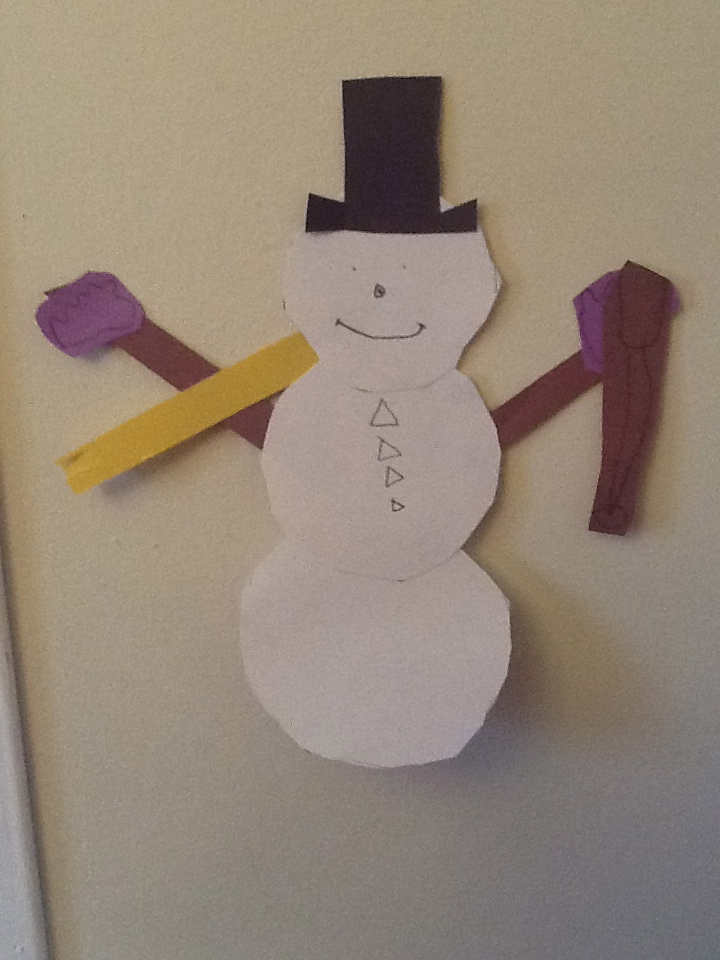
IMG_0088

So, why use glyphs?

  • Glyphs help students with decision-making and critical thinking.
  • Students practice following directions.
  • The glyph can be used as a language arts activity about the subject. A paragraph can be written about the topic of the glyph. This can help a student with paragraph writing since they could just take the data they have already been working with and make it into a paragraph.
  • Graphs can be made from the glyphs if you have more than one person participating. For instance if you had a glyph that pertained to summer activities you could graph one of the responses such as, “How many people like to go to the beach?”
  • Independent work can be encouraged through this activity. If you need to work with your preschooler and your second grader is waiting for you, have them complete a glyph.
  • You can tailor glyphs to fit your needs. Use this as an assessment tool in order to see if the topic was understood.
  • Students can create their own glyphs, which is a higher thinking process.

The Book of the King

I have some good news for students who like adventure stories.  I found a new book series for upper middle and junior high students that I am excited to tell you about. It is called the Wormling Series by Jerry Jenkins and Chris Fabry.  It is has all the great elements of an adventure story: good; evil; dragons; kings; an unlikely hero and an invisible kingdom. This would also be a terrific read aloud series for your family.

If you think this sounds similar to the Bible, you would be correct in your assumption. It is fast-paced and leaves you with enough questions to make the story moving along and wondering how the enemy will be defeated. I am looking forward to reading more of these books in the series.

Click Here to see all the titles in the Wormling series.301591

Kindergarten Readiness: Social Studies, Math, Science, Art and Music Part III

cartoon_house_st5This is a series on readiness skills and resources for preschoolers taking the next “Big Step” to kindergarten.

This week I want to look at mathematic concepts and science. Behind each skill is a website that has worksheets to print or online games to play. This is the last in the series. 🙂

Social Studies

  • Recognizes basic traditions such as birthdays
  • Understands that people live in different parts of the worlds and have different customs and traditions
  • Explores simple maps and visual representations of neighborhoods or communities (Making a map)

Mathematics Concepts

  • Compares the size of groups of objects using language such as “more,” “less” and “same as” (kidzone website is a great resource!)
  • Arranges objects in size order (big to small, or small to big) (havefunteaching has answer keys for self checking if you want to set up a work station)
  • Uses comparison words, like “bigger,” “smaller,” “heavier,” etc.
  • Understands concepts of none, some and all and more than and less than
  • Identifies and draws a square, circle and triangle (practice worksheets for shapes)
  • Correctly counts four to ten objects (tlsbooks has a large variety of worksheets)
  • Knows that the final number counted represents the total number of objects in a set
  • Recognizes some numbers, 1 – 10 (FREE Number sense worksheets)
  • Can distinguish numbers from letters, and understands that numbers relate to quantity
  • Understands the effects of addition and subtraction

Science

  • Shows interest and asks questions about objects and events observed in their environment (create a scavenger hunt list)
  • Notices common properties and differences among objects and materials
  • Knows some facts about common plants and animals, such as what they eat and baby names (Baby animal names online game)
  • Recognizes some objects in the sky such as the sun, moon, clouds and lightning(Check out this adorable solar system lapbook)

Creative Arts & Music

  • Recognizes and names basic colors (Colors and Shapes matching cards)
  • Draws recognizable shapes and simple objects (see link above or Shapes and Colors worksheet)
  • Tells a story with pictures
  • Moves to a beat
  • Explores with common musical instruments
  • Enjoys improvising or copying musical patterns

Kindergarten Readiness: Reading and Writing Skills Part II

Ashley's Get Well Wish

Ashley’s Get Well Wish

Last week I looked at Motor, Reasoning and Language Skills for preschoolers taking the “Big Step” toward kindergarten. This week these are the skills for Reading and Writing. The above picture is from my niece, isn’t it sweet? 🙂

Reading Skills

  • Looks at books or pictures on their own
  • Pretends to read books by reading the pictures
  • Tries to read in everyday situations (signs, labels, etc.)
  • Recognizes rhyming words (worksheet 1, worksheet 2, more rhyming worksheets! A list of ending sounds to rhyme with your scholar)
  • Blends sounds into words
  • Recognizes some common words in print (flashcards Use flashcards for a matching game, online sight words game)
  • Recognizes many uppercase and lowercase letters (worksheets, online alphabet games)
  • Recognizes some letter sounds (A lot of sound activities pinned for you! Click on the website under the picture you are interested in seeing.)
  • Relates stories to personal experiences
  • Puts events of a story in order (beginning, middle, end) Idea: Pick a favorite book and read aloud to your child. Ask them to tell you what happened at the beginning, in the middle of the story and the end. If this is overwhelming to your child, start with identifying the beginning and increasing it to the telling about the end. Do what happened in the middle after both of the others have been mastered.

Writing Skills

  • Tries to write words (practice sheets, more practice sheets)
  • Asks you to write words or notes to others
  • Attempts to write own name and recognizes their own name in print Idea: Provide paper and stickers for an extra incentive and fun way to display their name. Create a place to display their work such as the refrigerator or a cork board.

Kindergarten Readiness: Working on Skills in Preschool Part I

abcs“How do I know if my child is ready for kindergarten?” moms ask me when trying to determine when they should start educating their child. While I am no expert, I do have a checklist of skills this week regarding motor, reasoning, language, reading,  and writing skills to help you. (www.leapfrog.com) I have also listed resources, both worksheets and online games if you are working with your preschooler to prepare them for the “Big Step”. There are so many terrific links to check out and worksheets to download here for your student to enjoy and have fun with learning.

Motor Skills

  • Can put puzzles together (for purchase, online puzzles)
  • Cuts with scissors (printable worksheets)
  • Holds pencils and crayons correctly “Why does it matter?” It can help with comfort, legibility, fluidity, brain development, and less stress on your joints. (Here’s a video you can watch to help with correctly holding a pencil. Do you have a left-handed student? This picture will help.  left hand grip)
  • Builds with blocks (wooden, duplos)
  • Tries to tie own shoes (video)
  • Enjoys outdoor activities, like running, jumping and climbing In other words, your child is physically active.

Reasoning Skills

  • Matches or groups objects according to size, shape or color (Check out these worksheets: tangrams, comparing shapes, coloring shapes )
  • Groups objects that are the same and can describe how they are the same or different (online game)
  • Understands concepts of in/out, under/over, on/off, front/back, etc. (Directional worksheets)
  • Shows an understanding of the passing of time, including concepts of before and after, and today, yesterday and tomorrow

Language Skills

  • Talks in sentences
  • Follows one- and two-step oral directions (A fun activity that incorporates following directions, shapes, and movement, free worksheets)
  • Uses sentences that include two or more ideas
  • Uses descriptive language
  • Knows by heart and recites some common nursery rhymes and songs (A website of  common and not-so-common nursery rhymes!)
  • Pretends, creates and makes up songs or stories
  • Tells or retells stories and/or everyday experiences (Write down stories your little one dictates to you. Make into a book and have them illustrate it.)
  • Asks questions and expresses curiosity
  • Expresses ideas so that others can understand

Next week I will have Reading and Writing Skills and resources for you. Have a great week!

~Lisa