Archives

Picture Studies in Art

I believe art is a valuable course of study for our children as it brings beauty and appreciation of the world to our children. (It is also a required subject for students if you are homeschooling here in Ohio.) If you think you have to be an artist in order to teach it, or that your children have to create a finished product, let me assure you that needn’t be the case. Studying paintings and artists can be done without creating anything, but I think it would be fun and children make better connections to the subject if this is incorporated into your studies.

A great series to introduce students to the concept of focusing on paintings is a series called Come Look with Me.There are 12 books in the series at present and each book has a painting that your student observes carefully, information about each artist and painting, and questions to discuss concerning each picture. There are no right or wrong answers since the purpose of the questions is to get children to go beyond glancing at a painting. The great thing is that young and old will enjoy these books!
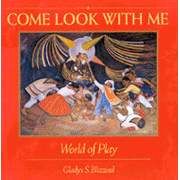
Come Look with Me: World of Play, Gladys Blizzard

Come Look With Me: Enjoying Art with Children, Gladys Blizzard


I have found some amazing resources to help you if you are interested in pursuing picture and artist studies further. I have included some do-it-yourself studies as well as commercial packages that have everything ready to go for you.

The first one is a blog called Artist Study– Charlotte Mason Style with a tremendous amount of resources that will help you to learn more in detail about artist studies. There are many downloadable forms, book recommendations, and activities. Grades K-12.

Picture Study Portfolios is a portfolio of laminated cards of various artists with information and questions that accompany each work of art. It is designed for students K-12. This includes more than just paintings, which I like.

After you have studied some of these great paintings and learned about the artists, why not go to local art museums? Found below are a few that are within driving distance of the Cincinnati area. Don’t live in the area? Please leave a comment if you have a museum recommendation since some of us may get the opportunity to visit or another reader lives near you who would benefit from your recommendation.

Cincinnati Art Museum  Admission: FREE 🙂 Hours: Monday CLOSED Tues- Sun. 11:00 AM – 5:00PM Map and Directions

Taft Museum of Art FREE  SUNDAY Admission Hours: Monday CLOSED Tues- Sun. 11:00 AM – 5:00PM Map and Directions

Dayton Art Institute  Admission: FREE for students, $8.00 adults, $5.00 for groups and senior citizens Map and Directions

REGULAR MUSEUM HOURS
Monday Closed
Tuesday Closed
Wednesday 10:00 a.m. – 5:00 p.m.
Thursday 10:00 a.m. – 8:00 p.m.
Friday 10:00 a.m. – 5:00 p.m.
Saturday 10:00 a.m. – 5:00 p.m
Sunday Noon – 5:00 p.m.

Columbus Museum of Art Admission: FREE  on SUNDAY, $10.00 adults, $5.00 for students 6-17  $8.00 for senior citizens 60+ and students 18+ with ID Map and Directions Click on Visiting

Indianapolis Museum of Art  Admission: FREE Map and Directions

Tuesday – 11 am to 5 pm
Wednesday – 11 am to 5 pm
Thursday – 11 am to 9 pm
Friday – 11 am to 9 pm
Saturday – 11 am to 5 pm
Sunday – noon to 5 pm
Closed Mondays, Thanksgiving, Christmas and New Year’s Day.

Speed Museum of Art, Louisville, Kentucky  Admission: $10.00 Adult, $8.00Senior (65+),  $5.00 Child 3-17,Free for Child under 3

Wednesday 10a to 5p
Thursday 10a to 5p
Friday 10a to 9p
Saturday 10a to 5p
Sunday 12p to 5p
Monday closed
Tuesday closed

Be sure to take a journal, a pencil and some colored pencils with you to draw a favorite painting. Have a great time!

ACT and SAT test preparation

The ACT and SAT college entrance exams are a vital component of a home school student’s criteria for admission into a higher learning institution. Many colleges place a greater emphasis on these tests scores for home school students than public or private school students. The rationale is that these are non-biased, objective, standardized tests that are an indicator of future academic performance. You may have questions about these tests as to which one should your student take and when to take them. I have collected some data for you to read concerning each exam that I think is helpful. Even though the writing portion is optional on the ACT, I would highly recommend you have your scholar take this too. The majority of colleges want to see these scores as well.

Facts regarding the ACT:

Frequency: 6 times/year
Duration: 3 hours, 3½ hours including essay
Sections: English, Math, Reading, Science, Writing
Cost: $49.50
Maximum Score: 36
Average Score: 21

Facts regarding the SAT:

Frequency: 7 times/year
Duration: 3 hours, 45 minutes
Sections: math, critical reading, writing
Cost: $49
Maximum score per section:  800
Average score Math – 516
Critical reading – 501
Writing – 492
How do I know which test is best for my student? The Princeton Review has an excellent compare/contract article from where I have taken the information.

  1. ACT questions tend to be more straightforward. Questions are often easier to understand on a first read. On the SAT, a student may need to spend time figuring out what is being asked before they can start solving the problem.
  2.  The SAT has a stronger emphasis on vocabulary. Your scholar will excel here if they are a wordsmith.  If words aren’t their strength, (s)he may do better on the ACT.
  3. The ACT has a Science section, while the SAT does not. Your student doesn’t need to know anything about amoebas or chemical reactions for the ACT Science section. It is meant to test reading and reasoning skills, based upon a given set of facts. But if you have a scholar who is truly science oriented, the SAT might be a better fit.
  4. The ACT tests more advanced math concepts.The ACT requires you to know a little trigonometry, in addition to the algebra and geometry you’ll find on the SAT. That said, the ACT Math section is not necessarily harder, since many students find the questions to be more straightforward than those on the SAT.
  5. The ACT Writing Test is not required. The 25-minute SAT essay is required, and is factored into your Writing score. The 30-minute ACT Writing Test is optional. If you choose to take it, it is not included in your composite score—schools will see it listed separately. I would NOT have your student skip this section since most colleges ask for this score.
  6. The SAT is broken up into more sections. On the ACT, your  scholar tackles each content area (English, Math, Reading, and Science Reasoning) in one big chunk, with the optional Writing Test at the end. On the SAT, the content areas (Critical Reading, Math, and Writing) are broken up into ten sections, with the required essay at the beginning. You do a little math, a little writing, a little critical reading, a little more math, etc. Will it distract or refresh you to move back and forth between different content areas?
  7. The ACT is more of a “big picture” exam. College admissions officers care about how your scholar did on each section of the SAT. On the ACT, they’re most concerned with the composite score. So if a student is weak in one content area but strong in others, they could still end up with a very good ACT score.
To find out more about the ACT click  here. To find out more about the SAT click here.

How do I  prepare a student for these tests?

Begin early and practice, practice, practice! I used to think that the students who received a perfect score just walked in and took the test once. Not so! I have since read articles and spoken to parents whose children were National Merit Finalists who said they had their student do this as part of school, incorporating it into their schedule, much like you would do if you had basketball or dance practice. I think a good time to begin studying and practicing for these tests is in the spring of their Sophomore year if you’d like them to take the PSAT (an exam for the National Merit Scholarship) at the beginning of their junior year. If you are not going to have them take the PSAT, then have them begin in the fall of their junior year, Your student can review tests questions, work on some math problems, study vocabulary words, read literature, and write responses to the selections every day. The key to taking these tests is being familiar with the types of questions that are given, gauging the time spent on each question or problem, and of course, knowing the answers! I would have your scholar take the test in the spring of junior year and again in the fall of senior year. The tests can ve taken as often as you wish, just be sure to register early as not every school is a test site.

Find resources for your student to practice. Your student can practice online at the following sites: ACT: The ACT SAT: SAT Collegeboard

If you are interested in having your student practice specifically for the SAT essay portion, here is a free ebook by James Stobaugh.

There are a great number of books that have tips and practice tests available for purchase. Each book is a bit different and I actually took both of me sons to the bookstore and had them look at each one to determine the book they liked best. They chose a different book than I thought they would like and Malcolm even chose the  ACT in a box. He enjoyed the portability of the flashcards to review when he away from home.

Here are some books to consider:

McGraw Hill’s ACT Prep Book 2012

Cracking the ACT 2012 Edition

Kaplan ACT Premier 2012 Edition

Cracking the SAT, 2012 Edition

Kaplan 12 Practice Tests, 2012 Edition

Holiday Hustle and Bustle: Less-stress school ideas

I was just thinking of how the busyness of the holiday season and all of that hustling about can be stressful, especially when it comes to school. Why not put some fun into your school schedule and use the holiday season as a springboard for your academic studies?  Here are some of the things we have done over the years in place of our regular schedule leading up to Christmas. After the idea I have italicized the area of educational study that would pertain to it.

Write a Christmas newsletter and send it electronically This saves on postage, you can add cool graphics and be easily edited. language arts, technology

Play educational games to review facts (online math games, make- your- own math games, phonics rules, science, social studies,etc.) various subjects

Read the story of Christmas (Luke 1,2 and Matthew 1, 2) language arts- reading, listening, narration

Write and  illustrate a narrative of the Christmas story. It can be close to the original story or taken from a totally different perspective or time period.  For example: an innkeeper’s point-of-view, set in modern-day, etc. language arts-narration, summarization, grammar,punctuation

Look at the map of Jerusalem to see where Mary and Joseph traveled, calculate the distance social studies, math

Study the  vocabulary of  Christmas– manger, host of angels, Immanuel, swaddling clothes, crèche, lowly, etc. language arts

Delve into the history of  Christmas carols and share what you have learned, either through narration or a written summary. language arts, social studies

Read about other countries that celebrate Christmas social studies, language arts

Read about Hanukkah and make some Hanukkah crafts. social studies, language arts, art

Read about Saint Nicholas Look on a map to see where he lived. Discuss his life and kindness to others. social studies, language arts

Read  the history of the  Twelve days of Christmas. Who would give someone 12 lords anyway? Calculate how many items would be in our house if your true love gave you each of the items listed in the song. social studies, language arts, math

Make cookies and take to neighbors, shut-ins, and the nursing home. home arts, math, social skills 

Shop for those less fortunate. Make Christmas cards to go with the present. home arts, financial literacy, art, language arts

Write and decorate a Christmas card and send to a serviceman or woman art, language arts

Invite someone over to help bake, make crafts, or gingerbread houses.  home arts, art

Have a great month!

Animals and Nature

The last two weeks I have been writing about teaching nonfiction to students and also about writing nonfiction reports. Click on the underlined links if you’d like to read about these topics. If you have decided to write a nonfiction report on animals I have some great resources for you.

My children loved looking at pictures of animals when they were young. They were curious about all different kinds and I loved reading about them and discovering details about them I didn’t know.

I was reintroduced to a magazine called Nature Friend. This great magazine has articles about animals and activities to accompany them. Each moth your children can learn to draw a featured animal, do a science activity, complete a scavenger hunt, and read articles about various animals. Mention code TOSE1133 when calling, or enter coupon code TOSE1133 on Internet orders and receive $3.00 off your subscription. Offer ends 12/31/11. If you are unsure as to whether you would like to purchase it you can review a sample of it online for free! There is a supplemental study guide that be purchased too.

Nature Readers were a big hit in our home. Each reader is at a different reading level so they can be read independently or read aloud. There are five in the set, but you can order them separately. These are terrific to use on inclement days!

Nature’s Art Box, Laura C. Martin This looks like a great book to use as a resource for creating nature-related crafts and projects as well as seeing what artists have done with natural objects. If the weather is less than desirable or you don’t have any of those resources where you live, you can purchase nature items at a hobby supply store.

Freebie: Animal Alphabet Card Game

I saw the Teacher Book Bag booth at the Cincinnati Home School Convention when I had gone and was impressed that  Donna had great products at an affordable price. Right now she is offering a free animal alphabet card game recommended for preschool through first grade. It is great not only for learning letters of the alphabet, but also your child is learning to classify animals. It is played like Old Maid, so younger students will be able to learn quickly.

The best part of this game is it is free! 🙂 You can preview and download it by clicking on the link here