Archives

Dental Health Month

pexels-photo-257256

February is Dental Health Month and this year’s theme (2017) is about the importance of drinking tap water. At first glance you may not see the connection between water and teeth, but sweet, sugary drinks promote tooth decay. Listed below are activities and some resources to help you teach.

How about starting out with the proper way to brush those pearly whites?

Video The is a 2 minute clip from Colgate about proper brushing.

Nothing quite helps with discussing the effects sugar has on teeth than an experiment!

SCIENCE Experiment

You will need: 1 jar, 1 can of dark soda, and 1 egg (not hard boiled)

Empty the contents of the soda into the jar. Add the egg and cover the jar. Have your daughter predict what is going to happen to the egg. Write down the prediction. Ask her how long she thinks it will take for something to happen to the egg. Record this as well.

Check the egg after one day. What has happened to the egg? Write down observations.(You will notice that the egg is slightly discolored. No change with the shell.)

Check the egg in one week and take the it out of the jar. Write and/or draw what has happened to the egg. (You will notice that it is getting darker, but the shell is not softening yet.)

Check in two weeks and take the it out of the jar. Write and/or draw what has happened to the egg. (Egg continues to darken, but the shell is not soft.)

Check in three weeks and take the it out of the jar. Write and /or draw what has happened to the egg. (Egg continues to darken, and the shell might be showing signs of softening.)

images

Check in four weeks and take the it out of the jar. Write and/or draw what has happened to the egg. (Egg is very dark and some, if not all, of the enamel should be worn off. (Eww!)


How about a game or art activity to help with dental health?

Eat This! Not That! Game  Cut out pictures of food from magazines or grocery flyers, or images from the internet . Ask your son to find healthy foods, such as fruits, vegetables and milk. Then look for unhealthy foods, such as candy and soda. Put all these pictures into a large pile. Take two small brown bags and draw a “happy tooth” on one bag and a “sad tooth” on the other. Together, sort out the pictures and place them in the correct bag. (source: http://www.colgate.com)

Art project: Older students can create a a collage of pictures showing good and bad choices.

Here are some worksheets. 🙂

American Dental Association has some worksheets for elementary students. Just scroll down the page to download them.

Oral Health Made Easy You could use some of these worksheets when you watch the brushing video.

Teeth Printables for preschool and early kindergarten at Mama’s Learning Corner look like fun for younger students. The packet includes a maze, dot-to-dot, writing pages, and the alphabet.

What happens when people see actual teeth that have been soaked in soda?

Video  This is an interesting and funny video about young adult soda drinkers. I am not sure they changed their minds, but hopefully they did!


Indoor Play Activities

Living in a climate that is cold during the winter months can bring out the boredom comments. My boys knew better than to utter the words, “I am bored!” because I would have them do a chore for me since they obviously did not have enough to do. They actually were talking about that just the other day! 🙂

Here are some ideas to help with boredom for young and old alike.

screen-shot-2017-01-13-at-6-29-00-am

Kinetic Sand

Materials
1 cup fine sand
1/2 tbsp cornstarch
1 tsp dish soap
water (as needed)
*Food coloring

Directions
Step 1: In a plastic bowl, mix fine sand and cornstarch together.
Step 2: Add the dish soap and then add water a little at a time so that it holds together, but is not too wet. Combine thoroughly until well mixed.
* Step 3: Add food coloring (optional).
Step 4: Let dry for 1-2 hours.
Step 5: Begin playing!

The amazing thing about this sand is that it holds together well and it doesn’t make a mess! whaat?!  Add cookie cutters and plastic knives (if age appropriate) for your children to use. I can’t wait to use this myself! This is a stress reliever, creative play medium and excellent aid for fine motor skills.

School Connections Science- discuss objects have matter; Physical Education– fine motor skills; Health– relieving stress If you have a child who becomes frustrated or stressed, discuss using this as a means of taking your feelings out on an object rather than someone.

Oobleck Ingredients

  • 1 part water (1/2 cup)
  • 1.5 to 2 parts cornstarch (1 cup)
  • Small amount of food coloring (optional)

Mix ingredients

  • Start with the water in a bowl and add the cornstarch a bit at a time.
  • Stir with a plastic spoon until it has a gooey consistency. You may want to use your hands.
  • When the Oobleck is just right, slowly add food coloring, if you want. This can be a challenge to get it mixed properly.
  • Now you can play with it. Be sure to keep it in a plastic container as it is ooey gooey and can stick to surfaces. But, it is so worth making  and playing with it!

Things to do with Oobleck

  • Grab a handful and squeeze it. Let it ooze through your fingers.
  • Make a puddle and quickly drag your fingers through it.
  • Put it into a plastic container and shake it .
  • Jab at the Oobleck and then slowly let your finger sink in.
  • Roll some Oobleck into a ball. It becomes solid, but when you stop moving it, it will melt back into your hand.

Warning! Don’t drop Oobleck on cloth furniture, a deck, or sidewalk. It’s hard to get off.

  • Oobleck isn’t poisonous, but it tastes awful. Wash your hands after playing. Make sure children are supervised.
  • Wear old clothes, as oobleck tends to get messy. While it is messy, it will come out with a bit of water.
  • Lay a couple newspapers on the surface where you are playing.
  • If Oobleck is left out too long, it will dry out and turn back to cornstarch. Throw it away if this occurs.

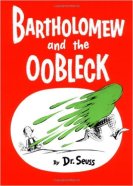
School Connections:  Science- you can discuss what is a Non-Newtonian fluid. Newton described how ‘normal’ liquids or fluids behave, and he observed that they have a constant viscosity (flow). … We call these ‘strange liquids’ nonNewtonian fluids. …NonNewtonian fluids change their viscosity or flow behavior under stress.  Reading– Read Bartholomew and the Oobleck. You can discuss weather, the consequences of our actions and wishes, being grateful, or what is a hero. 

Video  This is a wonderful reading of the story. Click on the word video to take you there.

 Interactive Book  A fun app to engage your student in the reading of the story. This is especially helpful for those that are not yet reading or not reading at this level, but like to have stories read to them.

51aj9mj1pal-_sx354_bo1204203200_


If you are interested in purchasing the book, click on it to take you directly to Amazon.

Geography Ideas

Science has proven the more senses you involve when learning something new, the more it will help you to remember it. I can use all the help I can get and I think that might be true for your child as well.

I had the opportunity this summer  to see a book, Draw the USA, that your child can use for geography throughout the years. Using their artistic abilities, amazing maps can be created. Even if she is not an artist, she can still be successful with this since it is a step-by-step drawing book that begins with a basic shape and not attention given to every nook and cranny of the states. Draw the USA is broken into a step-by-step process and can be done as a  year long project as you are studying the states. I can guarantee that your budding geographer will remember the states better using this technique.

If your child would become frustrated with this, then purchase some tracing paper. He will benefit from this and you can always use the book again when he is capable of drawing it on his own. This book will certainly be a resource that you will use time and time again.

If, for whatever reason, you choose not to have your student draw, then you can purchase puzzles of  the United States. As she is working the puzzle, have her say the names of the states as she places it in the correct spot. Hearing, seeing, touching, involve quite a number of senses to aid in memorization.

You can also purchase placemats and ask questions of your children when you eat. For instance: “What state is north of Ohio?” or  “What states are along the west coast?”

When you are studying geography it is beneficial to have other supports or materials to help your student with the concept of landforms and geographical boundaries. I suggest purchasing a large wall map such as this one by Rand McNally so that you can study the states more in depth, looking at physical features such as mountain ranges, rivers, deserts, plains, etc.

61v7uvrclfl-_sy318_bo1204203200_

Atlases are excellent hands-on tools that children can study maps in greater detail. You can also teach exact location (latitude, longitude) better this way. We use atlases, such as the one pictured below, in my World Geography class when studying geography. Be sure to get an up-to-date atlas if you are studying the world as countries are renamed or even created, South Sudan and Kosovo come to mind.

61azitc-3al-_sx388_bo1204203200_

This author, Kristin J. Draeger, also has Draw the Europe; Draw Africa; Draw Asia; and Draw Canada and you can use the same ideas for teaching geography in these areas of the world as well. Hang your child’s finished works on the wall of your schoolroom when you finish. You may even want to join them and include your drawings on the wall!

img_2612


Pigeon: Helping with Health

Why don’t children in general like to take showers or baths? Maybe it is because they don’t want to take time out because they feel they will miss out on all the fun they are having. Or, the water gets to cold, or they don’t like wrinkly fingers…(those were all of my excuses!)

As I have posted on my blog recently, health is an area that homeschool moms don’t think to include  when teaching. You do not have to use a formal text, but take some time to write down a few topics you are covering so that you can check it off of your “subjects studied this year ” list.

I found a cute book that I think will naturally lead into the topic of personal hygiene. You won’t have to point fingers at your child, but watch the story of Pigeon unfold and hopefully, point out some things that happens to him as a result of needing a bath.

You can watch a video or read the book. I wonder if you can entice your reluctant bath-taker by reading the book to them while they are in the bath?? 🙂

~Lisa

A Thanksgiving Unit


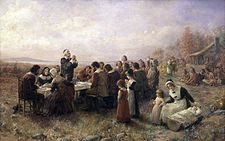
The First Thanksgiving, Jennie Brownscombe

I love this national holiday for several reasons. First, it’s not too commercialized! It’s a bit hard to sell thankfulness, don’t you think? If so, I would order a case or two of it.

Another reason I like Thanksgiving is the history regarding why the Pilgrims came to America;  plus I love to read about the life of Squanto.  He chose to help the race of people who had enslaved him and were responsible (directly or indirectly) for his tribe’s demise. Squanto is one of my heroes! I have included a list of books that I have enjoyed reading to my sons about Squanto and the Pilgrims that I think you will too.

One more reason I like Thanksgiving is because this day focuses on God and the blessings He has given to us. I have included some copywork/dictation pieces for your students to practice their handwriting. Make an extra set and send them to the grandparents as I am sure they would enjoy receiving them.

Would you like to focus on Thanksgiving and do unit study? I have some lapbooks that you can download. I have included two to get you started. Just look over the activities and see which ones you would like to do with your family. I have activities for students all the way from preschool through high school.

Crafts and Art Activities: There are so many ideas that it can be overwhelming. I have only provided you with some we have done as well as a few websites.

Placemats– Make a placemat for each guest that will be attending dinner. Laminate them with contact paper so that the artwork is not destroyed with gravy. Start early on this if you have a large gathering so as not to overwhelm your artists. You can personalize the placemats or make general themes.

Click to enlarge

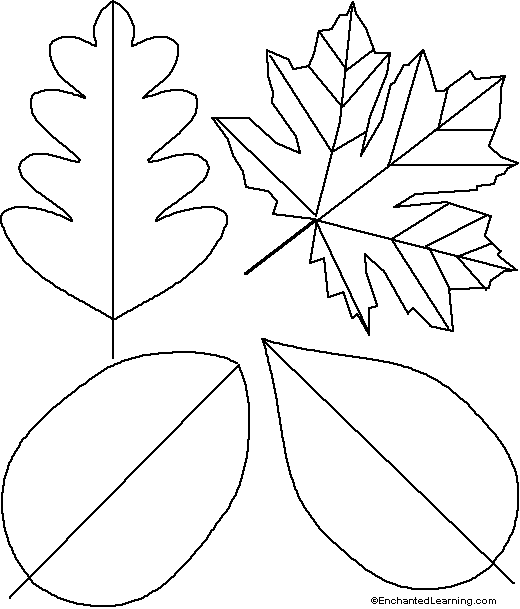
Thankful Wreath– Using fall colors, trace your children’s hands onto the paper and cut them out. Have each person tell you (if they are little) or write one thing they are thankful on each of the hands. Glue the fingers of one hand on to the palm of another hand. You will need to have several sets as you will want to form a wreath shape from the hands. If you have a larger number of children than you can accommodate for creating a wreath then you can make more or… you can make a wreath with construction paper leaves instead.

Thanksgiving coloring pages. Print off a few to take with you on the long car ride to Grandma if you are traveling.

How about a word find or crossword puzzle? There are several levels of difficulty that are given on this website.

Have you ever seen about.com? I have found them to be an excellent resource for topics we are studying. You are sure to find something on these two pages that you and your children will enjoy pertaining to puzzles and word finds.

Enchanted Learning has a variety of crafts, worksheets, and mini books to create for elementary students.

Here is a crossword puzzle for Bible: Psalms of Thanksgiving . You can use these verses for copywork as well.

History:

Research the first Thanksgiving.  Ideas about how to use this for school: Have student(s) narrate what they have read; ask comprehension questions about the passage; calculate how many years it was from the time of the first Thanksgiving until George Washington declared  a day of thanks.

Here is another site from Scholastic under the heading of Research Starters that has the history and additional websites to investigate. click here This website can be used for middle- senior high students.

Watch a video from the History Channel about Thanksgiving. (for older students) Accompanying the video are questions to answer.

There is quite a bit of information on this website about the Mayflower. You can read the original compact  and also read it in Governor Bradford’s own handwriting by going here: Mayflower Compact. Middle school students can narrate what they have read and answer questions such as: What was the purpose of the signing of the compact ? Why did all men sign and not women? Junior/senior high students can create their own compact. Consider why it would be important to include when beginning a new colony.  Have them create a model of their colony.

Plimouth Plantation (website with many things to do and see) I would recommend you to go to  Just for Kids, but don’t stop there because there is quite a bit to look at on this website. Older students can use this website to research topics.

Scholastic. com has some fabulous resources that contain videos of the Pilgrim’s and Native American’s villages. There are also activities to accompany your unit. Click on the right hand side for activities, lessons, and worksheets.

Research how and when Thanksgiving became a national holiday.

Books to Read:

Squanto, Friend of the Pilgrims by Robert Clyde Bulla  Discuss how Squanto helped the Pilgrims. Squanto reminds me of another man who was ill-treated but turned it around for the good of a nation. His name was Joseph and you can read his story in the bible: Genesis chapters 37-50.  Older students can compare and contrast him to Squanto.

The Thanksgiving Story by Alice Dalgliesh This is a nice read aloud for younger students.

Stories of the Pilgrims by Margaret Pumphrey  This a great book for all ages as a read aloud for younger students and an assigned reader for older students. Older students can pick a few stories to highlight and tell to the family if everyone is not going to be reading it.

The If You series are books that my children and I found to provide details and factual information in an interesting format. Here are two that pertain to Thanksgiving:

If You Were at the First Thanksgiving by Anne Kamma

If You Sailed on the Mayflower in 1620 by Ann DeVito

How about including a book report to accompany the reading? Here is a book report form from ABC Teach  thanksgiving book reports

Copywork/Dictation:

Students can copy these scripture passages on to a piece of notebook paper. Glue a piece of construction paper to the back to provide a frame. Hang up the masterpieces and memorize this month.

James 1:17

Every good gift and every perfect gift is from above, and comes down from the Father of lights, with whom there is no variation or shadow of turning.

1 Chronicles 16:34
Oh, give thanks to the LORD, for He is good! For His mercy endures forever.

Older students: Use any of the documents listed above as a resource  for  copying such as the Mayflower Compact or the declaration of a day of thanks from George Washington.

Here’s a Thankfulness Character Study for your family. Click Here

Lapbooks:

Here is a lapbook for younger students to complete using the book Give Thanks to the Lord: Celebrating Psalm 92 by Karma Wilson. If you can’t find the book you can still use the psalm from your favorite translation.

Another lapbook from homeschool share based upon the book Goody O’Grumpity by Carol Ryrie Brink. Even if you do not use the book that is recommended, you can still use the lapbook ideas.

Have a wonderful Thanksgiving!