Archives

February Copywork

Presidents Day and Black History Month are both in February and I wanted to honor each  of these historical events by featuring quotes from famous people. I have enjoyed learning about George Washington and Martin Luther King over the years of studying history.

I just finished reading Booker T. Washington’s autobiography and all I can say is, what an incredible man! If you have never read Up from Slavery, I highly recommend it. Booker was known as the Black Moses and did so much for the Negro community in helping educate former slaves during the Reconstruction period. It was difficult to limit myself to a couple of quotes! CLICK ON LINK FOR COPYWORK february-copywork-dictation-passages

february-copywork-dictation-passages_000001


Here are some books for your student to read about each of these men who helped shape our history.

61ZW1aS15aL._SY419_BO1,204,203,200_.jpg


David Adler has written excellent biographies for elementary students to enjoy. Featuring his life from birth through his two presidencies, this can be a read aloud for first and second grade students.  Grades 3+

Click on book to purchase.


51vvb8vnyal-_sy386_bo1204203200_ Writing with a quill pen, rolling beeswax candles, and playing games that were popular during George Washington’s time are a few of the 21 activities that are in this interactive biography. Timelines, maps, and journal entries are included in this For Kids series that your student is sure to enjoy! Grades 4+      Click on book to purchase.
 

51vzrgqlexl-_ac_us160_

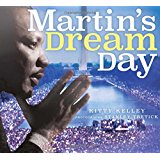
In the book, Martin Luther King, Jr.’s “I Have a Dream” that was spoken at the March on Washington for Jobs and Freedom, the hardships and triumphs he experienced along the way bring the speech to life. Grades 3+ Click on book to purchase.


61khfogqpul-_sy498_bo1204203200_


Using the six enduring principles that “Uncle M.L.” taught, King’s niece describes events that took place during the Civil Rights movement in which practiced them. Grades 5+ Click on book to purchase.


51wrleiftcl-_sx466_bo1204203200_

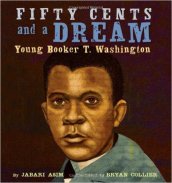
“Born into slavery, young Booker T. Washington could only dream of learning to read and write. After emancipation, Booker began a five-hundred-mile journey, mostly on foot, to Hampton Institute, taking his first of many steps towards a college degree. When he arrived, he had just fifty cents in his pocket and a dream about to come true. The young slave who once waited outside of the schoolhouse would one day become a legendary educator of freedmen.

Award-winning artist Bryan Collier captures the hardship and the spirit of one of the most inspiring figures in American history, bringing to life Booker T. Washington’s journey to learn, to read, and to realize a dream.” – Booklist   Grades 2+ Click on book to purchase. 

51qfdklk3cl-_sx390_bo1204203200_

Chronicling Mr. Washington’s life,  this is a graphic novel biography for elementary students who would like to learn more about the amazing and selfless man who helped educate freed blacks after the Civil War. Grades 2+ Click on book to purchase.


51bjldiwql-_sx312_bo1204203200_

This Dover Edition of Up From Slavery is such an affordable price for  a wonderful book. Mr. Washington had such wisdom in educating blacks and reaching out to whites during the Reconstruction Period. I found myself wanting to underline much of the book because of the things he had to say about love, forgiveness, working hard, and the value of education. Why did I wait so long to read this autobiography? This is a keeper for your home library. 9th grade +  Click on book to purchase.

When do you cite sources? A free tutorial

in-text-citation-high-school-image-200x300Aagh! Your high school student writing on a subject they don’t know much about can be mind-rattling enough, but citing sources can be equally intimidating. This is where some help on the subject is invaluable.

Sharon Watson, author of  a favorite writing curriculum of mine called, Jump In! A Workbook for Reluctant and Eager Writers,  shares her knowledge on the subject in her article about giving written credit where credit is due.

In this tutorial she gives plenty of examples as well as items for your student to practice because things like this can be tricky! You can either have your daughter work on the computer, or there are pdfs that can be downloaded. Mrs. Watson thought of us homeschool moms and provided the answers too. 🙂 To see this invaluable resource, click on In-Text Citation Tutorial for High School Students.

It is never too early to begin learning about citing sources when researching and writing  of topics has begun. Mrs. Watson also has a junior high tutorial with answers to help students begin this important component of academic writing. To learn more, go to her In-Text Citation Tutorial for Middle School Students.

Writing Boxes

Have you heard this comment before? “I can’t think of anything to write!” I can empathize with our students because sometimes I have the same thing happen to me. Soooo, how do you help your child to come up with ideas?  

I saw the phrase writing box that was advertising stationary and pens inside a decorative box, but those words gave me an idea of what could be done for story writing. My thought was to find two or three items to put into a small box that your son or daughter would open.  Who doesn’t like the idea of lifting the lid on a box and discovering the contents that are held inside? These items provide the prompts to create a story without you having to rack your brain to come up with an interesting sentence writing prompt. Let me give you some ideas of what these boxes could have in them.

Writing Box 1 The items inside the writing box are: a storybook, a toy, and a small unlit candle. A story that is just waiting to be told could be about a child (let’s say Tillie) who is reading a book. While she is doing so, the toy that is sitting on the Tillie’s lap comes alive and jumps into the book! Later it is discovered that the toy has taken the candle along with them to light the way on their journey… 

img_3321


Writing Box 2  The items inside the writing box are: a favorite pair of socks (clean of course!), a watch, and an advertisement for a restaurant. We get those monthly magazines that have goods and services advertised in them; why not put them to good use? A possible story could be that your son is all ready for the day with his favorite pair of socks and comfy sneakers. He has some allowance money and goes to the restaurant (the one found in the writing box) with some friends. While he is eating, he glances at his watch only to discover that he has been at there for eight hours! How is that possible? Could that watch be a special time vortex watch…?

img_3319

Of course, those are only my ideas and examples of what kind of stories can be created. Discuss story ideas with the items before beginning writing if your son or daughter has a difficult time. You could start out with a comment such as, “What do these items have in common?” Can you think of a way that these items can be used together?  Jump in on the conversation to help create story ideas, be the scribe by writing down the ideas, and review all the possibilities so that your budding writer has success.

If you would like to have some more fun on a different day, you can have your daughter help with creating a writing box. Have her pick three items and she can tell her story with the ones she has selected.

I hope this helps to get the creative juices flowing. Why not choose three items for yourself and model the writing activity by creating your own story? Be sure to have everyone share when you finish. 

Happy writing!

~Lisa

Indoor Play Activities

Living in a climate that is cold during the winter months can bring out the boredom comments. My boys knew better than to utter the words, “I am bored!” because I would have them do a chore for me since they obviously did not have enough to do. They actually were talking about that just the other day! 🙂

Here are some ideas to help with boredom for young and old alike.

screen-shot-2017-01-13-at-6-29-00-am

Kinetic Sand

Materials
1 cup fine sand
1/2 tbsp cornstarch
1 tsp dish soap
water (as needed)
*Food coloring

Directions
Step 1: In a plastic bowl, mix fine sand and cornstarch together.
Step 2: Add the dish soap and then add water a little at a time so that it holds together, but is not too wet. Combine thoroughly until well mixed.
* Step 3: Add food coloring (optional).
Step 4: Let dry for 1-2 hours.
Step 5: Begin playing!

The amazing thing about this sand is that it holds together well and it doesn’t make a mess! whaat?!  Add cookie cutters and plastic knives (if age appropriate) for your children to use. I can’t wait to use this myself! This is a stress reliever, creative play medium and excellent aid for fine motor skills.

School Connections Science- discuss objects have matter; Physical Education– fine motor skills; Health– relieving stress If you have a child who becomes frustrated or stressed, discuss using this as a means of taking your feelings out on an object rather than someone.

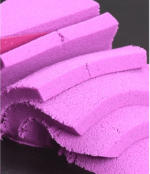
Oobleck Ingredients

  • 1 part water (1/2 cup)
  • 1.5 to 2 parts cornstarch (1 cup)
  • Small amount of food coloring (optional)

Mix ingredients

  • Start with the water in a bowl and add the cornstarch a bit at a time.
  • Stir with a plastic spoon until it has a gooey consistency. You may want to use your hands.
  • When the Oobleck is just right, slowly add food coloring, if you want. This can be a challenge to get it mixed properly.
  • Now you can play with it. Be sure to keep it in a plastic container as it is ooey gooey and can stick to surfaces. But, it is so worth making  and playing with it!

Things to do with Oobleck

  • Grab a handful and squeeze it. Let it ooze through your fingers.
  • Make a puddle and quickly drag your fingers through it.
  • Put it into a plastic container and shake it .
  • Jab at the Oobleck and then slowly let your finger sink in.
  • Roll some Oobleck into a ball. It becomes solid, but when you stop moving it, it will melt back into your hand.

Warning! Don’t drop Oobleck on cloth furniture, a deck, or sidewalk. It’s hard to get off.

  • Oobleck isn’t poisonous, but it tastes awful. Wash your hands after playing. Make sure children are supervised.
  • Wear old clothes, as oobleck tends to get messy. While it is messy, it will come out with a bit of water.
  • Lay a couple newspapers on the surface where you are playing.
  • If Oobleck is left out too long, it will dry out and turn back to cornstarch. Throw it away if this occurs.

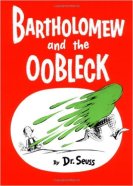
School Connections:  Science- you can discuss what is a Non-Newtonian fluid. Newton described how ‘normal’ liquids or fluids behave, and he observed that they have a constant viscosity (flow). … We call these ‘strange liquids’ nonNewtonian fluids. …NonNewtonian fluids change their viscosity or flow behavior under stress.  Reading– Read Bartholomew and the Oobleck. You can discuss weather, the consequences of our actions and wishes, being grateful, or what is a hero. 

Video  This is a wonderful reading of the story. Click on the word video to take you there.

 Interactive Book  A fun app to engage your student in the reading of the story. This is especially helpful for those that are not yet reading or not reading at this level, but like to have stories read to them.

51aj9mj1pal-_sx354_bo1204203200_


If you are interested in purchasing the book, click on it to take you directly to Amazon.

Copywork and Dictation

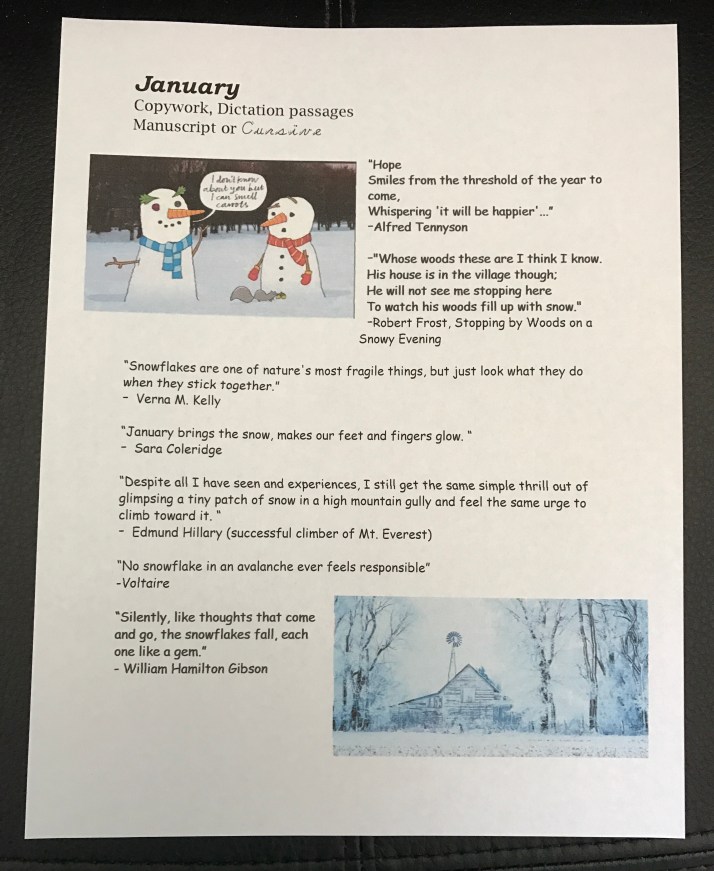
I was just enjoying the beautiful falling snow outside my window and it gave me inspiration to create some quotes with a January theme for copywork and/or dictation. So, why do I think copywork is worth spending time on; isn’t it more busywork? Actually, there are quite a number of essential benefits that I see in this practice.

Copywork

helps students to become faster with writing, thus, students can complete copying work and writing more quickly.

causes students to slow down and look at the words, helping them with spelling.

helps students who need practice with their fine motor skills.

helps dyslexic students. When students write the letters and make the sounds as they are copying, it helps the brain make the connections between letters and sounds.

helps practice with handwriting. I encourage you to teach cursive to your child. We need our students to be able to read historical documents and they will not be able to do so if we have not taught them to read and write it. Cursive has also been shown to help dyslexic students.

creates an activity for your child to concentrate.

gives the students exposure to wonderful descriptions, quotes, and literature.

provide the opportunity to add artistic flair to the written passages.

Dictation is when you read the passage to your student and they write what you have spoken. Your child studies the passage before you begin the dictation. At first, you can start with you writing the passage and leave a few words out that your pupil must write. The goal is to work up to the point where you read the entire passage and your student writes it.

Dictation

causes students to listen carefully.

provides the opportunity to see correct punctuation. What better examples than to see how passages are written in actuality instead of your child just reading about it in a textbook.

gives your student circumstances to write quickly and, therefore, will help in taking notes. At the beginning of the year I talk more slowly when I teach than later in the year because I expect my students to be able to keep up, and they are able to do so since they have had practice taking notes.

I have created a copywork page for January with quotes and poems that I believe you find useful. There are some quotes that will lead to some great discussions.  I am including a link so that you can download it for your family’s use. january-copywork-dicatation-passages  I hope you enjoy the cartoon.

My friend and colleague, Rita Cevasco has a couple of videos that she explains copywork in more detail. CLICK HERE She also has a free webinar coming up and a class on spelling and phonics. Signups for these two events are soon.

fullsizerender