Archives

Mathematical Literature

I found an amazing book that I think you will enjoy. It is called Literature- Based Math Activities: An Integrated Approach by Alison Abrohms. I checked to see if the books that were featured were easily accessible from the library before recommending this resource and good news- they are!
Here are the topics covered in the book: Number Sense and Numeration; Whole Number Concepts; Geometry, Patterns, and Spatial Sense; measurement, Money, and Time; Fractions, Probability, and Graphing. There are reproducible worksheets, math activities, and ideas on how to extend the book to other subject areas.

I also found another book at the library that uses literature, but is geared more toward middle school and has math standards listed for each book. Exploring Math with Books Kids Love by Kathryn Kaczmarski

I have a confession to make- I have not been all that crazy about math having had bad experiences as a child.  I was disinclined to dig all that deep into doing any more with math as a home schol mom other than a few picture books here and there. 😦 If only I had resources like this I would have enjoyed the subject much more. If you are like me and do not like math, read some of the books featured in the above-mentioned book or try these books below and I think you will find math to be a lot more fun!

Additional books with mathematical concepts:

Sir Cumference and the First Round Table, Cindy Neuschwander (This is for older elementary students since it is discussing the concept of circumference.)

Math Potatoes, Mathterpieces, The Grapes of Math (and more!) Greg Tang  These books are great for problem solving and thinking creatively.

Bunny Money, Rosemary Wells (If you haven’t read Max and Ruby stories yet, you are in for a treat!)This book comes also has activities about money.

Bunny Party, Rosemary Wells A book about counting

Fractions: After you read these books you either have to bake something with your child(ren) or eat pizza. Either will be a wonderful hands-on activity. 🙂

Apple Fractions, Jerry Pallotta

Fraction Fun, David A. Adler This covers fractions AND money!

Fraction Action, Loreen Leedy

Full House: An Invitation to Fractions, Dayle Ann Dodds

The Hershey’s Milk Chocolate Bar Fractions Book, Jerry Pallotta (Prolific author of non-fiction books- both math and science)

Free Math Assessment

“How can I find out what in what areas my student is lacking and where are his weaknesses in math?” was something I was asked recently when doing narrative reviews. Good question! If you are using a textbook, see if the publisher offers an assessment test. If not, I found a  free online math assessment (preschool – adult) that can be taken multiple times. You can use this tool  to help you plan the upcoming year as it shows you areas where your child missed questions.

While you are looking at the site, be sure to find the section that says Free Assessment Test. This can be retaken, which I think is a nice feature. If your student needs additional help you can subscribe to their tutoring service.

I took the 2nd grade test ( I passed!) and found it to be informative and helpful. Be sure to allow enough time for your student to complete the test. It may take 30-60 minutes depending upon your student.

Reading Levels

One of the biggest challenges for home school mothers of new and early readers is determining what reading level and books to have your children read, whether that is aloud or independent. I have found a few resources to help you with that!

Scholastic has books at various reading levels and individual book titles that are categorized by grade, subject, and also price. It is called the  Guided Reading Leveling Chart.

The McCall-Crabbs Standard Test Lessons in Reading has five volumes that contain reading selections.  These short passages are read by the student within a 3 minute period with questions about the test afterward. Reading level is based upon how many questions were answered correctly. Keep in mind that this is just a short reading selection and a gives you a general idea. If your child is struggling, you may want to consider having your student tested for language processing issues or vision problems (tracking).

Tips: Make sure you have plenty of time for your budding reader to read aloud in order to gain fluency, confidence, and comprehension. Allowing them to pick books that are easy to read are a great way to ensure success. If you would like to increase vocabulary, discuss stories and characters, find good books to read aloud. Happy reading!

Selecting a Book (Independent reading)

How does your reader know if a book is just right for them? I found this Just Right Book Selection Rubric that I think will act as a good guide to ensure successful independent reading.

EASY

*you can read the words fluently (smooth and with an interesting voice)

*you have a large framework of knowledge for the subject

*there often are not a lot of words on a page

*you know how to say all the words

*there are not a lot of pages in the book

*sometimes the book has a larger font

*you totally understand the story

*your reading rate may be quicker

*your thinking comes easy as you read the words

CHALLENGING

*many of the words are too hard to decode (failed a five finger test)

*you don’t know what the tricky words MEAN

*your reading becomes choppy more than it is fluent

*you don’t have any framework of knowledge for the subject

*there are often a lot of words on the page

*often the font is small

*you lose focus as you are reading

*you are not enjoying the book because you have to do too much word work

*your thinking is confused

*your reading rate slows way down

JUST RIGHT

*you can read most of the words

*you can understand what you are reading

*you enjoy the book

*you may have some framework of knowledge for the subject

*you can read the book with smooth fluency but there are some choppy places

*your reading rate is just right- not too slow and not too fast

*you can figure out the tricky words and still get the meaning of the story

Source: http://www.readinglady.com/mosaic/tools/tools.htm

Summer (School) Ideas- Math Games and Resources

I had a mom ask me a great question. “I don’t want my son to become rusty on his math facts. I want to do school 2-3 times a week, but I want it to be fun. How do I do that?”

I believe in the power of fun! Turn reviewing math facts into a game and it won’t seem like “school” at all.

Math Facts On the Go

Why not review math facts while in the car? This requires 2 or more players. The caller (mom or an older sibling who knows the math facts) calls out a math problem to be answered by the opponents.  The first person to answer correctly receives 1 point. This is fine if you have two students who are at approximately the same skill level.  But, if they are not and let’s say John is pretty good, then give Jane a handicap of 5 points. The first one to reach 10 (you pick the number) wins the game. Challenge your children to beat you. My kids made excellent progress with their multiplication facts and they started beating me. I had to review my facts! This game can also be played with flashcards if it will only be you and your child. The card gets turned over to reveal the problem and each of you see it at the same time. If you choose this option you better wait until you are in a parking lot instead of while you are driving! This game can be used for all mathematical operations (addition, subtraction, multiplication, division).

Create a Puzzle This will require a little bit of your creative juices to make this game. It can be a single or multi-player game. I have included pictures so you have an idea of what I am thinking.

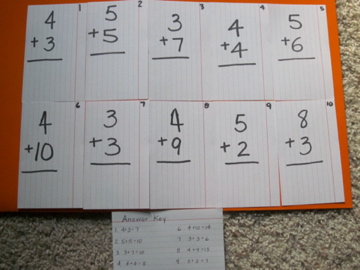
How to Make the Game: Using 10 index cards, (You can pick any number you wish) lay out the cards and draw a picture on the front of the cards. It doesn’t have to be fancy!

Turn all of the cards over being careful to keep the design as it was when face up. Write math problems on each of the cards.
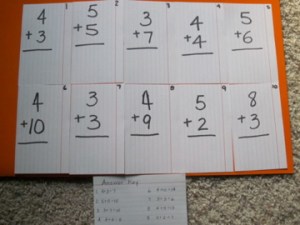
Write  a small number on the problem side in the right hand corner beginning from the problem on the left hand side and going to the right and so on until you have numbered each card. The player may put the cards with the math problem facing up without your help, using the numbers in the right-hand corner as a guide to do so.
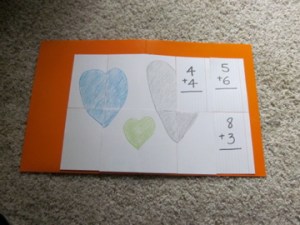
When the math problem is answered correctly it may be turned over to reveal the puzzle piece on the other side. The game continues until all math problems have been answered correctly and turned over to complete the puzzle.

How to play the game: Put all of the cards in the puzzle problem side up. Your scholar looks at each math problem and answers the math problem. If your mathematician answers the problem correctly (s)he may turn it over to reveal the design on the other side. The review is complete when all of the design has been completed. Make this self-checking by providing a list of the facts with an answer key. Your older students may enjoy making these problems for your younger students by designing the puzzles,writing the math facts and  making the answer key. They would be reviewing math facts too 🙂 Store in a plastic bag so the game can be reused. You can make additional puzzle games with new designs and new math problems.

Buzz

This game is used to review a specific fact family.  It can be played with two or more people.  The leader chooses a number between 2 and 9.  The leader says 1, the next player says the 2, and so on.  When they reach a multiple of the number chosen, the player says “buzz” instead of the number.  If a player forgets to say buzz or says it at the wrong time, he or she is out or you begin again if it is just two of you playing.  Play continues until you reach the last multiple of the number times 9. (12×9 for example)

Playing Doubles You will need dominoes to play this game.

Learning multiplication facts with 2 as a factor can be fun and easy with dominos.  Use domino doubles to demonstrate that multiplying by two is the same as adding doubles: 3+3=2×3, 4+4=2×4, and so on.  Have your scholar either tell you or write both addition and multiplication fact families for the various domino combinations.

Websites and Online Computer Games (Supervise younger students on the computer if necessary)

ixl

I found a website that has a great number of online math games that your children will enjoy. It even has awards and a game board that the student fills in online as activities are completed! It is called ixl and is for ages Pre-K to 8th grade. I looked at the Pre-K counting dots activity as well as middle grade activities. If problems are missed explanations are given as to why the answer is different than the one your student chose.

Mad Dog Math

Do you have a scholar who loves animals, dogs in particular? Here is a review of an online computer game: Heartfelt Homeschooling

Math Play

At Math Play there is a wide variety of fun online games to sharpen or reinforce skills. There are games for elementary through middle grades. They are organized by grade level, content, and game type.