Archives

Ideas to Help Boys With Writing

test-clip-art-9i4zjokiE

I have found when I am talking to moms about writing that generally boys have more difficulty writing than girls, although I know there are young women who struggle as well. I had the problem of getting one of my sons to write and together we had to work through the writing process. I believe that partnering and modeling are the keys to successful authorship.

  • Write ideas and stories down for them as they are sharing. Writing is communicating ideas on paper and shows your son he has something to write about.
  • Read his stories back to him. This is empowering to a student because he can see that what he has to say matters.
  • Validate your student as a writer. “You were sharing a story with me that I wanted to write down.” means the world  to a new writer since many times they aren’t quite sure where to begin or what to say. (That’s like me and my blog at times.:) )
  • Write along with him. Have you ever been given a project that is daunting that you wanted to keep push it off until that last-minute? Did you wish you has someone to help or encourage you? That’s how many new writers feel. When you sit down and write alongside your budding author, he will see that you value writing and the importance of doing it.
  • Start slowly. At first you may just need to write for a few minutes. That’s okay because ideas build upon themselves. Your son may just have a list of things at the beginning.  Lists are a way of communicating and can be expanded upon in the future if need be. You also can just let that idea go since it may not yield anything further. I have quite a few blog posts that I have begun, but have not been finished. That may be the same way with your son’s writing, and that is okay!
  • Share your writing too. As you share and model the writing process your son will see that writing isn’t it a one and done process. Saying things like, “Oh, I don’t like that sentence.” or, “I was looking for a different word to describe that.” lets him see the process of writing.
  • Keep at it. Writing is like any other skill. The more you do it, the easier it will become.

Some ideas that I have written about have been from the book that I used with my sons called, The Writer’s Jungle, by Julie Bogart.

Showcasing your Student’s Work: Writing

Showing student work for a portfolio review in the area of writing can be done in various ways. Whether you have a student who is just beginning to write or a student who is authoring a novel, samples of work can be included in their portfolio review.

Primary Grades

Simple words and/or drawings are ways of writing and communicating so include those as part of your budding author’s portfolio. Can you guess what this is representing? If you guessed the fourth day of Creation you are right!

IMG_1362


If you have a child that is not yet writing, but loves to tell stories, be the scribe and write it down for them. You can read it back to them and they can illustrate parts of it. The important point is that they see themselves as an author, being able to communicate through writing.

Beginning writer’s work can also be samples of writing the alphabet or practicing their name.

Elementary and Middle School

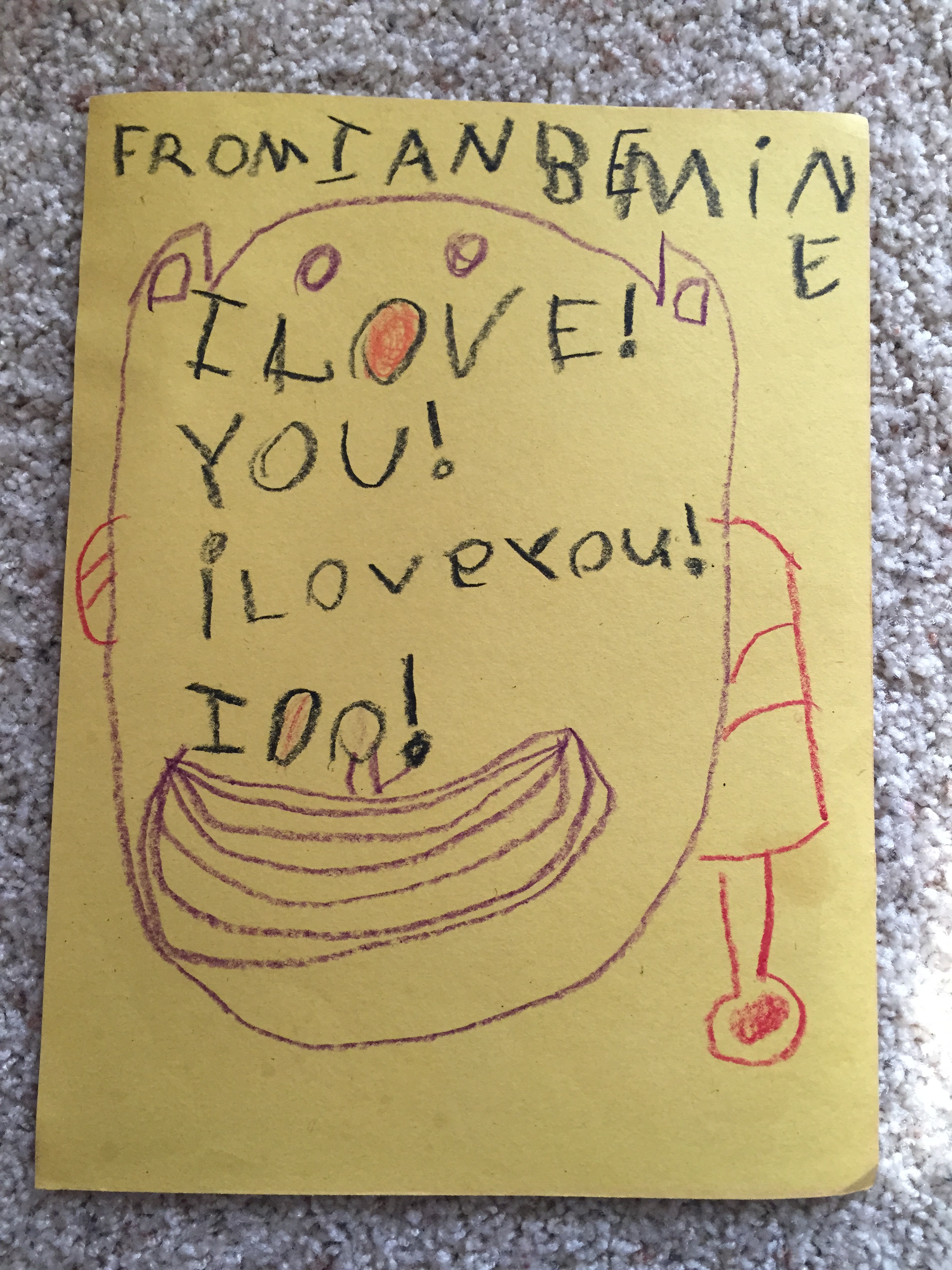
Children love to express their love and, while you may not consider a card  to be “writing”, it is because a thought or idea is being communicated.  Put those in the portfolio as part of language arts.

IMG_1354

What about lists and jokes? Yes, they count too! My son Ian had this eight page book that was nothing more than a list of animals and a name next to it. He had a lot of fun with it and would carry it with him throughout the day. I would see him scribbling something in it and then chuckle to himself as he read back over the list. The funny thing is that I just found that list the other day when I was cleaning out some of his old artwork!

Here are other ideas:

Short stories and chapters of books

How-to do something (play a game)

Writing a letter (take a picture of it before you send it off in the mail)

Book reports

Short research project (1-2 pages on various history or science topics)

For you who have techie children and families

Emails to a grandparent

Blog (Some of your children may be contributors to a blog or have their own.)

Facebook messages


Language Arts Games to Play

FullSizeRender

Sometimes it’s just hard coming up with a way to reinforce grammar and spelling lessons. Instead of workbooks, how about some games? Your student will be engaged longer with the subject and with more than one of the senses involved, will better retain the information. So, pull out the games and have fun!


Word Games

  • Scrabble and Scrabble Jr. are not only ways to work on spelling, but these games require some strategy in the placement of words on the board. Mathematics skills can be reinforced as well if scorekeeping is involved. You can purchase it as a board game or you can get the app. for FREE!
  • Scattergories (pick a general category and write 10 letters of the alphabet going vertically) You don’t even have to purchase the game! You can create your own. Set the timer for one minute. Each player reviews their words and whoever has the most wins that round. Determine how many points will win the game ahead of time.
  • Boggle is a great game to play for middle school and older students. This online version has a timer and you can see how many words you can spell within the allotted time. Not only is this an online game, but it can be a board game to play with the whole family. You cab also purchase it as a board game if you like. Click Here
  • Mad Libs are fun, nonsensical stories that you fill in the blanks. A review of parts of speech and even giving a mini lesson helps students to think of adjectives, adverbs, nouns and verbs (plus others) to complete the story. You can download stories or purchase them. You can even download a free app of the game!

Helping Children Become Good Readers

I have asked a friend of mine, Becky Boerner, to write a post for my blog today. The information for her blog is listed at the end of her article. Enjoy!

image

https://usplash.com

One of the ways we help our children become good readers is to give them direct instruction on how to be one.   The most effective and simple way I know to help your child become a good reader is by sharing your thought process with them as you read a book to them.    By sharing your insights and the insights below, you are helping your child to become a good reader.   I have divided up the process of  reading to before, during, and after.  Each part shares what a good reader does and then gives you some things to say to your child to share your thinking process.

Before reading- A good reader will think about what is the purpose of what I am about to read.  They will ask, “Am I trying to gain information on a topic or find out what happens in a story?”  By stating what you think the purpose of a story or text is  out loud you are modeling what good readers do.

A good reader will look at the title, pictures, headings, bold face print and begin to ask wondering questions.  You can ask these out-loud before you begin a story with your child.   I wonder what this story is about?  I wonder why that person is doing this on the cover?  I wonder what is going to happen in this story? I wonder if this is similar to another book I read?  I wonder if this relates to something else I have been learning?

During reading- A good reader will form pictures in their head about what they are reading.   You can facilitate this with your child by  sharing what pictures are in your head as you read a story.  “I am picturing the little girl sitting by the lake.  What do you see in your head?”  At first your child may say “nothing.”  That is fine.  Encourage them to make pictures in their heads of what they are reading and keep sharing the pictures that you have.

A good reader continues to ask wonder questions during a reading. You can pause in the middle of story and wonder out loud to your child. I wonder what what will happen next?  Did that make sense? I wonder why that happened? I wonder if this information verifies what I already know about  this topic or if it is new to me?

A good reader will reread a passage that did not make sense.  You can say to your child “That really did not make sense to me.  I am going to reread it.”  Then reread and discuss the passage.

A good reader is able to make inferences when reading. You can say to your child, I think that character is implying (blank)   I think the author is trying to say (blank)   Making inferences is a big part of reading comprehension.  Let your child know what you are inferring to make sense of a story or text.  It will help them learn to inference.

After reading a story or text- A good reader will check to see if the predictions they made came true.  You can model this by saying,” I was not right about that prediction and this happened instead.  It happened just like I thought it would.  My predictions were right. ”  You can also talk about any predictions your child made. For non-fiction you might say ” I did learn about (topic) just like I thought I would. I thought this what have better information on (blank).  This verifies what we learned on our field trip.”

Good readers are able to retell a story or summarize what they read to someone.  By sharing your retelling of a story, or sharing what you have learned, you model what a good reader does.  Asking your child to retell a story, or summarize is also helpful.

I try to do the above type of reading with my kids  1-3 times per week.  I do not think you need to do it every time you read something to them. At first it seems strange to stop in the middle of a book and reveal your thinking to your child.  But it is a very powerful way to instruct them on becoming a good reader.  It becomes more natural the more you try it.  Your child wants to hear what other good readers are thinking about. Especially when that good reader is you.

You as a parent are a good reader and by modeling your thought process you give your child a true gift.  You are drawing them into the group of good readers, and that is a gift that lasts a lifetime.

Becky Boerner M.Ed.
Ohio Homeschool Assessments
This was first posted on http://ohiohomeschool.blogspot.com/

Book Lists for Middle School

imagesI am sorry I couldn’t come up with an interesting title for this topic, but being direct works too. 🙂 It’s easy to keep up with reading ahead of your children when they are young readers, but it becomes more difficult as the books get longer. I am posting some lists here for you to be able to determine which ones are appropriate for your student. I don’t like getting caught off guard and trying to find a book while I am at the library. There are thousands to choose from at the library and I wander around pulling books off the shelf, reading the insides of dust covers.  After spending several moments of doing that, I  realize that the book is not suitable for my student and have to begin all over again. Thus, wasting time while I could be doing something else. I hope to save you from the same fate.

Middle School Lists

Suggested Classic List  This particular list has done part of the work for you as it has a description behind each title. don’t be intimidated that it says 8th grade if you are wanting a book for a 4th grader because there are titles that are lower leveled readers.

Good Reads Classic List This list has 83 titles listed and a rating/ review of each book.

Classic Middle School  This list has levels behind them, and I am not sure I agree with all of the placements, but you can determine that for your reader. A blogger has taken this list and written a description for each of the books. For details on specific books Click Here

Have a good week!

~Lisa