Archives

Oh, the Places You May Want to Go this Summer

Summer is rapidly approaching so I wanted to give you a list of places that are within the greater Cincinnati area. If you don’t live nearby, I am sure many of these ideas will be universal and help you think about what is in your area. This list is 6 pages long and includes summer camps, museums, parks, and some educational ideas to do as well. I could have gone on and on, but I do want you to go and do something besides reading my blog. 🙂 Have a great time!

Summer Activities

Here are  2 websites for activities around Cincinnati  and kidslist that you can enjoy; have a great time!

Gaming: Ideas for reviewing Math Facts

You have worked hard all year and your scholar has made tremendous progress on math facts. Don’t let your summer break undo all progress that has been made. Try a few math games!

Bingo
Make a bingo card with a grid of 25 answers for you and your mathematicians to play. Instead of calling B-4 you call out 4+3. If the answer you have called is on the bingo board, the player may cover their answer space. Be sure you have a master list of the math problems you have called out. You, as a caller, should play too! The first person to cover their answers wins. At first you can play that one line of correct answers wins. (across, down, diagonal) As your student gains confidence make it a Cover All. You can make coins be your counters and you can use this as a money counting lesson as well. For example: “I see you have 5 nickels on your bingo card. How much money is that?” This game can be done for all operations: multiplication; division; subtraction; and addition.

War Playing Card game
2 or more person game
Determine whether you will make the game addition, subtraction, or multiplication before beginning. Deal the entire deck of cards. Each player turns over the top card from their pile without looking at it. The person with the higher number needs to answer the problem correctly in order to win the hand. For example if two people are playing one person turns over a 7 and the other person turns over a 9. The person with the number 9 is the one who gets to answer. If they answer incorrectly, the other person has a chance to “steal” the cards. You tell your children that you will make mistakes. (Give more incorrect answers than correct answers if they are just learning facts.) If there is a draw (you both turn over the same number on the card) you must “go to war” against each other. You then each place 3 cards face down and one card face up- the person with the highest number then must answer the problem. Aces are valued as 1, while all the face cards (jack, queen, king) are valued as 10. The person with the most cards wins.Warning! This is like Chutes and Ladders- it never ends! You can set a certain number of rounds to play if you are short on time. My kids always loved “catching me” making mistakes so they could steal my hand. It really keeps your child involved in the game and reviewing facts with each hand.

Concentration
Make up 10-20 pairs of math fact cards and place them face down in random order in rows of 5’s. (One card would have 7+6 and the other card would match it with the answer of 13) Choose two cards to turn over. Only turn one card over at a time to see if you can match them. If they do not match then they are turned back over and the next person takes their turn. The person with the most pairs wins. Be sure if you are playing that you make mistakes so they can “catch” you. If they do catch you or you catch them and they are wrong- you get to take the matching pair. Be sure to have the player say the problem and the answer out loud each time two cards are turned over. The person with the most pairs at the end of the game wins.

Matching
Make a pattern and write out math facts with the answers on the card. Cut the card apart and have your scholar match them. For example- make a set of 20 hearts. Write 10-3= 7 and then cut the heart in half. Mix up the hearts with various subtraction problems and have your child match the hearts correctly.

Share a Little Debbie heart cake or make heart-shaped sugar cookies afterwards for a job well done. You can even make eating the cookies a math problem. There are 3 people and each will get 2 cookies, how many is that? Or, you can just eat them- yum, yum!

Lapbooks

Have you ever heard of a lapbook?  I can’t think of a better way to introduce children to note taking and summarizing. Cutting, gluing, and coloring are needed, but the finished product will bring smiles of satisfaction to you and your children. 🙂

A lapbook is a creative way of writing facts and ideas about a topic and using templates to display a student’s knowledge. The templates are cut out, written on, and then attached to a file folder that has been divided into thirds. The folder can be rather large depending upon how much you have decided to include, and therefore is read on your lap.

Amazingly enough, you can assign a research project to a student and you will hear moans and groans, see eyes rolling, and even certain individuals fall out of their chairs when the words “research paper” are mentioned (it has happened at my house), but if I say lapbook there isn’t that kind of reaction. I think part of it is due to the fact that there are small bits of information or mini books (also called minit) that are written instead of a blank piece of notebook paper or a blank page on the computer screen. I think that is invaluable if you have a student who hates to write or becomes overwhelmed with information.  Lapbooks are also terrific for summarizing and picking out details from passages that are read. Here are two examples of lapbooks that I found on the internet.
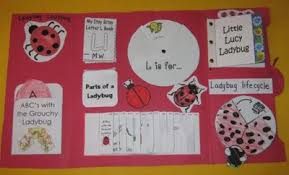
So, without further ado, here are some FREE resources for you to enjoy and to help you get started:

If you would like to hear and see someone talk about them  click here. The presenter specifically uses these for the Apologia Science series. If you are interested in seeing a step-by-step video of how lapbooks are created, here is a  lapbook tutorial with ideas.

www.homeschoolshare.com  I love this website because they have a tremendous amount and variety of topics. They have lapbooks according to ages  (toddler through middle school) and also some according to interest. Here is one that uses Mr. Popper’s Penguins as its focus: http://www.homeschoolshare.com/poppers_penguins.php

Here are lapbooks for younger students called Preschool Packs. There are so many to choose from that you could spend all year working on them.

Heart of Wisdom has a lapbook on the Passover and Exodus.

Are you interested in making your own lap books? Making Books With Children has free book projects that can either stand alone or be added to your lapbooks.

More Summer (School) Ideas

Here are more ideas for school this summer.

The zoo cannot be beat when you are discussing various animals and their habitats. Our local zoo has some wonderful programs. Once we examined elephant and zebu dung (regarding how various animals digest their food) and I even took it home and put it in my compost afterward!

County fairs are not only fun, but educational. You and your child(ren) can look at different breeds of animals, see various demonstrations, and eat some funnel cakes (yum!).

Farmer’s markets are a great way for your student(s) to get to speak with local farmers and ask questions about how things are grown. We have a number of them throughout the city and I enjoy talking to the vendors about various gardening techniques, how to use an unusual vegetable in dishes, etc.

Animal shelters are an option if your child is thinking about pursuing becoming veterinarian, loves animals, or you are thinking about buying a certain dog breed. Many times the shelters need people to walk the dogs and this could also go for volunteer hours if you have older students who need them for their high school transcripts.

Elementary Literature and Resources

This will be an ongoing list of children’s books as this is something I love. 🙂 I bet there will be something on this list that will help you with home schooling and making it fun. I have also added a short list of curriculum and resources.

Books (Preschool and Elementary)

Authors:

Eric Carle

Denise Fleming

Lois Ehlert

Mem Fox

Steven Kellogg

Rosemary Wells

Favorite Titles (preschool and young elementary)

Chicka Chicka Boom Boom– Bill Martin, Jr.

Chicka Chicka 1 2 3 Bill Martin, Jr.

Mouse Mess, Linnea Asplind Riley

Prince Cinders, Babette Cole

Caps for Sale Esphyr Slobodkina

The Story of Ferdinand Munro Leaf

Chapter Books (for young readers)

Henry and Mudge series, Cynthia Rylant

Cam Jansen,David Adler

Dragon Gets By (other in the series), Dav Pilkey

George and Martha, James Marshall 

Books (for reference )

Cathy Duffy’s 100 Top Picks, Cathy Duffy

The Three R’s, Ruth Beechick (a great review is at: www.cathyduffyreviews.com)

What Your Child Needs to Know When, Robin Sampson A checklist of skills are listed by grade.

Charlotte Mason Philosophy of Education

A Charlotte Mason Companion: Personal reflections on the Gentle Art of Teaching, Karen Andriola

A Charlotte Mason Education, More Charlotte Mason Education, Catherine Levison