Archives

Free Math Assessment

“How can I find out what in what areas my student is lacking and where are his weaknesses in math?” was something I was asked recently when doing narrative reviews. Good question! If you are using a textbook, see if the publisher offers an assessment test. If not, I found a  free online math assessment (preschool – adult) that can be taken multiple times. You can use this tool  to help you plan the upcoming year as it shows you areas where your child missed questions.

While you are looking at the site, be sure to find the section that says Free Assessment Test. This can be retaken, which I think is a nice feature. If your student needs additional help you can subscribe to their tutoring service.

I took the 2nd grade test ( I passed!) and found it to be informative and helpful. Be sure to allow enough time for your student to complete the test. It may take 30-60 minutes depending upon your student.

So Many Curriculums,How do I Choose?

Whether you have been home schooling for a long time or this is just the beginning of your journey, you may have realized that many home school families have a large number of children. I don’t; I only have two sons. At times I wish I had more, but my two sons were a whirlwind of non-stop activity and I really couldn’t see myself chasing more little ones. Call me a whimp, that’s okay; I probably am. With all that said, I only got two shots at trying out all the amazing curriculum that I saw at the home school convention and in the catalogs that I received.

“Where do I begin?” was my first thought and may be yours as well. First of all, decide what philosophy of education best meets what you want to accomplish with your family and best matches your ideals. Not sure of your philosophy? A great resource to help you decide what books and ideas you would like to pursue with your children is a website called Home School Curriculum Advisor and you can read the article entitled, Creating a Home Schooling Philosophy of Education Simply and Easily. Be aware that if this is the first time you are considering what your home education philosophy, it may take more time than you originally thought. It is well worth it though, and will save you countless hours of looking at curriculum and spending hard-earned cash needlessly.

Another component that is worth investigating is what type of learning style best fits your child(ren) and you. There are a variety of ways in which people learn: audio, visual, kinesthetic, or a combination of the aforementioned. Let’s face it, no two people are alike and some curriculum works better than others depending upon each individual. Here are some resources on learning styles to help you determine your scholar’s style: They Way They Learn, by Cynthia Tobias and The Big What Now Book of Learning, by Carol Barnier.

Will you be able to tailor each individual subject to meet each of your children’s needs? Probably not unless you have one student (obviously!), but you can be aware of the type of learners your children are and pay attention to the style of learning that best fits you too since you are teaching. You can love a program that uses workbooks as its mode of teaching and be enthusiastic about it, but if you have a kinesthetic learner who needs to be involved in projects and being able to move, your best laid plans will be hard to implement and will not be all that successful. I have found that unit studies and lap books provide a great balance for those who need hands-on activities and those who excel with workbooks and worksheets.

After you have decided what type of philosophy of education and the types of learners you have in your school, THEN begin to look at curriculum. 🙂 Even within the area of curriculum for a certain type of philosophy you will find different approaches and products. For instance, if you like Unit Studies you have a choice of making your own or using one already prepared. You can choose to do something general as in the history of Ohio or be specific and choose to concentrate just on local history. Be a little bit of detective and a little bit of hound dog. There are a wide variety of choices and products to choose from and if you hear or see something that no one else has tried, don’t be afraid to investigate, dig in, and go down a different path than everyone else if that is what you need to do for your family. I did and I was happy with the choices I made.

I have listed two resources to help you with curriculum choices. Take your time in reading through these.

Choosing a Home Schooling Method: Which One is Right for You? I like how the author has given you a brief overview of a particular philosophy of education and characteristics of the various programs.

Cathy Duffy’s 100 Top Picks for Home School Curriculum is a great resource book to purchase. She gives you a short inventory of the style of learners too and curriculum that would fit with your scholar’s style.

You have chosen a curriculum that you would like to order? Great! Here are some of my recommendations for home schooling products; they have a wide variety of books and also fun activities to enhance your curriculum.

Catalogs for Home Schooling Curriculum and Products You can request a catalog, but I have links to the websites listed below. Personally, I prefer a paper catalog,

“Why a paper catalog instead of the online version?” you may ask. Here are some of the reasons I like a paper catalog, although I do refer to the online versions too. You can mark in it with notes (if it can be found at the library, or be borrowed, etc.), you can take it anywhere, (even the bathroom while relaxing in the tub),sometimes you don’t always have internet connections (good reading while waiting out a storm in your basement 🙂 ), it is easily navigable-I can turn the pages, sticky note particular pages, etc.,and you can show other enthusiastic home school friends and ask veterans their opinions about products. I also keep catalogs close by my couch so when home school moms come to see me we can look at several curriculum options and products while they are meeting with me.

I just received my Rainbow Resource catalog in the mail and I love pouring over it. Oh Happy Day! There is just something about picking up that big catalog and holding it in my hands that makes me feel happy. (Be honest, many of you feel the same way when looking at home school products!) Beware! If you are new to home schooling, then do not let the size of the catalog deter you. It is easily 6 inches thick, but remember that it would be like putting all the products AND reviews of a small store into print.

Christian Book Distributors is another great resource, especially if you are looking for specific Christian titles.

Sonlight catalog has lists of books that are tried and true. I have used a large majority of the library books (also known as “living books”) they recommend in their programs as they can stand alone without using their particular program if you choose.

Veritas Press A classical education products catalog

Beautiful Feet Books I love the book selections and the literature guides,especially for middle schol students and older.

I hope that this helps you clarify your vision for your family and their education and helps eliminate the stress that you may feel in picking curriculum.

Reading Levels

One of the biggest challenges for home school mothers of new and early readers is determining what reading level and books to have your children read, whether that is aloud or independent. I have found a few resources to help you with that!

Scholastic has books at various reading levels and individual book titles that are categorized by grade, subject, and also price. It is called the  Guided Reading Leveling Chart.

The McCall-Crabbs Standard Test Lessons in Reading has five volumes that contain reading selections.  These short passages are read by the student within a 3 minute period with questions about the test afterward. Reading level is based upon how many questions were answered correctly. Keep in mind that this is just a short reading selection and a gives you a general idea. If your child is struggling, you may want to consider having your student tested for language processing issues or vision problems (tracking).

Tips: Make sure you have plenty of time for your budding reader to read aloud in order to gain fluency, confidence, and comprehension. Allowing them to pick books that are easy to read are a great way to ensure success. If you would like to increase vocabulary, discuss stories and characters, find good books to read aloud. Happy reading!

Summer (School) Ideas- Math Games and Resources

I had a mom ask me a great question. “I don’t want my son to become rusty on his math facts. I want to do school 2-3 times a week, but I want it to be fun. How do I do that?”

I believe in the power of fun! Turn reviewing math facts into a game and it won’t seem like “school” at all.

Math Facts On the Go

Why not review math facts while in the car? This requires 2 or more players. The caller (mom or an older sibling who knows the math facts) calls out a math problem to be answered by the opponents.  The first person to answer correctly receives 1 point. This is fine if you have two students who are at approximately the same skill level.  But, if they are not and let’s say John is pretty good, then give Jane a handicap of 5 points. The first one to reach 10 (you pick the number) wins the game. Challenge your children to beat you. My kids made excellent progress with their multiplication facts and they started beating me. I had to review my facts! This game can also be played with flashcards if it will only be you and your child. The card gets turned over to reveal the problem and each of you see it at the same time. If you choose this option you better wait until you are in a parking lot instead of while you are driving! This game can be used for all mathematical operations (addition, subtraction, multiplication, division).

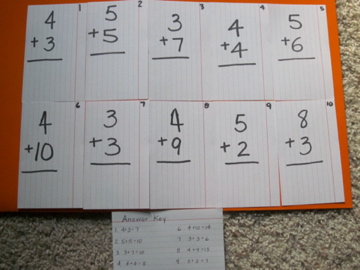
Create a Puzzle This will require a little bit of your creative juices to make this game. It can be a single or multi-player game. I have included pictures so you have an idea of what I am thinking.

How to Make the Game: Using 10 index cards, (You can pick any number you wish) lay out the cards and draw a picture on the front of the cards. It doesn’t have to be fancy!

Turn all of the cards over being careful to keep the design as it was when face up. Write math problems on each of the cards.

Write  a small number on the problem side in the right hand corner beginning from the problem on the left hand side and going to the right and so on until you have numbered each card. The player may put the cards with the math problem facing up without your help, using the numbers in the right-hand corner as a guide to do so.

When the math problem is answered correctly it may be turned over to reveal the puzzle piece on the other side. The game continues until all math problems have been answered correctly and turned over to complete the puzzle.

How to play the game: Put all of the cards in the puzzle problem side up. Your scholar looks at each math problem and answers the math problem. If your mathematician answers the problem correctly (s)he may turn it over to reveal the design on the other side. The review is complete when all of the design has been completed. Make this self-checking by providing a list of the facts with an answer key. Your older students may enjoy making these problems for your younger students by designing the puzzles,writing the math facts and  making the answer key. They would be reviewing math facts too 🙂 Store in a plastic bag so the game can be reused. You can make additional puzzle games with new designs and new math problems.

Buzz

This game is used to review a specific fact family.  It can be played with two or more people.  The leader chooses a number between 2 and 9.  The leader says 1, the next player says the 2, and so on.  When they reach a multiple of the number chosen, the player says “buzz” instead of the number.  If a player forgets to say buzz or says it at the wrong time, he or she is out or you begin again if it is just two of you playing.  Play continues until you reach the last multiple of the number times 9. (12×9 for example)

Playing Doubles You will need dominoes to play this game.

Learning multiplication facts with 2 as a factor can be fun and easy with dominos.  Use domino doubles to demonstrate that multiplying by two is the same as adding doubles: 3+3=2×3, 4+4=2×4, and so on.  Have your scholar either tell you or write both addition and multiplication fact families for the various domino combinations.

Websites and Online Computer Games (Supervise younger students on the computer if necessary)

ixl

I found a website that has a great number of online math games that your children will enjoy. It even has awards and a game board that the student fills in online as activities are completed! It is called ixl and is for ages Pre-K to 8th grade. I looked at the Pre-K counting dots activity as well as middle grade activities. If problems are missed explanations are given as to why the answer is different than the one your student chose.

Mad Dog Math

Do you have a scholar who loves animals, dogs in particular? Here is a review of an online computer game: Heartfelt Homeschooling

Math Play

At Math Play there is a wide variety of fun online games to sharpen or reinforce skills. There are games for elementary through middle grades. They are organized by grade level, content, and game type. 

To Assess or Not- that is the Question

Spring is finally here and that means we as home school parents in Ohio must have some type of academic evaluation done for each of our children.

“Should I have my student assessed or have him take a standardized test?” is a question I hear quite often from home school mothers. There are many advantages to a portfolio review (also known as a narrative assessment). Here are some reasons to consider:

This is a terrific way of reflecting on all the work you and your student did over the course of the academic year. It causes you to evaluate your curriculum and your schedule and decide what worked well and what needs to be changed for the upcoming year.

  • It is a marvelous option for younger and older students alike. Younger students may not be reading at an independent level that is required for testing, while older students just don’t want to take one-more-test!
  • You may have used a curriculum that would not be covered on the standardized test such as in the area of history. It may have concentrated on ancient history instead of doing American history like all the rest of the children on your block. That is the beauty of home schooling!
  • You did not use traditional curriculum and would like to discuss your year with a fellow home school mom and certified teacher.
  • Your child is an individual. Nationally normed tests do not allow for any differences. Questions may be interpreted differently by your child and because they did not know what was being asked they get it wrong. It’s difficult to watch your student ask you about a test question and knowing you could clarify their misinterpretation of it, but not being allowed to do so under the testing conditions.
  • Test results only confirm what you know are strengths and weaknesses of your student. Narrative assessments can provide you with an opportunity to ask a teacher for ideas and resources to help your student. Feedback can be given on how your child is doing in school.
  • If you are a resident of Ohio this fulfills the requirement in order to continue to school your children for the upcoming year.

I believe in you and your role as a teacher. I  believe in home schooling and the opportunities we each have to teach our children according to their unique abilities and giftings. If I may be of assistance with your portfolio review please email me. schoolmarm@cinci.rr.com