Archives

Apples! Activities for Your School Day

Did you know there are 2,500 varieties of apples are grown in the United States? 7,500 varieties of apples are grown throughout the world? 100 varieties of apples are grown commercially in the United States?* I didn’t either, but that explains why when I go to the store there is another type of apple I haven’t heard of that is available for me to try. Since September will be scurrying away so quickly and apples will soon be past picking, why not take advantage of the varieties that are available and teach an Interest Unit? If you live in Ohio, you can count this for your study of Ohio history. 🙂

Make Applesauce 

Most children love applesauce and it’s such an easy project that your children can help you make it. Start it in your crockpot in the morning and enjoy in the afternoon as a snack.

Materials needed:

8-10 apples- peeled, cored, and cubed

1/2 cup water

1/4 cup brown sugar (If you buy a sweet variety, you don’t even need this!)

1/4 teaspoon cinnamon (optional- add to the apples or wait until after it has cooked)

One large crockpot

Place all ingredients in the crockpot and turn on high. Allow apples to cook for 4-5 hours. Depending upon how chunky you want your applesauce to be, you can either take a wooden spoon or potato masher and break up the cooked apples into smaller pieces, or place in a blender and process until you have the desired consistency. Doesn’t this look good?

download

As the delicious smell of applesauce fills your house you can do some apple inspired school activities.

Free Apple Math Pack has a variety of preschool activities in a sampler. If you like, you can purchase the entire packet.

Thanks to John Chapman, aka Johnny Appleseed, apple orchards were begun across the midwest and were valuable to families who were traveling west during the westward expansion.

Here are some stories of his life to read. With older students, you can pick out the information that is true and that which is fabricated. Create tall tales about Johnny Appleseed.

Johnny Appleseed

Here are some comprehension questions for the story.

What was Johnny Appleseed’s name?

When did he live?

What was his purpose in growing apple trees?  Do you think this was a good idea? Explain why you think it was or was not a good idea.

Write one detail from your reading that is not true.

Why did people make up details about him that were not true?

————————————————————————————–

A documentary for children to watch about the life of Johnny Appleseed would be great for children to take notes. The Story of Liberty

Watch the Disney version of Johnny Appleseed

Compare and contrast the two videos. You could use a T-Chart or a Venn Diagram (Boy! it was hard to find a printable of this, but I found one. yay!)

Have a great day!  ~Lisa~

* (urbanext.illinois.edu/apples/facts.cfm)

Independence Day Resources

Happy Independence Day! Aren’t you glad to live here in the United States of America where we have great freedoms (speech, assembly, religion)? I have some video resources for you to use for this holiday.

download

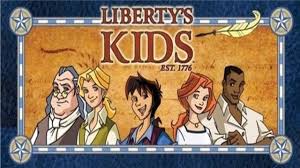
Liberty’s Kids– This is an animated series that has 48 videos about the American Revolution. Each of them is approximately 30 minutes long and cover different aspects of the war.  If you enjoy the series you can purchase them by clicking HERE.

Would you like an overview of the American Revolution? Here is a 9 minute video that explains it. * The narrator talks very quickly, so you will likely need to watch it a few times if you want your student to take notes. For the video only, watch below to avoid the sidebars of other video suggestions.


If you have older students and you would like them to learn more about the American Revolution, Khan Academy has 17 lessons with each having a slide show and documents pertaining to the war. There is also a quiz for your student to take afterward on the Declaration of Independence, The Article of Confederations, and The Constitution of the United States. Should you take a summer break, bookmark this resource to use in the future.

What exactly was written in the Declaration of Independence? Here is the document written for you to read: Declaration This same website also has lesson plans, questions, and activities. U.S. HistoryLesson Plans

If your student has an understanding about the American Revolution, then this music video will reinforce what the Declaration of Independence was about to the writers. (Set in a much more modern music style than 1776. 🙂 It’s Too Late to Apologize lesson. Here is the video. For the video only, watch below to avoid the sidebars of other video suggestions.

Enjoy your day! ~Lisa~

A Fun Writing Activity

Sometimes trying to get a child to write is like trying to get an overtired child to take a nap. It. isn’t. easy. I understand your frustration and exasperation since I have been there with my sons before too.

I was reading a blog today called Education with Docrunning and they were talking about creating a newspaper using this free tool at fodey.com. I was curious to see what it was all about and found this to be so fun that I spent more time than I had on creating a newspaper article. There is something about seeing what you have written in a newspaper format that makes it intriguing. I had so much fun that I created two articles and had to stop there. It is perfect for reluctant writers because not much is seen on the page. Of course, you can break it up into several newspapers if you like.

You can use my newspaper as a guide since you can see that you need to keep the name of your newspaper pretty short. Mine was McAfee’s Almanac and it was too long.  You can also make the date whatever you prefer. It would be great to use this style of summarizing an event from history, such as Martin Luther King Jr.’s speech, that occurred on August 28, 1963.  If you are interested in looking into this,  CLICK HERE

Teaching Multiple Children

“Which subjects are good to teach that all my children can learn at the same time?  How do I do it?” were questions that I was recently asked.  Some important things to consider are first, the subjects to teach.  Science, Social Studies, Health, Safety, Bible, and Read Alouds are broad enough in their topics that you can do this most easily. Since this will be a lengthy post and I want to be sure and include resources for you, it will be broken into several posts. This week is concerning Science and Social Studies.

Second, and the most important idea, is HOW to do this. Experiments are the easiest, and I believe, the most effective way to teach science to multiple children. Who doesn’t like to get involved in gathering supplies, taking part in an experiment, and observing what happens? Little ones can help with the gathering of supplies(not the handling of harmful chemicals of course!), your middle daughter/son can read the directions.  You, the instructor, can introduce the experiment, consider and discuss hypotheses, while your older daughter/son, if age appropriate, conducts the experiment.  Lab sheets can be filled out to varying degrees by those who can write (or draw pictures) and everyone can examine what happened. You can lead the discussion and oversee the cleanup.

Janice VanCleave has written excellent experiment books for all different ages. Not only does she explain the experiment in easy to understand terms, but they actually work! If you click on the picture, it will take you to the page with several of her titles. I have used several books in the Every Kid series, all the way up through 8th grade.

012847.jpg


In regards to social studies, reading aloud the book you are studying can involve all of your children. This can be done in several ways. you could and have everyone draw a picture of the events that are taking place. They could compile these pictures throughout the year to make a timeline. (Scroll down to find the timeline template you like.) Be sure the dates are recorded for each picture so they are in chronological order. 🙂 If your children are not interested in drawing, what about coloring a themed picture?

Raising Our Kids American History

Thought Co. Art History 

My Homeschool Printables History Coloring Pages

Do you have older students who enjoy coloring? I located free adult coloring sheets from museums around the world. (Some are cool, others are different, so be sure and peruse these and pick out what you feel is appropriate. The collections are below the picture of the scribe.) My Modern Met

Children enjoy dressing up, so what about having each student choose a historical figure to research and give facts about him/her? Your little ones can just say who they are, when they lived, and 1 or 2 facts about them. Your older children can research more details, give additional facts, the reason they chose this person, and their contribution or detriment to society.

Incorporating technology could easily be accomplished by recording the children reciting facts gathered. Family and friends could enjoy seeing the children and leave comments should you post it privately on YouTube. If you have some that are shy, then what about them being figures in a “wax museum” and writing the facts to be read by you or an older sibling?

Can’t sew, don’t have time? Here is a website with ideas for simple no-sew costumes: CLICK HERE  If your student would like to pick a broader category, then something as easy as a cowboy costume or Rosy the Riveter can be done when talking about the Great War.

images

You could not only consider this for history but also fine arts (sewing, designing costumes) and mathematics (logic and reasoning, constructing the costume). I would love to see your children’s costumes if you decide to do the historical character idea.


Have a great day!  ~ Lisa ~

Teaching to Interests

download

Teaching to your child’s interests is this week’s post, thanks to a friend of mine’s suggestion. So, how does one go about doing this? Do you need to ditch the textbooks? It’s really a great way to get your child interested in learning and can be done at any grade on any topic.

What really interests your son or daughter? I am sure you already know the answer to that question! Several years ago I tutored a young man who hated writing and just plain ol’ refused to do it for his mom. He was in 5th grade and his wise mother knew that he could not continue in his ways. Enter me, the tutor, to get this young man to write. I quickly found out that he was passionate about space travel and spent hours drawing models of ships. Not only did he draw them, but he had an extensive Lego collection of various types of Star Wars aircraft and other types of space modules. THIS was his passion and that’s how I reeled him in and got him to write. The first writing project was for him to describe the details of these spaceships.  Gladly writing, the young man enlightened me on a subject about which I knew nothing.This took several weeks before he exhausted this topic. Next, he went on to make paper towns and houses and writing billboards and descriptions to advertise houses that were for sale in his town.  Writing was not as tedious and gut-wrenching as he had thought. 🙂

If your daughter loves horses and your son is crazy about snakes (Just examples as we know anyone can be interested in these topics), why not incorporate these into your school day? You don’t need to get rid of your curricula, but you can use it to enhance what you are doing or replace a topic that is going to be covered next year. Horses or snakes (or whatever the topic) can be studied, drawn, read, researched, and written about, and a poster or PowerPoint can be created to wrap up the study. Look at all of the subjects we just included using those areas of interest: science, fine arts, language arts, and technology. You can even make up math problems involving that topic. For instance: 5 snakes were sunning themselves on the horse path. Along came 3 horses, but they got frightened and two ran away. How many were left? I couldn’t help myself! I had to combine both into a story problem. lol

images

Have a great week! ~ Lisa ~