Archives

Teacher Resources: Phone and Tablet Apps

UnknownWhere do you begin to look for good apps among the plethora of apps that are available? I have found a few sights that have apps from preschool all the way to high school. Best Apps for Kids has a review for each app and offers educational apps as well as ones to entertain. Family Education also has a list of educational apps, many that are free. Best Apps for Kids even have a Free App Friday! Speaking of free apps, here are a few to check out:

  • Kids ABC Letters Lite Preschoolers will enjoy this jigsaw puzzle approach to letters. The light version only has letters A to H, but you can download the complete version if you like it.
  • Play 123 This won a 2013 Editor’s Choice Award from Children’s Technology Review and teaches preschoolers their colors, numbers, and shapes.
  • Fun Brain Jr. Looks like so much fun as it teaches number sense, alphabetical order, and pattern sets.
  • Stack the States This app teaches and reinforces the location of the United States with a fun colorful game.
  • Word Ball The Electric Company from PBS has a game that teaches spelling for children ages 6 to 8.
  • Brain POP Movie This extremely popular app has a new educational movie to watch each day. Kids view a short documentary and there is a quiz afterwards and each movie can be archived to watch later.  It received a 5 star rating from Common Sense Media.

Enjoy your day and I hope you find an app that will benefit your student’s education. If you have found some apps that you like, please share. 🙂


Lapbooks

Italy lapbook coverI like looking for new resources that enhance my teaching. There are a few websites that I have as a “go to” when looking for ideas, so over the next few weeks I will share with you some of my finds. Today I am featuring lapbooks.

Unit Studies/Lapbooking

Home School Share is one of my favorites because the authors of these lapbooks have background information, ideas, and activities to accompany each of the lapbooks. There are several levels, beginning with preschool all the way through independent learners. There is a book that goes along with the lapbook, but if I can’t find the book at the library I have either substituted the book or not used one at all. Lapbooks are versatile and multi-grade leveled, which is perfect when teaching children of various ages and academic levels. I have used them with young students who cannot read yet all the way up to junior high students. If you are teaching several students, you can adjust the level at which you have them write the information and cut out the mini books. You will probably want to cut them out for your younger students and be their scribe. This lapbook was made by a 7th grader so you can judge accordingly to what you think your student is capable of completing. If it looks like too much, then use fewer mini books.

Italy lapbook inside

The above picture is the inside of the lapbook about Italy. Each of these pieces of paper has information the student has written inside of the mini book. This teaches summarizing and research, plus it’s a great way to have students write a report without all the fuss from them on the length of the paper. 🙂

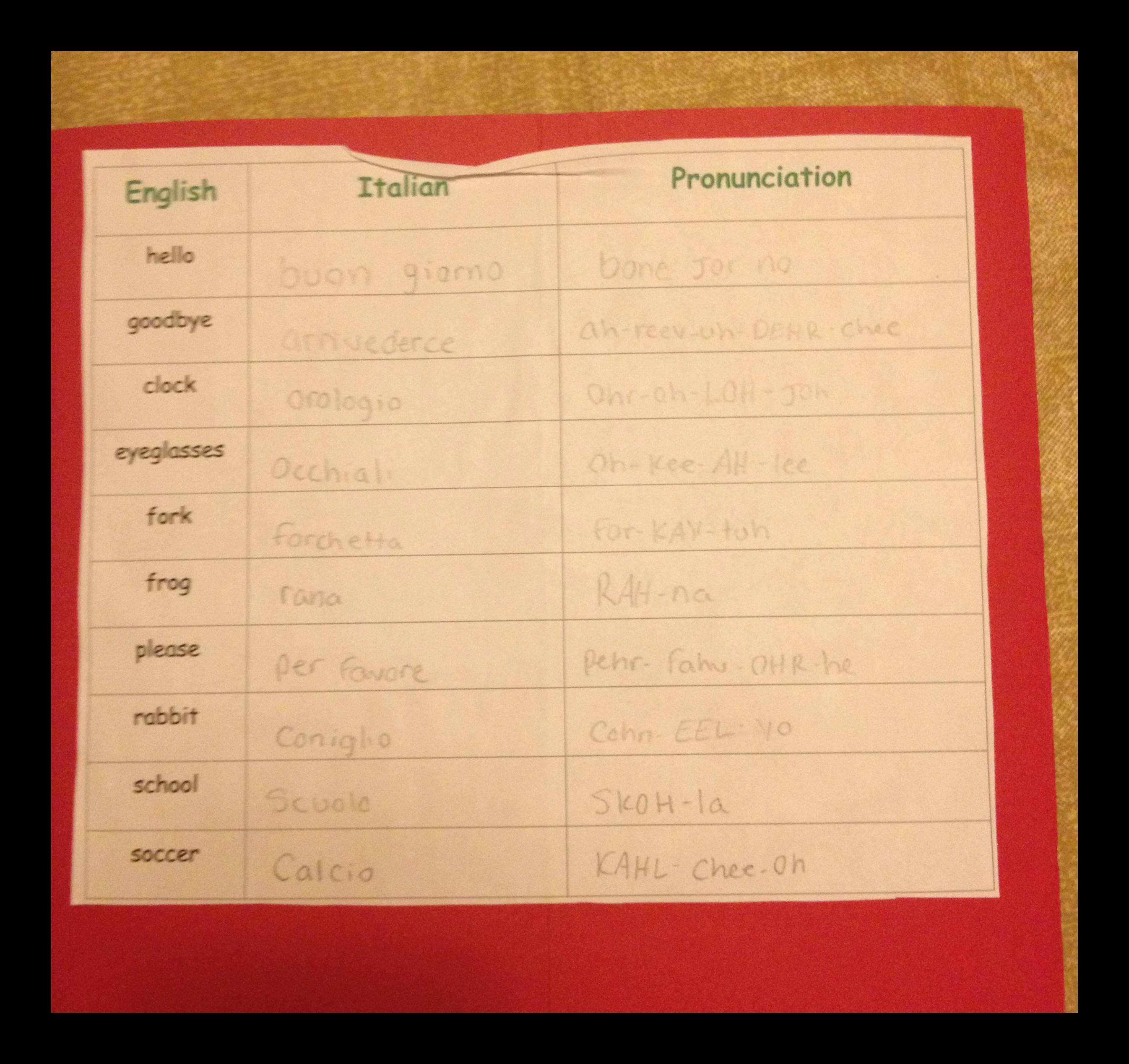
Italy lapbook back

This is the back cover that has vocabulary words the students had to find. The following website is helpful to translate; give the definition of the word if you need it ; and the audio pronunciation of the word. Click here

Another nice aspect of this particular website is that it is FREE! The only cost will be ink and paper you need to print the sheets and a file folder that acts as your lapbook. You can download as many or as few of the templates as you like. I have written about lapbooks before and have other websites to explore. Check out these too:

The Early Bird Catches a Co-op

bird_wormI was reviewing some information I had posted in July about homeschool co-ops and thought I’d send a note about when to inquire about them. NOW is the best time to do that as many co-ops are registering families before the school year ends. I have listed some reasons for and against participating in a co-op since it is important to consider what you are committing your family to participate in for the year.

3 Reasons to Join a Co-op:

  • Co-ops can enrich your academic program. Many co-ops have science labs, art, music, and physical education programs available to students. You may not have the equipment at your home or it can be difficult to do these activities by yourselves.
  • Co-ops provide social interaction opportunities for your child(ren) and you. It is not only important for your child to meet other children, but it is just as important for you to meet with other fellow homeschoolers. You just might meet your best friend at a co-op. 🙂
  • Co-ops support and encourage you. There were quite a few times that I needed some suggestions or a person to discuss matters with in regards to homeschooling. It’s nice to have other women who are on the same journey as you.

3 Reasons to Not Join a Co-op:

  • It is time consuming. You will be away from home for at least half of your school day. Look at your  school calendar and see how you will complete your academic subjects if you join a co-op. You will need to make accommodations to accomplish this, whether it is for your children to do schoolwork before you leave for co-op, or do it when you return home, or do it over the weekend. My boys were early risers so we did a math lesson beforehand.
  • It is a commitment. Once you make the decision to be involved in a co-op you are agreeing to be there for the entire duration of that session. Some co-ops have semester-long classes and some have year-long classes, so be sure and see what that entails before signing up for classes.
  • You will be required to help. A co-op is different than a drop-off program in that you will need to volunteer to help in some way. You may need to teach a class or be a classroom aide, so be sure to check and see what is expected of you.

If you are interested in finding out about co-ops here in the greater Cincinnati area, click HERE for a list of local co-ops. I hope you find a group that works for your family.

If, by chance, you don’t get into a co-op you could organize a small group of your own, but that’s a topic for another day…

~Lisa


Indoor Activities with Balloons

Balloons1-612x300Brrr! It’s cold outside and everyone is getting antsy.  Here are some fun ideas using balloons to help your children expend their energy. You can also incorporate some math and science with that physical education!

Balloon Juggling  Blow up two balloons and practice “tossing” them from hand to the other. First, throw one of them high into the air so that it is floating. As it begins to descend, add toss the other balloon into the air. Hit the one that is descending, causing it to rise. Hit the next balloon as it descends, causing it to rise. Keep the cycle going! Add a third balloon when you have mastered two balloons.

Balloon Rockets This activity is fun for all ages. The longer the room, the further the rocket will go.

You will need:

Balloons (elongated ones work best, but round ones work too)

1 Straw

Masking tape

1 clothes pin (the type with a spring)

Fishing line

2 Chairs (Ones which you can attach fishing line)

Tape measure, pencil, paper, graph paper

First, place each chair on opposite sides of the room.

Tie one end of the fishing line to one chair, making sure it is taut, otherwise the balloon rocket will “stall out”.

Next, thread the straw through the fishing line and then tie the fishing line to the other chair. This will be your rocket line.

Inflate the balloon, pinching the end closed with the spring clothes pin.

Use two pieces of tape to secure the balloon to the straw on the fishing line. Be sure the clothes pin end is pointing towards the end of the track and the nose of the balloon is pointed toward the chair across the room.

Move the straw with your rocket toward your beginning line.

Remove the close pin and let the rocket fly!

Okay, you know you can’t pass up the teachable moment so grab the tape measure and see how far the rocket flew.  Record the results and do it at least two more times. 🙂 How about graphing the results? balloon rocket data sheet   You can also compute the average distance, how long it took for the balloon to fly, and which one flew the farthest.

Balloon Volleyball

Items Needed;

1  balloon ( I like the 12″ balloons for this activity, but a 9″ balloon will work too.)

Masking tape

Directions:

First, lay the masking tape across the carpet, creating a boundary line. Next, create volleyball teams. Nest, inflate and tie the balloon.  Then, have your  teams stand on each side of the line. The object is to hit it over to the other side. The team who can keep the balloon from hitting the floor and not stepping over the line when it is on their side gets a point. The first team to reach 10 points wins.

Mini Marshmallow Popper This looks like a lot of fun and only requires for each popper a paper cup, a pair of scissors, a balloon, a rubber band, and some mini marshmallows. Be sure to make extras for friends to come over and play too!