Archives

Filling out the Notification Form-Part 2

Now that you are finished with the notification form you are ready to send it to your school superintendent. Most homeschool families send their paperwork in 2 weeks before school begins.

If you live in a school district that says Local School District in the title, you must send it to the county board of education. For instance, Southwest Local School District would be sent to Hamilton County Board of Education. If the title of your school district includes the word city in it you send it to the city’s superintendent. If you lived in Mason City School District you would send it the Mason school superintendent. If you do not know call your local school; they will be glad to help you.

It is advisable to take a couple of precautions before mailing your paperwork. Make a copy of all of your paperwork that you submit to the school in the event that it is lost or misplaced. It has happened! Consider sending it registered mail with a receipt. This service costs about $6.00, but it is worth the peace of mind to me. Things get hectic at the superintendent’s office as school is beginning and if  your paperwork would happen to get misplaced you have proof that it was delivered and received.

I would also mail it instead of dropping it off at the superintendent office. I have had friends drop off paperwork and then not receive their excuse from compulsory education.  As I stated previously, things are pretty crazy in August and paperwork could accidentally be misplaced. The school has ten business days to respond to your notification paperwork upon receipt. After that, it is assumed your student has been excused. I personally would not feel comfortable without receiving something in writing. If this happens to you call the office to inquire about it.

Once you receive your excusal letter make a copy once you receive it. Doing this is for a number of reasons.  First of all, I feel “official”! Second, in Cincinnati we have all kinds of perks for home schooling and the letter proves we are educators. Our library system has a teacher collection card and we can use our letter to also get this special card. Many places of business offer teacher discounts on books and educational supplies so your letter will act as proof of that for you. Last, if your student happens to be out during school hours  (babysitting, a part-time job, etc.) and is questioned by a police officer they can show the excusal letter. This never happened to my children, but I’d err on the side of caution.

Mail that paperwork in with confidence and have a great year!

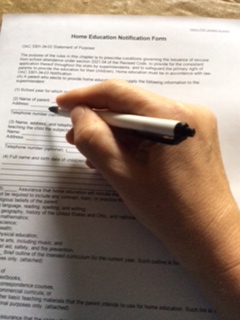
Filling out the Home Education Notification Form

photoIt’s getting close to the beginning of school!

In order to home school here in the great state of Ohio, you must submit the necessary paperwork in order for your child(ren) to be excused from compulsory attendance. The notification form can seem a bit intimidating, but once you have gone through this step-by-step explanation you will realize it wasn’t too difficult afterall. Please have the Ohio Home Education Notification form in front of you for reference. This is not legal advice- please contact HSLDA or a state/local home school organization if you have questions.

A. This is just the introduction- no need to put anything here.

(1) Fill in the upcoming school year- for example if you are going to teach your child in the fall you would write the current school year.

(2) Write your name and address. There is no need for you to fill in your telephone number.

(3) If you are not going to be teaching your child the majority of their school work, then you will need to list the person’s name here. For instance, if you work and your mother is going to do the teaching, you would list her name and address. The phone number is not needed.

(4) Full name and birthdate of your student(s) is listed here. Grade level is not necessary.

(5) Put a check mark on the line that shows you will be providing an education in each of these subject areas.

(6) Place a check mark on the line for the outline of intended curriculum.You have the freedom to change your mind once school begins. The school just wants to see that you have planned what you will be doing. You want to have a list of the concepts/ topics you intend to cover for the year. Please see an example of what I have submitted in years past  Each person’s list may look different based upon what you have planned. Each academic year will most likely look different. I suggest you have broad categories as this will give you the freedom to choose several types of curriculum should one not work out as you had planned. Here are examples for you to see: Elementary Intended Course of Study  High School Intended Couse of Study

(7) Check this line. Be sure to include a list of books, DVD’s and other curriculum that you intend to use for the year.  Titles of library books that I intend to use are listed here because I know that we will be using those for school.  Again, if the curriculum is not working out, you may choose something different during your school year. Here are two examples of what I have sent in previous years. Elementary Intended Curriculum   High School Intended Curriculum . I also have another blog post that gives you more specific details if you need clarification for lines 6 and 7.  outline of topics and curriculum

(8) Check this line with confidence! We all educate our children beyond the 900 hours the state requires. Education is not only limited to sit-down-at-the-table time and bookwork. This includes co-ops, playing outside (physical education), helping watch brothers and sisters (health- family life, safety), going to a library program (language arts, science, social studies, etc.), going grocery shopping (math, health), participating in a local park program (science), symphonies and plays (fine arts),etc. I documented these activities in my lesson plans by writing what we did.

(9) Check this line because you are qualified to educate your child(ren), but read this section to make sure you do meet the  qualifications to be able to home educate your child(ren).

(10) Lastly, sign your form that signifies that you have completed it and will abide by the requirements that were stated on the notification form.

Many people include a cover letter stating their intention to home school and a list of all the paperwork that is being included. If this is your first year to home school you do not need any type of evaluation (portfolio assessment or standardized test). This will be added after your first year is completed.

Congratulations! You have completed the form you and are that much closer to officially home schooling!

Mathematical Literature

I found an amazing book that I think you will enjoy. It is called Literature- Based Math Activities: An Integrated Approach by Alison Abrohms. I checked to see if the books that were featured were easily accessible from the library before recommending this resource and good news- they are!
Here are the topics covered in the book: Number Sense and Numeration; Whole Number Concepts; Geometry, Patterns, and Spatial Sense; measurement, Money, and Time; Fractions, Probability, and Graphing. There are reproducible worksheets, math activities, and ideas on how to extend the book to other subject areas.

I also found another book at the library that uses literature, but is geared more toward middle school and has math standards listed for each book. Exploring Math with Books Kids Love by Kathryn Kaczmarski

I have a confession to make- I have not been all that crazy about math having had bad experiences as a child.  I was disinclined to dig all that deep into doing any more with math as a home schol mom other than a few picture books here and there. 😦 If only I had resources like this I would have enjoyed the subject much more. If you are like me and do not like math, read some of the books featured in the above-mentioned book or try these books below and I think you will find math to be a lot more fun!

Additional books with mathematical concepts:

Sir Cumference and the First Round Table, Cindy Neuschwander (This is for older elementary students since it is discussing the concept of circumference.)

Math Potatoes, Mathterpieces, The Grapes of Math (and more!) Greg Tang  These books are great for problem solving and thinking creatively.

Bunny Money, Rosemary Wells (If you haven’t read Max and Ruby stories yet, you are in for a treat!)This book comes also has activities about money.

Bunny Party, Rosemary Wells A book about counting

Fractions: After you read these books you either have to bake something with your child(ren) or eat pizza. Either will be a wonderful hands-on activity. 🙂

Apple Fractions, Jerry Pallotta

Fraction Fun, David A. Adler This covers fractions AND money!

Fraction Action, Loreen Leedy

Full House: An Invitation to Fractions, Dayle Ann Dodds

The Hershey’s Milk Chocolate Bar Fractions Book, Jerry Pallotta (Prolific author of non-fiction books- both math and science)

Free Math Assessment

“How can I find out what in what areas my student is lacking and where are his weaknesses in math?” was something I was asked recently when doing narrative reviews. Good question! If you are using a textbook, see if the publisher offers an assessment test. If not, I found a  free online math assessment (preschool – adult) that can be taken multiple times. You can use this tool  to help you plan the upcoming year as it shows you areas where your child missed questions.

While you are looking at the site, be sure to find the section that says Free Assessment Test. This can be retaken, which I think is a nice feature. If your student needs additional help you can subscribe to their tutoring service.

I took the 2nd grade test ( I passed!) and found it to be informative and helpful. Be sure to allow enough time for your student to complete the test. It may take 30-60 minutes depending upon your student.

So Many Curriculums,How do I Choose?

Whether you have been home schooling for a long time or this is just the beginning of your journey, you may have realized that many home school families have a large number of children. I don’t; I only have two sons. At times I wish I had more, but my two sons were a whirlwind of non-stop activity and I really couldn’t see myself chasing more little ones. Call me a whimp, that’s okay; I probably am. With all that said, I only got two shots at trying out all the amazing curriculum that I saw at the home school convention and in the catalogs that I received.

“Where do I begin?” was my first thought and may be yours as well. First of all, decide what philosophy of education best meets what you want to accomplish with your family and best matches your ideals. Not sure of your philosophy? A great resource to help you decide what books and ideas you would like to pursue with your children is a website called Home School Curriculum Advisor and you can read the article entitled, Creating a Home Schooling Philosophy of Education Simply and Easily. Be aware that if this is the first time you are considering what your home education philosophy, it may take more time than you originally thought. It is well worth it though, and will save you countless hours of looking at curriculum and spending hard-earned cash needlessly.

Another component that is worth investigating is what type of learning style best fits your child(ren) and you. There are a variety of ways in which people learn: audio, visual, kinesthetic, or a combination of the aforementioned. Let’s face it, no two people are alike and some curriculum works better than others depending upon each individual. Here are some resources on learning styles to help you determine your scholar’s style: They Way They Learn, by Cynthia Tobias and The Big What Now Book of Learning, by Carol Barnier.

Will you be able to tailor each individual subject to meet each of your children’s needs? Probably not unless you have one student (obviously!), but you can be aware of the type of learners your children are and pay attention to the style of learning that best fits you too since you are teaching. You can love a program that uses workbooks as its mode of teaching and be enthusiastic about it, but if you have a kinesthetic learner who needs to be involved in projects and being able to move, your best laid plans will be hard to implement and will not be all that successful. I have found that unit studies and lap books provide a great balance for those who need hands-on activities and those who excel with workbooks and worksheets.

After you have decided what type of philosophy of education and the types of learners you have in your school, THEN begin to look at curriculum. 🙂 Even within the area of curriculum for a certain type of philosophy you will find different approaches and products. For instance, if you like Unit Studies you have a choice of making your own or using one already prepared. You can choose to do something general as in the history of Ohio or be specific and choose to concentrate just on local history. Be a little bit of detective and a little bit of hound dog. There are a wide variety of choices and products to choose from and if you hear or see something that no one else has tried, don’t be afraid to investigate, dig in, and go down a different path than everyone else if that is what you need to do for your family. I did and I was happy with the choices I made.

I have listed two resources to help you with curriculum choices. Take your time in reading through these.

Choosing a Home Schooling Method: Which One is Right for You? I like how the author has given you a brief overview of a particular philosophy of education and characteristics of the various programs.

Cathy Duffy’s 100 Top Picks for Home School Curriculum is a great resource book to purchase. She gives you a short inventory of the style of learners too and curriculum that would fit with your scholar’s style.

You have chosen a curriculum that you would like to order? Great! Here are some of my recommendations for home schooling products; they have a wide variety of books and also fun activities to enhance your curriculum.

Catalogs for Home Schooling Curriculum and Products You can request a catalog, but I have links to the websites listed below. Personally, I prefer a paper catalog,

“Why a paper catalog instead of the online version?” you may ask. Here are some of the reasons I like a paper catalog, although I do refer to the online versions too. You can mark in it with notes (if it can be found at the library, or be borrowed, etc.), you can take it anywhere, (even the bathroom while relaxing in the tub),sometimes you don’t always have internet connections (good reading while waiting out a storm in your basement 🙂 ), it is easily navigable-I can turn the pages, sticky note particular pages, etc.,and you can show other enthusiastic home school friends and ask veterans their opinions about products. I also keep catalogs close by my couch so when home school moms come to see me we can look at several curriculum options and products while they are meeting with me.

I just received my Rainbow Resource catalog in the mail and I love pouring over it. Oh Happy Day! There is just something about picking up that big catalog and holding it in my hands that makes me feel happy. (Be honest, many of you feel the same way when looking at home school products!) Beware! If you are new to home schooling, then do not let the size of the catalog deter you. It is easily 6 inches thick, but remember that it would be like putting all the products AND reviews of a small store into print.

Christian Book Distributors is another great resource, especially if you are looking for specific Christian titles.

Sonlight catalog has lists of books that are tried and true. I have used a large majority of the library books (also known as “living books”) they recommend in their programs as they can stand alone without using their particular program if you choose.

Veritas Press A classical education products catalog

Beautiful Feet Books I love the book selections and the literature guides,especially for middle schol students and older.

I hope that this helps you clarify your vision for your family and their education and helps eliminate the stress that you may feel in picking curriculum.