Archives

Art: A Picture is Worth a Thousand Words

unless you have skills like me, then you will need 1,000 words to explain what you created! I come from a family of artists, all of them have a career pertaining to art. In my family we have a toy designer, home designers- both interior and exterior, and a jewelry maker. All of them can paint and  draw well too. Then there’s me… let’s just say I appreciate art and those who can make it.  I am not just being modest here either!

One time my dad offered to have a painting class for me and my sisters and two older nieces in my parents’ home. All of us came with various-sized canvases. I bought a 5″x7″ and was wishing I had bought a 4″x6″ canvas as we began painting. I chose paint a bouquet of sunflowers and tried to make it realistic. I should have gone for abstract.

It took several weeks to paint it and then we had an “art show”. Various-sized canvases (all large) were displayed proudly around the room and, while I wish I could have hidden it behind my back, I timidly put my painting on a small easel as was required for the show and went to join my family. We oohed and awed, and offered impressions and remarks on each that had been done as we walked around the room. Some of the girls were talking about getting their pictures framed.

Then we came to my sunflower painting. There was a long pause as my family tried to think of kind words to say about “It”. “Oh. That’s nice, Lis!”  and ” I like the colors you chose,” was about all that they could say. I don’t blame them. I was embarrassed for them and for me. At least I tried. If you are wondering if I kept the painting, absolutely not! I sold it on ebay! (not really!) 😉

Knowing my artistic limitations I found other more capable people to help me. I asked my dad to teach my sons some art classes when they were young and my older sister did some art projects with them one year, but I primarily depended upon art classes at a local co-op to help me with this area. I know not everyone has the same opportunities that I did for my children so I am posting some websites that have lesson plans to help you. I also have some books listed that I found to be a great help in exposing my budding artists to famous works of art without going to an art gallery or museum every week.

Internet

Art Lessons and Lesson Plans This is a terrific resource since it has lessons according to grade level, medium, artists, just to name a few of the categories.

Crayola When I think of crayola, I think of coloring sheets. Not so with this website. There are lessons and background information about the projects that I found informative.There are lessons for preschool through high school.

Artsonia You are required to sign up for the website, but after you do, there are over 3,000 lesson plans to peruse.

Art Projects for Kids This website is for ages K-5th grade, but I can see it being adaptable for older students as well. You can purchase lessons, all within the comfort of your home.

Books

The Usborne Book of Art Skills, Fiona Watt This has a great variety of art lessons for elementary students.

Oxford First Book of Art, Gillian Wolfe An introduction for children to art around the world.

A Child’s Book of Art, Lucy Micklethwaite This book has over 100 paintings to study, whether it would be color, form, style, or something else, this is a great book to begin with. Look for more of Lucy’s titles. She is one of my favorite authors for art studies.

Come Look With Me:Enjoying Art with Children, Gladys Blizzard I love her books and have recommended these to home school families over the years. These are a wonderful way to discuss art and give children the opportunity to study a picture rather than just hurriedly glance at it. She has more books to enjoy, so don’t stop there!

How to Draw What You See, Rudy De Reyna This looks like a great book to help an older student begin drawing. The important point is to practice, practice, practice!

Have fun, get messy, and do a project or two yourself. The main thing is to expose your artists to the world of art. Who knows? Maybe you have a famous artist in the making. 🙂

Nature Journals

Living here in Ohio is wonderful because we have four seasons and we can take advantage of the days by observing how plants, animals, and weather changes as the seasons pass. I think it is important for children to be outside as often as possible, for as long as possible.

One idea for your children to do something outside is to keep a nature journal. These journals are a way to not only observe, but also to write, take notes, draw, and respond to the world around them.  This can be done seasonally, weather permitting. I found some great resources to help you get started with this and explain it in more detail.

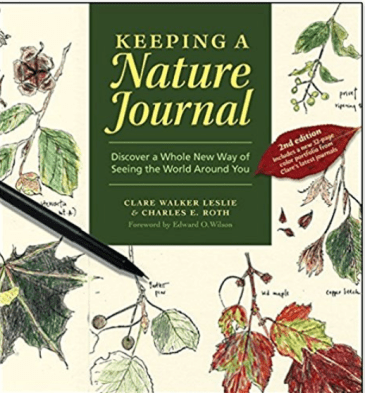
Keeping a Nature Journal, Clare Walker Leslie

Screen Shot 2018-05-28 at 5.32.50 PM

Here is a blog post that describes what a nature journal is and how-to steps by Rhythms of Play

If you don’t have the time or inclination to make a journal, you can also purchase one. This is a nice journal to get you started. My Nature Journal: A Personal Nature Guide for Young People, Adrienne Olmstead

Nature journals can be for ALL ages, including you! You think you’d like to try it? Here are some ideas and tips that will come in handy! click here

One thing you will need in addition to a journal and items to sketch with and perhaps color are some pocket guides to have on hand or take along if you go somewhere. I have a variety of them ranging from wildflowers to rocks and minerals to animal tracks. In this electronic age, you can even get Ipod/smart phone apps such as bird or leaf identification. I love it! When I went out west my husband I took ibird with us and were able to identify scrub jays and ospreys. There were some small birds we were unsure of so we played the call of a warbler and you should have seen all the birds come near the feeder where we were for a closer look to see what strange bird was making that sound!

Here are some various paperback guides that are compact and lightweight. Golden Guides are easy and will help you get started with nature journaling. I only listed a few since there are many to choose from and it will depend upon what you want to study.

Mammals

Reptiles and Amphibians

Insects

And here are resources to use when you get further along on your nature observations and identifications.

Handbook of Nature Study, Anna Comstock This book has been in use for a long time and has recently been reprinted. It has fantastic descriptions of the plants as well as observations that can be modeled for younger children by reading it aloud. This can be used independently by older students. Look at the Handbook of Nature Study blog that uses this book for its newsletters and ideas.

The Nature Handbook: A Guide to Observing the Great Outdoors, Ernest H. Williams- actual photographs and ecosystems where you would find them

Are your children unsure about how to draw something? Here are some books that will help get you started.

I Can Draw Animals, Ray Gibson (for beginning artists)

I Can Draw Animals, Tony Tallarico (for experienced artists)

Enjoy the nice days and feel to post a journal entry of what your naturalists (and you) chose to draw and study.

Book Report Ideas

Sometimes it is difficult to think of interesting ways to do book reports. Here are some ideas that I have done with my own children, with classes I have taught and ways to implement them.

  • Create your own book cover design and/or jacket with a summary and review of the book inside. Use actual library books as examples for this as it might be difficult for children to grasp this without seeing several examples.
  • Have famous people write a review of the book. For instance, if you were going to write a report on Cinderella you could have the wicked step mother say, “Don’t read this book! It is an inaccurate and unfair telling of the story from a spoiled girl’s viewpoint.” One of the mice that was changed into a horse to drive the coach might say, “This was the best day of my life! I was transformed into a magnificent beast and ran as fast as the wind!”
  • Describe the book’s main characters- who you liked/disliked and tell why. How could their character be changed in order for you to like them if you disliked them?
  • Design a wanted poster of the antagonist of the book. Add the following to the poster: Title, character, what is the crime or injustice, and plot.
  • Dramatize your favorite part of the book. Write it as a play, record and send your masterpiece to someone to watch.
  • Create a model or diorama of one of the important parts of the book. Invite a friend over to see it or take a picture and send it to a friend or relative.
  • Illustrate or paint the story depicting important parts of the book.
  • Rewrite the story’s ending.
  • Draw a map with all the places in the book where the story took place. If there are too many places, choose a favorite scene from the book.
  • Write a letter to one of the characters in the book asking pertinent questions in regards to the book.
  • Make a food dish from that time period. What would some of the characters choose to eat and why? For instance, you could make hard tack for Jim Hawkins, the narrator of Treasure Island or you could make your own version of Stone Soup and have it for dinner.

Here are some resources for you that can be found on the internet.

Just Readin’: Books for Middle School and Junior High

Summer is such a great time to read! I am crazy busy during the school year and feel “guilty” if I sit down to read. However, during the sumer I allow myself time to kick back, relax and just do some readin’.

Among some of the books I have chosen to  read this month are middle school (4-6th grade) and  junior high (7th-8th grade) books. I scrapped quite a few that were recommended on websites. Twaddle (a Charlotte Mason term) is a word that best describes those titles and I ended up whittling the towering stack of books down to ones that I thought were either interesting, funny, or thought-provoking. All of these books can be found at the local library.

The Great Brain John D. Fitzgerald  *MS  This series is one of my all-time favorites. Tom, the older brother of the narrator, is always scheming to make money and in his little brother’s eyes he’s “The Great  Brain”. I have read them to students in third grade and sixth grade. These are books that are universally loved.

Far Flung Adventures: Fergus Crane, Paul Stewart, Chris Riddell  *MS  I loved this book! Very creative, funny and original. The illustrations are interesting as well.

Perloo the Bold, Avi  *MS Timid and fearful Perloo becomes an unwilling leader in this tale.

Because of Winn-Dixie Kate Di Camillo  *MS,*JH I enjoyed this book because of the transformation of the narrator. A great book to discuss.

The Witch of Blackbird Pond Elizabeth George Speare *JH Don’t let the title fool you, there aren’t really any witches. This is  a terrific read.

Calico Captive Elizabeth George Speare *JH Based upon a true story during the French and Indian War.

Bronze Bow Elizabeth George Speare *JH A Newberry award winner of a story of a young man whose life is changed after hearing the teachings of Jesus.

The Westing Game– Ellen Raskin  *JH A mystery with a twist that will keep readers engaged in trying to figure out “who dun-it” or didn’t!

Watership Down– Richard Adams  *JH An adventure story of courage and fortitude. This would be a great book to discuss character issues with your children.

Maniac Magee Jerry Spinelli *JH A Newberry Award winner about a young man who doesn’t see “color” in a town that is divided. I ended up crying although I didn’t expect to do so.

*MS= Middle School

*JH= Junior High

I realize that many middle school students can read older level books, but it doesn’t always mean that they understand the complexity of a story. Therefore, I listed some titles as junior high rather than middle school.

Science: Thoughts, Resources for Chemistry (Elementary)

When I taught science at a local school the rate for me being able to successfully demonstrate experiments was nearly 0%. Oh, yes, I had a few that were successful, but only a handful. Part of the issue was that the textbook that we were using required resources that we really didn’t have available and I couldn’t afford to buy the supplies.  What stands out most clearly in my mind was me saying to the class,”Let’s read about the experiment.” Not very hands- on.

As you can imagine, the thought of teaching science with experiments to my own children wasn’t met with all that much confidence. But, I was determined that my children would not see my hesitancy when it came to doing them and I resolved to do better than when I taught my 6th grade students. Good news! I had a much better success rate teaching my sons and I actually looked forward to teaching experiments. In fact, I had such a confidence boost that I now teach Earth/Space Science to 8th grade students at a home school program and we do experiments. (successfully too) Victory- huzzah!

What is my secret to success? (For just 29.99 you can buy my book and find out- just kidding.) I started out slowly and simply. I began with elementary non-fiction science literature from the library, naturalist programs at parks,community science programs, and slowly ventured out on my own. I made sure I picked experiment books that had detailed instructions and explanations for me as well as my children. Did all of the experiments work? Of course not, but I just kept on trying. I figured some experiments are better than none and that failure is part of “experimenting”.

Some of my home school experiments make for great stories; I hope you don’t mind me indulging. My sons were about 6 and 9 at the time this science success/flop occurred. We had successfully completed the experiment where you have a clean empty 2 liter bottle and you put a small amount of vinegar in the bottom of it. You then fill a 9 inch balloon with a prescribed amount of baking soda using a funnel. After you have completed that, you hold the baking soda-filled balloon in one hand while keeping the ballon pinched closed and place the lip of the balloon over the opening of the 2 liter bottle. You release the neck of the balloon and proceed to gently shake a small amount of baking soda into the bottle so that it mixes with the vinegar. You stand back as the remaining baking soda falls into the vinegar and watch the chemical reaction that begins to occur. Ta-da! You have a terrific visual demonstration of carbon dioxide gas inflating the balloon. It worked beautifully and we were all beaming at our little inflated balloon.

But, I was a bit disappointed, okay, majorly disappointed because the balloon was so tiny. I thought to myself,”I have a bigger balloon than was called for in the experiment so I can just add more and really make that balloon inflate!” So, after I cleaned up the first experiment I decided to triple the amounts of vinegar and baking soda since bigger is better, right? 🙂 It was beautiful as the 12 inch balloon began to expand, growing larger and larger. In fact, the balloon had so much carbon dioxide gas that it began to lift off of the kitchen counter.

“Wow! This is awesome!” I shouted to my sons. Malcolm was just as excited as I was, while Ian on the other hand, wasn’t so sure.

“Mom, the balloon is getting pretty big! Don’t you think we ought to just pull it off?” he asked with an edge of apprehension in his voice.

“No, I am sure it’s just about finished. ” as I said while I continued holding the 2 liter bottle in my hand to keep it from floating in the air. “Don’t worry- the balloon won’t—”

BANG! A huge explosion sounded in my ear as the contents of the baking soda-filled balloon went shooting all over me and my kitchen like a fireworks display. Baking soda had spewed all over my hair,face, and clothing as well as all over the cabinets, ceiling and fan. The boys were safe as they had just moved away from me and my experiment just a minute prior to my reassurance. I did have a small amount of doubt and had them move for safety’s safe- good thing, huh?

“I told you!” was the response from Ian, while Malcolm said, “Cool! Can we do it again?”

TIP: Follow the instructions carefully- even if it seems a bit under-dramatic. Unless, of course, you like explosions and messes; you learn from them as well. 😉 You don’t need bunsen burners, graduated cylinders, but a pair of safety goggles would be a good idea. The main thing is to experiment. Make predictions, don’t be afraid to try,and get messy. After all, you can clean up later and if you have a crazy thing happen you can laugh about it with your science partners. (your children)

Science Books I used every one of these books with my budding chemists.

Fizz, Bubble and Flash!: Element explorations and Atom Adventures, Anita Brandolini   (grades 4-7) A great book I used for a chemistry overview. I even impressed the window salesman with facts about argon and kryptonite when he came. (Home school mom show-off!)

Super Science Concoctions: 50 Mysterious Mixtures for Fabulous Fun, Jill Frankel Hauser (grades 1-4) This is a fun book for exploring chemistry.

Janice VanCleave’s Chemistry for Every Kid, Janice VanCleave (grades 4-8) I love this series  ___________ for Every Kid (moms too!) Her experiments work and the explanations she gives make sense.

Here are some websites with fun, free experiments.

Fizzing and Foaming  A science experiment using baking soda and vinegar. You can create your own volcanoes as well.

ZOOM  Lots of fun experiments to do based upon the PBS Kids show Zoom.

Countertop Chemistry Experiments that be done in your kitchen with easily accessible ingredients.