Archives

Summer (School) Ideas- Math Games and Resources

I had a mom ask me a great question. “I don’t want my son to become rusty on his math facts. I want to do school 2-3 times a week, but I want it to be fun. How do I do that?”

I believe in the power of fun! Turn reviewing math facts into a game and it won’t seem like “school” at all.

Math Facts On the Go

Why not review math facts while in the car? This requires 2 or more players. The caller (mom or an older sibling who knows the math facts) calls out a math problem to be answered by the opponents.  The first person to answer correctly receives 1 point. This is fine if you have two students who are at approximately the same skill level.  But, if they are not and let’s say John is pretty good, then give Jane a handicap of 5 points. The first one to reach 10 (you pick the number) wins the game. Challenge your children to beat you. My kids made excellent progress with their multiplication facts and they started beating me. I had to review my facts! This game can also be played with flashcards if it will only be you and your child. The card gets turned over to reveal the problem and each of you see it at the same time. If you choose this option you better wait until you are in a parking lot instead of while you are driving! This game can be used for all mathematical operations (addition, subtraction, multiplication, division).

Create a Puzzle This will require a little bit of your creative juices to make this game. It can be a single or multi-player game. I have included pictures so you have an idea of what I am thinking.

How to Make the Game: Using 10 index cards, (You can pick any number you wish) lay out the cards and draw a picture on the front of the cards. It doesn’t have to be fancy!

Turn all of the cards over being careful to keep the design as it was when face up. Write math problems on each of the cards.

Write  a small number on the problem side in the right hand corner beginning from the problem on the left hand side and going to the right and so on until you have numbered each card. The player may put the cards with the math problem facing up without your help, using the numbers in the right-hand corner as a guide to do so.
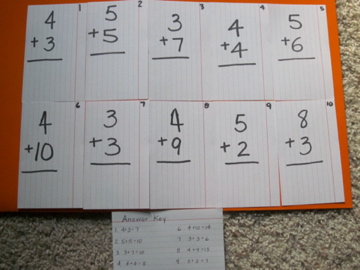
When the math problem is answered correctly it may be turned over to reveal the puzzle piece on the other side. The game continues until all math problems have been answered correctly and turned over to complete the puzzle.

How to play the game: Put all of the cards in the puzzle problem side up. Your scholar looks at each math problem and answers the math problem. If your mathematician answers the problem correctly (s)he may turn it over to reveal the design on the other side. The review is complete when all of the design has been completed. Make this self-checking by providing a list of the facts with an answer key. Your older students may enjoy making these problems for your younger students by designing the puzzles,writing the math facts and  making the answer key. They would be reviewing math facts too 🙂 Store in a plastic bag so the game can be reused. You can make additional puzzle games with new designs and new math problems.

Buzz

This game is used to review a specific fact family.  It can be played with two or more people.  The leader chooses a number between 2 and 9.  The leader says 1, the next player says the 2, and so on.  When they reach a multiple of the number chosen, the player says “buzz” instead of the number.  If a player forgets to say buzz or says it at the wrong time, he or she is out or you begin again if it is just two of you playing.  Play continues until you reach the last multiple of the number times 9. (12×9 for example)

Playing Doubles You will need dominoes to play this game.

Learning multiplication facts with 2 as a factor can be fun and easy with dominos.  Use domino doubles to demonstrate that multiplying by two is the same as adding doubles: 3+3=2×3, 4+4=2×4, and so on.  Have your scholar either tell you or write both addition and multiplication fact families for the various domino combinations.

Websites and Online Computer Games (Supervise younger students on the computer if necessary)

ixl

I found a website that has a great number of online math games that your children will enjoy. It even has awards and a game board that the student fills in online as activities are completed! It is called ixl and is for ages Pre-K to 8th grade. I looked at the Pre-K counting dots activity as well as middle grade activities. If problems are missed explanations are given as to why the answer is different than the one your student chose.

Mad Dog Math

Do you have a scholar who loves animals, dogs in particular? Here is a review of an online computer game: Heartfelt Homeschooling

Math Play

At Math Play there is a wide variety of fun online games to sharpen or reinforce skills. There are games for elementary through middle grades. They are organized by grade level, content, and game type. 

Summer (School) Ideas for Writing

A home school mom asked me for some writing ideas to keep skills up during the summer. Here are a few that we have enjoyed.

Ideas for Writing

Conversational journal I am not exactly sure what else to name it, but the idea is that you purchase a small spiral bound notebook and write a question in it. For instance, it has been raining quite a bit here lately and I am beginning to feel quite waterlogged! A question I asked one of my sons was, “Can you think of a rainy day activity you would like to do? Why?” His response, “I’d like to go with my friends and jump around in the water and take photos. Why? Because if I wait until we have a sunny day to take pictures it may not ever happen!” Good answer since we have had rain 10 out of the last 11 days.  Now, some of you may be wondering how do I get my child to write when (s)he  doesn’t like to do it? I believe it is all in the timing. When the guys were younger I would put the notebook on their pillow and the rule was that the notebook needs to be on my pillow by the following evening with a response. I would send them up to bed 15-30 minutes before lights were to be out for the evening. I don’t know about your children, but to delay bedtime was a huge issue with my family. This was a great way for them to delay while at the same time having them write and communicate with me. The other rule was: “Ask me a question.” We had some great “conversations”. You respond back to them and put the notebook back on their pillow. Collect the notebook and start another conversation as often as you like. I have actually kept some of these notebooks since they are a time capsule of sorts. I believe you will be pleasantly surprised to see the response you get from your children. There may be resistance at first, but be persistent and you will reap  a reward.

Family Newsletter

There are great templates on our word processors for creating a family newsletter. Include vacation pictures and add captions, include activities you did around town, why not add some family funnies (comments or incidents that occurred), or interview one family member.  Send electronically or do it the old-fashioned way! Addressing envelopes is actually a language arts objective. Be creative and have fun. You can use this as part of your portfolio review (written narrative).

Writing is more than just creative pieces. It is communicating an idea or thought in a written manner. If you have a child who is totally resistant to writing a paragraph then how about creating lists? (birthday,potential summer activities,friends to have over or visit, my favorite foods lists, places to visit, favorite books, etc.) What about making up hints for a treasure hunt either outside or inside for a rainy day or have your student create a list of things to find on a Nature Walk?

Preparing for a Portfolio Review

How do I prepare for a Portfolio Review?

Since you are preparing a portfolio of the academic year it is important for you to have a sampling of your pupil’s work in each subject area.  Samples should be from the beginning, middle, and end of the academic year.  The portfolio can include papers, workbooks, projects, pictures, artwork, test results, or any other items that show the student’s progress.

How should the portfolio be organized?

Ohio regulations require that a student complete work in all subject areas listed on the Home Education Notification Form. Organize the work in the order that they appear:

  • Language, Reading, Spelling, Writing
  • Geography, History and Government (U.S., Ohio, and local)
  • Mathematics
  • Science, Health
  • Physical Education, Fine Arts
  • First Aid, Safety, and Fire Prevention

What guidelines should I use to prepare the portfolio?

Follow the outline of your course of study that you sent to the superintendent.  This will be beneficial as a guideline to help you put your portfolio in order. Organize the paperwork in chronological order by subject and date schoolwork.  If traditional curriculum was used,take workbook pages or you can take the entire book. If other means were employed, take a representation to review. (pictures, projects, a narrative of your school year, etc.)

 Subject areas may be organized as follows:

  • Reading – A list of books and/or readers and other sources that were utilized for reading. (computer software, games, websites) You do not need to have a huge list, you just want to show progress is being made.
  • Language Arts/ Creative Writing – Samples of journals and compositions. (stories, poems, letters, etc.)  Handwriting, spelling, sentence structure, and grammar will be evaluated based on writings. If you have workbooks you may bring those.
  • Math – A representative cross section of daily work and tests to show mastery of concepts.
  • Geography, History, Government, Science, and Health – A list of the concepts covered  throughout the year. Workbooks, pictures, or projects can be provided.
  • Fine Arts, Extra Curricular Activities – A list of field trips, classes, music lessons sports activities, etc.

What will an assessor provide as a result of the Portfolio Review?

Your assessor will sign a state approved Academic Assessment Report you will take home with you at the conclusion of your personal appointment. This is to be sent to the superintendent when you notify for the upcoming academic year. You make a copy for your own records and send the original to the superintendent. If you are interested in having me do a review for you, please contact me so we can set up an appointment. schoolmarm@cinci.rr.com

To Assess or Not- that is the Question

Spring is finally here and that means we as home school parents in Ohio must have some type of academic evaluation done for each of our children.

“Should I have my student assessed or have him take a standardized test?” is a question I hear quite often from home school mothers. There are many advantages to a portfolio review (also known as a narrative assessment). Here are some reasons to consider:

This is a terrific way of reflecting on all the work you and your student did over the course of the academic year. It causes you to evaluate your curriculum and your schedule and decide what worked well and what needs to be changed for the upcoming year.

  • It is a marvelous option for younger and older students alike. Younger students may not be reading at an independent level that is required for testing, while older students just don’t want to take one-more-test!
  • You may have used a curriculum that would not be covered on the standardized test such as in the area of history. It may have concentrated on ancient history instead of doing American history like all the rest of the children on your block. That is the beauty of home schooling!
  • You did not use traditional curriculum and would like to discuss your year with a fellow home school mom and certified teacher.
  • Your child is an individual. Nationally normed tests do not allow for any differences. Questions may be interpreted differently by your child and because they did not know what was being asked they get it wrong. It’s difficult to watch your student ask you about a test question and knowing you could clarify their misinterpretation of it, but not being allowed to do so under the testing conditions.
  • Test results only confirm what you know are strengths and weaknesses of your student. Narrative assessments can provide you with an opportunity to ask a teacher for ideas and resources to help your student. Feedback can be given on how your child is doing in school.
  • If you are a resident of Ohio this fulfills the requirement in order to continue to school your children for the upcoming year.

I believe in you and your role as a teacher. I  believe in home schooling and the opportunities we each have to teach our children according to their unique abilities and giftings. If I may be of assistance with your portfolio review please email me. schoolmarm@cinci.rr.com

Gaming: Ideas for reviewing Math Facts

You have worked hard all year and your scholar has made tremendous progress on math facts. Don’t let your summer break undo all progress that has been made. Try a few math games!

Bingo
Make a bingo card with a grid of 25 answers for you and your mathematicians to play. Instead of calling B-4 you call out 4+3. If the answer you have called is on the bingo board, the player may cover their answer space. Be sure you have a master list of the math problems you have called out. You, as a caller, should play too! The first person to cover their answers wins. At first you can play that one line of correct answers wins. (across, down, diagonal) As your student gains confidence make it a Cover All. You can make coins be your counters and you can use this as a money counting lesson as well. For example: “I see you have 5 nickels on your bingo card. How much money is that?” This game can be done for all operations: multiplication; division; subtraction; and addition.

War Playing Card game
2 or more person game
Determine whether you will make the game addition, subtraction, or multiplication before beginning. Deal the entire deck of cards. Each player turns over the top card from their pile without looking at it. The person with the higher number needs to answer the problem correctly in order to win the hand. For example if two people are playing one person turns over a 7 and the other person turns over a 9. The person with the number 9 is the one who gets to answer. If they answer incorrectly, the other person has a chance to “steal” the cards. You tell your children that you will make mistakes. (Give more incorrect answers than correct answers if they are just learning facts.) If there is a draw (you both turn over the same number on the card) you must “go to war” against each other. You then each place 3 cards face down and one card face up- the person with the highest number then must answer the problem. Aces are valued as 1, while all the face cards (jack, queen, king) are valued as 10. The person with the most cards wins.Warning! This is like Chutes and Ladders- it never ends! You can set a certain number of rounds to play if you are short on time. My kids always loved “catching me” making mistakes so they could steal my hand. It really keeps your child involved in the game and reviewing facts with each hand.

Concentration
Make up 10-20 pairs of math fact cards and place them face down in random order in rows of 5’s. (One card would have 7+6 and the other card would match it with the answer of 13) Choose two cards to turn over. Only turn one card over at a time to see if you can match them. If they do not match then they are turned back over and the next person takes their turn. The person with the most pairs wins. Be sure if you are playing that you make mistakes so they can “catch” you. If they do catch you or you catch them and they are wrong- you get to take the matching pair. Be sure to have the player say the problem and the answer out loud each time two cards are turned over. The person with the most pairs at the end of the game wins.

Matching
Make a pattern and write out math facts with the answers on the card. Cut the card apart and have your scholar match them. For example- make a set of 20 hearts. Write 10-3= 7 and then cut the heart in half. Mix up the hearts with various subtraction problems and have your child match the hearts correctly.

Share a Little Debbie heart cake or make heart-shaped sugar cookies afterwards for a job well done. You can even make eating the cookies a math problem. There are 3 people and each will get 2 cookies, how many is that? Or, you can just eat them- yum, yum!