Archives

Nature Journals

Living here in Ohio is wonderful because we have four seasons and we can take advantage of the days by observing how plants, animals, and weather changes as the seasons pass. I think it is important for children to be outside as often as possible, for as long as possible.

One idea for your children to do something outside is to keep a nature journal. These journals are a way to not only observe, but also to write, take notes, draw, and respond to the world around them.  This can be done seasonally, weather permitting. I found some great resources to help you get started with this and explain it in more detail.

Keeping a Nature Journal, Clare Walker Leslie
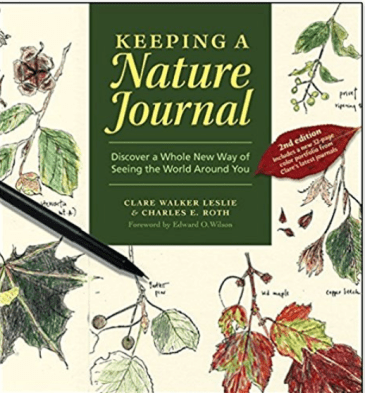
Screen Shot 2018-05-28 at 5.32.50 PM

Here is a blog post that describes what a nature journal is and how-to steps by Rhythms of Play

If you don’t have the time or inclination to make a journal, you can also purchase one. This is a nice journal to get you started. My Nature Journal: A Personal Nature Guide for Young People, Adrienne Olmstead

Nature journals can be for ALL ages, including you! You think you’d like to try it? Here are some ideas and tips that will come in handy! click here

One thing you will need in addition to a journal and items to sketch with and perhaps color are some pocket guides to have on hand or take along if you go somewhere. I have a variety of them ranging from wildflowers to rocks and minerals to animal tracks. In this electronic age, you can even get Ipod/smart phone apps such as bird or leaf identification. I love it! When I went out west my husband I took ibird with us and were able to identify scrub jays and ospreys. There were some small birds we were unsure of so we played the call of a warbler and you should have seen all the birds come near the feeder where we were for a closer look to see what strange bird was making that sound!

Here are some various paperback guides that are compact and lightweight. Golden Guides are easy and will help you get started with nature journaling. I only listed a few since there are many to choose from and it will depend upon what you want to study.

Mammals

Reptiles and Amphibians

Insects

And here are resources to use when you get further along on your nature observations and identifications.

Handbook of Nature Study, Anna Comstock This book has been in use for a long time and has recently been reprinted. It has fantastic descriptions of the plants as well as observations that can be modeled for younger children by reading it aloud. This can be used independently by older students. Look at the Handbook of Nature Study blog that uses this book for its newsletters and ideas.

The Nature Handbook: A Guide to Observing the Great Outdoors, Ernest H. Williams- actual photographs and ecosystems where you would find them

Are your children unsure about how to draw something? Here are some books that will help get you started.

I Can Draw Animals, Ray Gibson (for beginning artists)

I Can Draw Animals, Tony Tallarico (for experienced artists)

Enjoy the nice days and feel to post a journal entry of what your naturalists (and you) chose to draw and study.

Book Report Ideas

Sometimes it is difficult to think of interesting ways to do book reports. Here are some ideas that I have done with my own children, with classes I have taught and ways to implement them.

  • Create your own book cover design and/or jacket with a summary and review of the book inside. Use actual library books as examples for this as it might be difficult for children to grasp this without seeing several examples.
  • Have famous people write a review of the book. For instance, if you were going to write a report on Cinderella you could have the wicked step mother say, “Don’t read this book! It is an inaccurate and unfair telling of the story from a spoiled girl’s viewpoint.” One of the mice that was changed into a horse to drive the coach might say, “This was the best day of my life! I was transformed into a magnificent beast and ran as fast as the wind!”
  • Describe the book’s main characters- who you liked/disliked and tell why. How could their character be changed in order for you to like them if you disliked them?
  • Design a wanted poster of the antagonist of the book. Add the following to the poster: Title, character, what is the crime or injustice, and plot.
  • Dramatize your favorite part of the book. Write it as a play, record and send your masterpiece to someone to watch.
  • Create a model or diorama of one of the important parts of the book. Invite a friend over to see it or take a picture and send it to a friend or relative.
  • Illustrate or paint the story depicting important parts of the book.
  • Rewrite the story’s ending.
  • Draw a map with all the places in the book where the story took place. If there are too many places, choose a favorite scene from the book.
  • Write a letter to one of the characters in the book asking pertinent questions in regards to the book.
  • Make a food dish from that time period. What would some of the characters choose to eat and why? For instance, you could make hard tack for Jim Hawkins, the narrator of Treasure Island or you could make your own version of Stone Soup and have it for dinner.

Here are some resources for you that can be found on the internet.

Science: Thoughts, Resources for Chemistry (Elementary)

When I taught science at a local school the rate for me being able to successfully demonstrate experiments was nearly 0%. Oh, yes, I had a few that were successful, but only a handful. Part of the issue was that the textbook that we were using required resources that we really didn’t have available and I couldn’t afford to buy the supplies.  What stands out most clearly in my mind was me saying to the class,”Let’s read about the experiment.” Not very hands- on.

As you can imagine, the thought of teaching science with experiments to my own children wasn’t met with all that much confidence. But, I was determined that my children would not see my hesitancy when it came to doing them and I resolved to do better than when I taught my 6th grade students. Good news! I had a much better success rate teaching my sons and I actually looked forward to teaching experiments. In fact, I had such a confidence boost that I now teach Earth/Space Science to 8th grade students at a home school program and we do experiments. (successfully too) Victory- huzzah!

What is my secret to success? (For just 29.99 you can buy my book and find out- just kidding.) I started out slowly and simply. I began with elementary non-fiction science literature from the library, naturalist programs at parks,community science programs, and slowly ventured out on my own. I made sure I picked experiment books that had detailed instructions and explanations for me as well as my children. Did all of the experiments work? Of course not, but I just kept on trying. I figured some experiments are better than none and that failure is part of “experimenting”.

Some of my home school experiments make for great stories; I hope you don’t mind me indulging. My sons were about 6 and 9 at the time this science success/flop occurred. We had successfully completed the experiment where you have a clean empty 2 liter bottle and you put a small amount of vinegar in the bottom of it. You then fill a 9 inch balloon with a prescribed amount of baking soda using a funnel. After you have completed that, you hold the baking soda-filled balloon in one hand while keeping the ballon pinched closed and place the lip of the balloon over the opening of the 2 liter bottle. You release the neck of the balloon and proceed to gently shake a small amount of baking soda into the bottle so that it mixes with the vinegar. You stand back as the remaining baking soda falls into the vinegar and watch the chemical reaction that begins to occur. Ta-da! You have a terrific visual demonstration of carbon dioxide gas inflating the balloon. It worked beautifully and we were all beaming at our little inflated balloon.

But, I was a bit disappointed, okay, majorly disappointed because the balloon was so tiny. I thought to myself,”I have a bigger balloon than was called for in the experiment so I can just add more and really make that balloon inflate!” So, after I cleaned up the first experiment I decided to triple the amounts of vinegar and baking soda since bigger is better, right? 🙂 It was beautiful as the 12 inch balloon began to expand, growing larger and larger. In fact, the balloon had so much carbon dioxide gas that it began to lift off of the kitchen counter.

“Wow! This is awesome!” I shouted to my sons. Malcolm was just as excited as I was, while Ian on the other hand, wasn’t so sure.

“Mom, the balloon is getting pretty big! Don’t you think we ought to just pull it off?” he asked with an edge of apprehension in his voice.

“No, I am sure it’s just about finished. ” as I said while I continued holding the 2 liter bottle in my hand to keep it from floating in the air. “Don’t worry- the balloon won’t—”

BANG! A huge explosion sounded in my ear as the contents of the baking soda-filled balloon went shooting all over me and my kitchen like a fireworks display. Baking soda had spewed all over my hair,face, and clothing as well as all over the cabinets, ceiling and fan. The boys were safe as they had just moved away from me and my experiment just a minute prior to my reassurance. I did have a small amount of doubt and had them move for safety’s safe- good thing, huh?

“I told you!” was the response from Ian, while Malcolm said, “Cool! Can we do it again?”

TIP: Follow the instructions carefully- even if it seems a bit under-dramatic. Unless, of course, you like explosions and messes; you learn from them as well. 😉 You don’t need bunsen burners, graduated cylinders, but a pair of safety goggles would be a good idea. The main thing is to experiment. Make predictions, don’t be afraid to try,and get messy. After all, you can clean up later and if you have a crazy thing happen you can laugh about it with your science partners. (your children)

Science Books I used every one of these books with my budding chemists.

Fizz, Bubble and Flash!: Element explorations and Atom Adventures, Anita Brandolini   (grades 4-7) A great book I used for a chemistry overview. I even impressed the window salesman with facts about argon and kryptonite when he came. (Home school mom show-off!)

Super Science Concoctions: 50 Mysterious Mixtures for Fabulous Fun, Jill Frankel Hauser (grades 1-4) This is a fun book for exploring chemistry.

Janice VanCleave’s Chemistry for Every Kid, Janice VanCleave (grades 4-8) I love this series  ___________ for Every Kid (moms too!) Her experiments work and the explanations she gives make sense.

Here are some websites with fun, free experiments.

Fizzing and Foaming  A science experiment using baking soda and vinegar. You can create your own volcanoes as well.

ZOOM  Lots of fun experiments to do based upon the PBS Kids show Zoom.

Countertop Chemistry Experiments that be done in your kitchen with easily accessible ingredients.

Lesson Plans: journal entries (Part 4)

I used  a journal format as my means of record keeping when I was teaching kindergarten. This was helpful with keeping track of the school year and traditional lesson plans weren’t the best way of recording our year. I had a yearly overview and curriculum that I used, but didn’t write out any formal plans as I discussed in my previous posts. There are a wide variety of journals and I picked a style that was most comfortable for me.  Here is an example of what I did:

Monday, August 22

Reading– Today Malcolm and I worked on singing the ABC’s. I had him write the letters in rice. (Note: This is done by having a plastic, resealable container of rice that little hands and fingers can write  their letters instead of paper and pencil.) I read aloud Ten Terrible Dinosaurs, by Paul Strickland

Writing– He wrote his name and the word policeman when he drew his picture for Social Studies. We are starting to make a book of community helpers.

Math-Sorting/ Counting/Graphing- Malcolm sorted M&M’s into colors and we counted how many of each color were in the bag.We made a graph for each of the colors and as a treat ate ALL of them! 🙂

Social Studies- Community Helpers We read People at Work, by Bobbie Kalman and Malcolm drew a picture of what he might like to do when he grows up.

Art-He drew a picture of a policeman.

Science/Health– We read My Five Senses, by Aliki  Malcolm had to guess five different items by smell only. I put them in plastic snack bags and had him close his eyes and guess what the items were. cinnamon, cotton ball with vinegar, cotton ball with cologne, a stick of spearmint  chewing gum, a fresh lemon slice. We discussed colds and how you can prevent them such as, eat healthy foods, get plenty of rest, wash your hands, sneeze into a tissue or the crook over your arm, etc.

Junior/Senior High

You can also have your junior and senior  high students keep a journal or blog of their studies. You can check progress this way and  be independent, while still having your input and guidance. One of my sons visited coffee shops since he is interested in having his own one day. He kept a blog about where he had been, likes/dislikes, what he had to drink, house specialties, and photographs of the shop.

I hope this series has helped you with your lesson planning. I pray your school will be filled with many days of laughter and awe-filled days as you teach your child(ren).

Lesson Plans: using library books (Part 3)

Planning with Other Types of Curriculum

It’s just as easy to write out plans for other types of curriculum as it is with textbooks. The resources I have used in years past have been primarily library books and DVD’s. I have also used online courses, co-ops and educational programs where I dropped off my sons for a class, and have  had family,friends, and local parks teach classes to my sons as well.

Planning for  the Year

The first thing I do is decide what topics we are studying.  I then look for resources that go along them. For example, when we were studying Ancient Rome and Greece I had my son take a month-long online class on the Emperors of Rome.  At other  times I had my sons take online writing courses. Here I didn’t have a say as to when we were going to do it, I just worked my other plans around those classes. I would plug them into the schedule so I didn’t plan other things in that time slot.

I have written out an overview using multiple resources that you can view here Overview of Year Other Curriculum Note that all of the books and resources I have listed can be found at the library or online.

Planning for the Week

After I have made a tentative yearly schedule I believe the month is filled out well enough to give me a general idea of what should be covered so I don’t make a monthly schedule. I believe in less is best when it comes to paperwork.  I plan one week at a time, perhaps two if I am fairly certain things are going to be “normal” around my house. Here is a weekly lesson plan based upon the yearly overview listed in the above paragraph. Weekly Lesson Plan

Remember, do one thing at a time. Planning provides huge dividends and provides you with direction, a sense of accomplishment, and will give you more free time in the long run.

Part 4  Journal Entries The last in the series about lesson plans.