Archive by Author | Lisa McAfee

Reading Levels

One of the biggest challenges for home school mothers of new and early readers is determining what reading level and books to have your children read, whether that is aloud or independent. I have found a few resources to help you with that!

Scholastic has books at various reading levels and individual book titles that are categorized by grade, subject, and also price. It is called the  Guided Reading Leveling Chart.

The McCall-Crabbs Standard Test Lessons in Reading has five volumes that contain reading selections.  These short passages are read by the student within a 3 minute period with questions about the test afterward. Reading level is based upon how many questions were answered correctly. Keep in mind that this is just a short reading selection and a gives you a general idea. If your child is struggling, you may want to consider having your student tested for language processing issues or vision problems (tracking).

Tips: Make sure you have plenty of time for your budding reader to read aloud in order to gain fluency, confidence, and comprehension. Allowing them to pick books that are easy to read are a great way to ensure success. If you would like to increase vocabulary, discuss stories and characters, find good books to read aloud. Happy reading!

Selecting a Book (Independent reading)

How does your reader know if a book is just right for them? I found this Just Right Book Selection Rubric that I think will act as a good guide to ensure successful independent reading.

EASY

*you can read the words fluently (smooth and with an interesting voice)

*you have a large framework of knowledge for the subject

*there often are not a lot of words on a page

*you know how to say all the words

*there are not a lot of pages in the book

*sometimes the book has a larger font

*you totally understand the story

*your reading rate may be quicker

*your thinking comes easy as you read the words

CHALLENGING

*many of the words are too hard to decode (failed a five finger test)

*you don’t know what the tricky words MEAN

*your reading becomes choppy more than it is fluent

*you don’t have any framework of knowledge for the subject

*there are often a lot of words on the page

*often the font is small

*you lose focus as you are reading

*you are not enjoying the book because you have to do too much word work

*your thinking is confused

*your reading rate slows way down

JUST RIGHT

*you can read most of the words

*you can understand what you are reading

*you enjoy the book

*you may have some framework of knowledge for the subject

*you can read the book with smooth fluency but there are some choppy places

*your reading rate is just right- not too slow and not too fast

*you can figure out the tricky words and still get the meaning of the story

Source: http://www.readinglady.com/mosaic/tools/tools.htm

Summer (School) Ideas- Math Games and Resources

I had a mom ask me a great question. “I don’t want my son to become rusty on his math facts. I want to do school 2-3 times a week, but I want it to be fun. How do I do that?”

I believe in the power of fun! Turn reviewing math facts into a game and it won’t seem like “school” at all.

Math Facts On the Go

Why not review math facts while in the car? This requires 2 or more players. The caller (mom or an older sibling who knows the math facts) calls out a math problem to be answered by the opponents.  The first person to answer correctly receives 1 point. This is fine if you have two students who are at approximately the same skill level.  But, if they are not and let’s say John is pretty good, then give Jane a handicap of 5 points. The first one to reach 10 (you pick the number) wins the game. Challenge your children to beat you. My kids made excellent progress with their multiplication facts and they started beating me. I had to review my facts! This game can also be played with flashcards if it will only be you and your child. The card gets turned over to reveal the problem and each of you see it at the same time. If you choose this option you better wait until you are in a parking lot instead of while you are driving! This game can be used for all mathematical operations (addition, subtraction, multiplication, division).

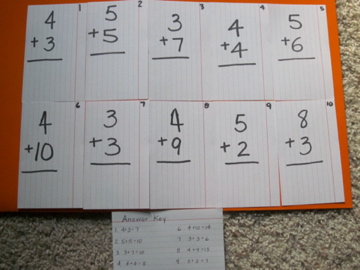
Create a Puzzle This will require a little bit of your creative juices to make this game. It can be a single or multi-player game. I have included pictures so you have an idea of what I am thinking.

How to Make the Game: Using 10 index cards, (You can pick any number you wish) lay out the cards and draw a picture on the front of the cards. It doesn’t have to be fancy!

Turn all of the cards over being careful to keep the design as it was when face up. Write math problems on each of the cards.
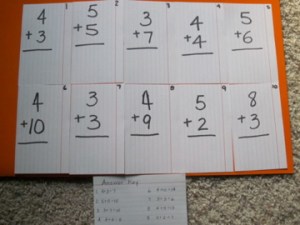
Write  a small number on the problem side in the right hand corner beginning from the problem on the left hand side and going to the right and so on until you have numbered each card. The player may put the cards with the math problem facing up without your help, using the numbers in the right-hand corner as a guide to do so.
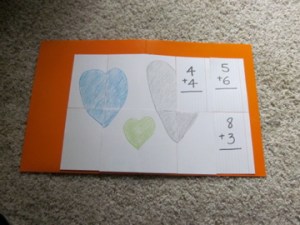
When the math problem is answered correctly it may be turned over to reveal the puzzle piece on the other side. The game continues until all math problems have been answered correctly and turned over to complete the puzzle.

How to play the game: Put all of the cards in the puzzle problem side up. Your scholar looks at each math problem and answers the math problem. If your mathematician answers the problem correctly (s)he may turn it over to reveal the design on the other side. The review is complete when all of the design has been completed. Make this self-checking by providing a list of the facts with an answer key. Your older students may enjoy making these problems for your younger students by designing the puzzles,writing the math facts and  making the answer key. They would be reviewing math facts too 🙂 Store in a plastic bag so the game can be reused. You can make additional puzzle games with new designs and new math problems.

Buzz

This game is used to review a specific fact family.  It can be played with two or more people.  The leader chooses a number between 2 and 9.  The leader says 1, the next player says the 2, and so on.  When they reach a multiple of the number chosen, the player says “buzz” instead of the number.  If a player forgets to say buzz or says it at the wrong time, he or she is out or you begin again if it is just two of you playing.  Play continues until you reach the last multiple of the number times 9. (12×9 for example)

Playing Doubles You will need dominoes to play this game.

Learning multiplication facts with 2 as a factor can be fun and easy with dominos.  Use domino doubles to demonstrate that multiplying by two is the same as adding doubles: 3+3=2×3, 4+4=2×4, and so on.  Have your scholar either tell you or write both addition and multiplication fact families for the various domino combinations.

Websites and Online Computer Games (Supervise younger students on the computer if necessary)

ixl

I found a website that has a great number of online math games that your children will enjoy. It even has awards and a game board that the student fills in online as activities are completed! It is called ixl and is for ages Pre-K to 8th grade. I looked at the Pre-K counting dots activity as well as middle grade activities. If problems are missed explanations are given as to why the answer is different than the one your student chose.

Mad Dog Math

Do you have a scholar who loves animals, dogs in particular? Here is a review of an online computer game: Heartfelt Homeschooling

Math Play

At Math Play there is a wide variety of fun online games to sharpen or reinforce skills. There are games for elementary through middle grades. They are organized by grade level, content, and game type. 

Summer (School) Ideas for Writing

A home school mom asked me for some writing ideas to keep skills up during the summer. Here are a few that we have enjoyed.

Ideas for Writing

Conversational journal I am not exactly sure what else to name it, but the idea is that you purchase a small spiral bound notebook and write a question in it. For instance, it has been raining quite a bit here lately and I am beginning to feel quite waterlogged! A question I asked one of my sons was, “Can you think of a rainy day activity you would like to do? Why?” His response, “I’d like to go with my friends and jump around in the water and take photos. Why? Because if I wait until we have a sunny day to take pictures it may not ever happen!” Good answer since we have had rain 10 out of the last 11 days.  Now, some of you may be wondering how do I get my child to write when (s)he  doesn’t like to do it? I believe it is all in the timing. When the guys were younger I would put the notebook on their pillow and the rule was that the notebook needs to be on my pillow by the following evening with a response. I would send them up to bed 15-30 minutes before lights were to be out for the evening. I don’t know about your children, but to delay bedtime was a huge issue with my family. This was a great way for them to delay while at the same time having them write and communicate with me. The other rule was: “Ask me a question.” We had some great “conversations”. You respond back to them and put the notebook back on their pillow. Collect the notebook and start another conversation as often as you like. I have actually kept some of these notebooks since they are a time capsule of sorts. I believe you will be pleasantly surprised to see the response you get from your children. There may be resistance at first, but be persistent and you will reap  a reward.

Family Newsletter

There are great templates on our word processors for creating a family newsletter. Include vacation pictures and add captions, include activities you did around town, why not add some family funnies (comments or incidents that occurred), or interview one family member.  Send electronically or do it the old-fashioned way! Addressing envelopes is actually a language arts objective. Be creative and have fun. You can use this as part of your portfolio review (written narrative).

Writing is more than just creative pieces. It is communicating an idea or thought in a written manner. If you have a child who is totally resistant to writing a paragraph then how about creating lists? (birthday,potential summer activities,friends to have over or visit, my favorite foods lists, places to visit, favorite books, etc.) What about making up hints for a treasure hunt either outside or inside for a rainy day or have your student create a list of things to find on a Nature Walk?

Pencils, Papers, Books, Oh My!

I get a kick out of my 7th grade class because I have one or two students who are always asking for a pencil. The rest of their home school mates carry “extras” for them so they can be prepared. It reminds me of my own junior high experiences where I felt like I was scattered in a thousand different directions and really never quite able to stay on top of my organizational skills.

Do you have a junior high student that is disorganized, scattered, messy?  Much of it is due to the fact that they are not mature yet. Here are some ideas to help them organize paperwork and supplies.

* Keep loose leaf notebook paper in a binder.

* Date papers for easy reference.

* Put a label on the edge of the binder with the subject clearly marked so it can be found easily. Label the front too!

* Choose one area to work in or if you have a student who likes to move around the house, ALL papers, books, supplies must be put away before moving to another location.

* Coordinate notebooks and binders to be the same color. For instance, if your student has a binder and notebook needed for history, choose red for both of them.

* Keep all supplies for class in a specific area. Train your student to put away the supplies when finished. It saves time and frustration if pencils are in a cup, on a desk, in a certain area.

* Find a home for things. (books, binders, notebooks, supplies, etc.) If there is not a home for it, the item will be put in a strange place and the hunting begins again 🙂 I know! It happens to me with my belongings.

* Have your student help decide where things should go. Perhaps they need you to verbalize the process so they can hear how you organize. Also, if they get to help they will feel their opinions are valued and they may have an idea of why they want to keep an item in a certain place- within reason of course!

Happy organizing!