Archives

Setting Goals

Goals are a means to help you be organized with school and home, therefore, relieving stress. Goals can be as simple or as detailed as you like. The idea is to have a plan for accomplishing something you need to complete.

Last month I had a dark, ominous cloud hanging over my head as I was thinking about the upcoming school year. I knew I had to prepare for 6 classes that I am teaching this year and quite frankly, it was overwhelming me. I didn’t want to deal with it. I just wanted to run away, but I decided to stand  and conquer this amount of work I had to get done.

elderly_lady5.gif This not an actual picture of me as I was not smiling.

So,with pen in hand I wrote down ALL that I wanted to accomplish for the next month in regards to school. It is said that the pen is mightier than the sword. 😉

I filled an entire 8.5″x11″ sheet of paper and I write small! I wrote each class in a separate category and listed under each one what I wanted to accomplish. It took me a solid 2 weeks to accomplish the majority of the list and another week to finish up other details, but VICTORY! I did it and it has been a great feeling. I treated myself  to a day trip with Dale to Natural Bridge, Kentucky and had no feelings of thinking I should be home working on lesson plans. —Pause here and visualize me doing a happy dance.

Are you feeling a little like I did with clouds hanging over you? Here are some tips that I have found helpful:

  • Establish Categories

Do you just want to work on school or do you need to include the house as well?  I will list the house as an example since this is the area I need to work on right now.

  • Write Subcategories

List all of the things you want to do within that category. For instance, under the category of house my subcategory is the kitchen. I could list the basement as well, but I am trying to not take on more than I can possibly accomplish over the next week.

  • List specifics

What exactly do I want to accomplish in the kitchen? In my kitchen I’d like to clean out the Lazy Susan,the refrigerator,and clean the pantry.

  • List details of how to accomplish these tasks, including delegating part of the job to a family member.

“Many hands makes light the work.” was an old Shaker saying that I think holds true in this instance.  I am going to ask my son, Ian, to put all of the canned goods and other items for the Lazy Susan on the counter and to check  expiration dates on canned goods. You can make it fun for your young helpers by setting a challenge to see who can find the oldest can in the bunch. Dale just brought up a bottle of catsup from the basement cabinet yesterday with an expiration date of 2009. ewww!

I don’t really list the details for the refrigerator since I know I just need to get rid of old food and clean the shelves and compartments. If you are asking for one of your children to help, then that is an entirely different matter! List everything that you possibly need done so you don’t have a partly done job that you must go back and do yourself or have them finish later. Regarding the pantry I made a list that has the following items: empty pantry, check expiration dates, wipe off shelves, wipe down walls, clean floor, take inventory of items, make grocery list of needed groceries, and put all items back on shelves.

  • Schedule a Time to Accomplish your Goal

Allow plenty of time to complete your goal. Will it take an hour, a day, a week? Clear your schedule and don’t let anything interrupt until you are finished with that goal or until the time you allotted has been used. If you didn’t finish set another time, no longer than a week, to get it finished. Remember, it took me a long time to complete my lesson plans, but I stuck with it and got it finished.

  • Cross off Completed Tasks

I like to have boxes to check off next to the items that need to be done. I also like to use a bright highlighter to visually see what I have accomplished. If that doesn’t matter to you, don’t do it; it’s all a matter of preference.

  •  Admire and Celebrate your accomplishments.

You did it! Congratulations on completing your goal. What do you want to tackle next?

Now that you have read through how I set goals and take on tasks, why don’t you take a few minutes to think about an area where you need to work? If you have a long list break it down into smaller pieces. Start by  setting a goal, making a list, and enlisting some helpers. You’ll feel soooo much better, giving you more time to spend with your family, friends, and of course, schoolwork. It looks like my next goal will be to clean out the cabinet in the basement where the catsup was residing, or I could start on my lesson plans for October….

Art: A Picture is Worth a Thousand Words

unless you have skills like me, then you will need 1,000 words to explain what you created! I come from a family of artists, all of them have a career pertaining to art. In my family we have a toy designer, home designers- both interior and exterior, and a jewelry maker. All of them can paint and  draw well too. Then there’s me… let’s just say I appreciate art and those who can make it.  I am not just being modest here either!

One time my dad offered to have a painting class for me and my sisters and two older nieces in my parents’ home. All of us came with various-sized canvases. I bought a 5″x7″ and was wishing I had bought a 4″x6″ canvas as we began painting. I chose paint a bouquet of sunflowers and tried to make it realistic. I should have gone for abstract.

It took several weeks to paint it and then we had an “art show”. Various-sized canvases (all large) were displayed proudly around the room and, while I wish I could have hidden it behind my back, I timidly put my painting on a small easel as was required for the show and went to join my family. We oohed and awed, and offered impressions and remarks on each that had been done as we walked around the room. Some of the girls were talking about getting their pictures framed.

Then we came to my sunflower painting. There was a long pause as my family tried to think of kind words to say about “It”. “Oh. That’s nice, Lis!”  and ” I like the colors you chose,” was about all that they could say. I don’t blame them. I was embarrassed for them and for me. At least I tried. If you are wondering if I kept the painting, absolutely not! I sold it on ebay! (not really!) 😉

Knowing my artistic limitations I found other more capable people to help me. I asked my dad to teach my sons some art classes when they were young and my older sister did some art projects with them one year, but I primarily depended upon art classes at a local co-op to help me with this area. I know not everyone has the same opportunities that I did for my children so I am posting some websites that have lesson plans to help you. I also have some books listed that I found to be a great help in exposing my budding artists to famous works of art without going to an art gallery or museum every week.

Internet

Art Lessons and Lesson Plans This is a terrific resource since it has lessons according to grade level, medium, artists, just to name a few of the categories.

Crayola When I think of crayola, I think of coloring sheets. Not so with this website. There are lessons and background information about the projects that I found informative.There are lessons for preschool through high school.

Artsonia You are required to sign up for the website, but after you do, there are over 3,000 lesson plans to peruse.

Art Projects for Kids This website is for ages K-5th grade, but I can see it being adaptable for older students as well. You can purchase lessons, all within the comfort of your home.

Books

The Usborne Book of Art Skills, Fiona Watt This has a great variety of art lessons for elementary students.

Oxford First Book of Art, Gillian Wolfe An introduction for children to art around the world.

A Child’s Book of Art, Lucy Micklethwaite This book has over 100 paintings to study, whether it would be color, form, style, or something else, this is a great book to begin with. Look for more of Lucy’s titles. She is one of my favorite authors for art studies.

Come Look With Me:Enjoying Art with Children, Gladys Blizzard I love her books and have recommended these to home school families over the years. These are a wonderful way to discuss art and give children the opportunity to study a picture rather than just hurriedly glance at it. She has more books to enjoy, so don’t stop there!

How to Draw What You See, Rudy De Reyna This looks like a great book to help an older student begin drawing. The important point is to practice, practice, practice!

Have fun, get messy, and do a project or two yourself. The main thing is to expose your artists to the world of art. Who knows? Maybe you have a famous artist in the making. 🙂

Nature Journals

Living here in Ohio is wonderful because we have four seasons and we can take advantage of the days by observing how plants, animals, and weather changes as the seasons pass. I think it is important for children to be outside as often as possible, for as long as possible.

One idea for your children to do something outside is to keep a nature journal. These journals are a way to not only observe, but also to write, take notes, draw, and respond to the world around them.  This can be done seasonally, weather permitting. I found some great resources to help you get started with this and explain it in more detail.

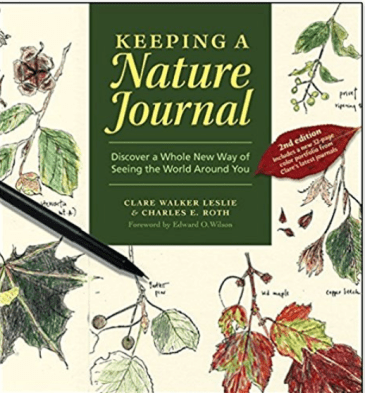
Keeping a Nature Journal, Clare Walker Leslie

Screen Shot 2018-05-28 at 5.32.50 PM

Here is a blog post that describes what a nature journal is and how-to steps by Rhythms of Play

If you don’t have the time or inclination to make a journal, you can also purchase one. This is a nice journal to get you started. My Nature Journal: A Personal Nature Guide for Young People, Adrienne Olmstead

Nature journals can be for ALL ages, including you! You think you’d like to try it? Here are some ideas and tips that will come in handy! click here

One thing you will need in addition to a journal and items to sketch with and perhaps color are some pocket guides to have on hand or take along if you go somewhere. I have a variety of them ranging from wildflowers to rocks and minerals to animal tracks. In this electronic age, you can even get Ipod/smart phone apps such as bird or leaf identification. I love it! When I went out west my husband I took ibird with us and were able to identify scrub jays and ospreys. There were some small birds we were unsure of so we played the call of a warbler and you should have seen all the birds come near the feeder where we were for a closer look to see what strange bird was making that sound!

Here are some various paperback guides that are compact and lightweight. Golden Guides are easy and will help you get started with nature journaling. I only listed a few since there are many to choose from and it will depend upon what you want to study.

Mammals

Reptiles and Amphibians

Insects

And here are resources to use when you get further along on your nature observations and identifications.

Handbook of Nature Study, Anna Comstock This book has been in use for a long time and has recently been reprinted. It has fantastic descriptions of the plants as well as observations that can be modeled for younger children by reading it aloud. This can be used independently by older students. Look at the Handbook of Nature Study blog that uses this book for its newsletters and ideas.

The Nature Handbook: A Guide to Observing the Great Outdoors, Ernest H. Williams- actual photographs and ecosystems where you would find them

Are your children unsure about how to draw something? Here are some books that will help get you started.

I Can Draw Animals, Ray Gibson (for beginning artists)

I Can Draw Animals, Tony Tallarico (for experienced artists)

Enjoy the nice days and feel to post a journal entry of what your naturalists (and you) chose to draw and study.

Just Readin’: Books for Middle School and Junior High

Summer is such a great time to read! I am crazy busy during the school year and feel “guilty” if I sit down to read. However, during the sumer I allow myself time to kick back, relax and just do some readin’.

Among some of the books I have chosen to  read this month are middle school (4-6th grade) and  junior high (7th-8th grade) books. I scrapped quite a few that were recommended on websites. Twaddle (a Charlotte Mason term) is a word that best describes those titles and I ended up whittling the towering stack of books down to ones that I thought were either interesting, funny, or thought-provoking. All of these books can be found at the local library.

The Great Brain John D. Fitzgerald  *MS  This series is one of my all-time favorites. Tom, the older brother of the narrator, is always scheming to make money and in his little brother’s eyes he’s “The Great  Brain”. I have read them to students in third grade and sixth grade. These are books that are universally loved.

Far Flung Adventures: Fergus Crane, Paul Stewart, Chris Riddell  *MS  I loved this book! Very creative, funny and original. The illustrations are interesting as well.

Perloo the Bold, Avi  *MS Timid and fearful Perloo becomes an unwilling leader in this tale.

Because of Winn-Dixie Kate Di Camillo  *MS,*JH I enjoyed this book because of the transformation of the narrator. A great book to discuss.

The Witch of Blackbird Pond Elizabeth George Speare *JH Don’t let the title fool you, there aren’t really any witches. This is  a terrific read.

Calico Captive Elizabeth George Speare *JH Based upon a true story during the French and Indian War.

Bronze Bow Elizabeth George Speare *JH A Newberry award winner of a story of a young man whose life is changed after hearing the teachings of Jesus.

The Westing Game– Ellen Raskin  *JH A mystery with a twist that will keep readers engaged in trying to figure out “who dun-it” or didn’t!

Watership Down– Richard Adams  *JH An adventure story of courage and fortitude. This would be a great book to discuss character issues with your children.

Maniac Magee Jerry Spinelli *JH A Newberry Award winner about a young man who doesn’t see “color” in a town that is divided. I ended up crying although I didn’t expect to do so.

*MS= Middle School

*JH= Junior High

I realize that many middle school students can read older level books, but it doesn’t always mean that they understand the complexity of a story. Therefore, I listed some titles as junior high rather than middle school.

Career Explorations

I love the fact that with home schooling we can customize our children’s education to fit their needs. High school can be used to investigate options for careers to help your student take the next step toward adulthood. I have a friend who taught a class at one of our local home school co-ops and she has given me permission to use an article from her blog about this topic.  I have edited it somewhat and added a few of my own examples. I have provided a link to her blog at the bottom of the page if you’d like to read it in its entirety.

Career Exploration is a Process, Not a Point
Learning the process is the goal in teaching a Career Exploration class. Express to your student that he or she may not know specifically what they want to be, but the class will teach them a process that allows them to search and plan better.

The 4 Step Career Exploration Process:

  1. Investigate-Discover your personality, abilities, skills and priorities
  2. Match possible careers to your personality
  3. Research potential careers to see if there is a fit
  4. Prepare a plan to pursue your career choice

By way of example, Ian found out when he took the interest survey that a possible career choice would be in radio. He volunteered for 6 weeks at a local radio station and decided that it would not be a career path he would likely follow.

Helpful Resources
The most helpful tools for teaching the Career Exploration process are a collection of several on-line interest surveys and personality quizzes (see Resources). Many are free or charge only a small amount. These surveys will direct your student to several career choices to research further. We used the least expensive and quickest quizzes in our class, the Jung Typology Test from Humanmetrics.com and the CareerKey.org test for $9.95. Some students took the longer tests, such as Career Direct and The Call. Each costs around $80 and is very thorough.

After picking four to six possible careers, a student should carefully research them. They should investigate the working conditions, skills needed, pay rates and future outlook for their chosen fields. For conducting research on-line, the Bureau of Labor Statistics has a valuable site (see Resources). Consider having your student interview someone in their chosen field. They will greatly benefit from doing this as it either changed their minds significantly, or confirmed their career choices.

It would be beneficial to have your scholar  pick one book from topics that included career exploration, high school planning, college preparation, or study habits. Do What You Are and What Color is Your Parachute? For Teens are two books that are helpful in making career investigations. In the book, Do what You Are, the reader takes a personality test and then researches matching career choices. What Color is Your Parachute? For Teens has students consider interests, skills, personality types, and work environments to identify potential dream jobs.

Having a Goal
The last step for students in the Career Exploration process is creating an education and experience plan to meet their goals. Students need to think about what classes and part-time jobs they can pursue today to prepare them for their futures. If a student has a goal in sight, schoolwork and part-time jobs become more meaningful. Information can be found in several home schooling books on high school planning.

Your student should also learn the graduation requirements in your state, and also what most colleges expect. All of this information is on-line, and the College Board web site is also helpful. After undertaking these steps, your student can create a high school plan that is unique to him or her. Is your student crazy about math? Be sure to look at the college majors that concentrate in that area. Do you have a child who is talented in art? What kind of opportunities can be found while in high school? Perhaps your church has a VBS that needs an art coordinator or a summer camp that needs a craft counselor. (cooky name, but we had one at our camp)

Life is an Adventure
The Career Exploration experience may trigger something dynamic for your student. A metamorphosis can occur as students begin to chart a career path with manageable steps to get there. Encourage your high school student to consider carefully how they manage their time, what kind of classes they select and what kind of part-time jobs they work. Each decision in life can open doors that will lead them on the path to their goals and dreams. I hope enjoy guiding your student to investigate his/her personality, match them with potential careers, research occupations to find a good fit, and then execute a plan to reach their goals.

Resources for Career Exploration

Books:

Web Sites:

Carol Topp (CarolToppCPA.com) has had several careers including wife, mother, Industrial Engineer and now Accountant. She is currently enjoying a season of home schooling and running a home-based accounting practice. She encourages teenagers to investigate careers though starting a micro business at MicroBusinessForTeens.com