Archives

Free Online Marriage and Family Expo

Do you feel like your marriage needs a bit of rejuvenation after your year of homeschooling? I have the thing for you!  I just received this information about a free online Marriage and Family Expo that will be held on Tuesday, May 22 at 5:30 pm EDT. Guest speakers are Todd and Debbie Wilson (Familyman) and Jay and Heidi St. John (The Busy Homeschool Mom).

Todd is an author, blogger, and speaker. “Todd and his wife Debbie, along with their eight children spend several months of the year traveling the country encouraging moms and dads. His humor, realness, and straight talk to men (& women) have become his trademark.” For more information about his ministry, click here.

Heidi is also an author, blogger, and speaker. “For more than a decade, Jay and Heidi St. John have been ministering to homeschooling families. In 2010, Heidi drew from her experience as a busy homeschool mom to write The Busy Homeschool Mom’s Guide to Romance, which was an extension of a class she had been teaching at homeschool conferences for several years.” For more information about Heidi, click here.

The Old Schoolhouse is sponsoring this event and it is open to the first 1000 people who register. Here is the link to read more about it and sign up: click here. I hope you are able to attend.  It looks like a lot of fun. 🙂

Organizing Thoughts in Writing: Venn Diagrams

The Comparison/Contrast Paper

A few weeks ago I was tutoring a young man and told him he would be writing a comparison/contrast paper by using a Venn diagram. His response was a blank expression and a question some of you may be asking, “What is that?”

I am glad you asked. Let me show you!
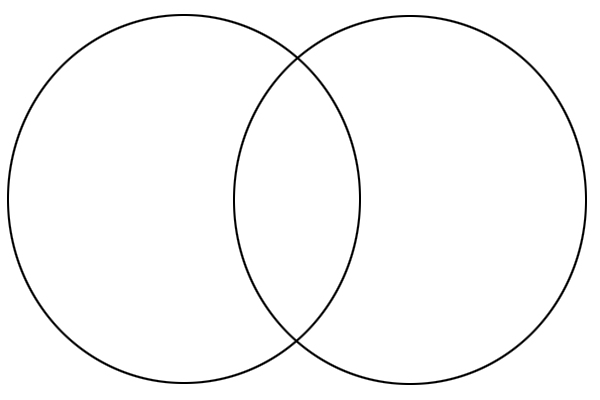
I know it looks like two overlapping circles (which they are), but these two circles  are a graphic organizer that help a writer compare and contrast two items. It is particularly useful to people who are visual learners or are having a difficult time being able to generate how items can be different and alike.  Let me give you an example of what I am discussing so you can teach this to your child(ren).

In this compare and contrast paper we will look at land animals and sea animals. This will be at an elementary level, but can easily be adapted for younger or older students. You can require less or more depending upon your student’s knowledge base.

Starting with the circle to the left, label  directly above it Land Animals. Label the circle to the right as Sea Animals and the overlapping area as Shared.

Now, inside the land animal circle list all the characteristics of these creatures that are different from sea animals.

Next, do the same with the circle to the right for the sea animals.

Last, list all of the characteristics that are shared by both land and sea animals. (Note that I listed they all don’t live in the same place. I was thinking of habitats. Some land animals live in Africa while others live in South America and some sea animals live in the Mediterranean Sea while others live in a different body of water.)

Now that you have determined similarities and differences, it is time to write the paper. There are three different ways to write a comparison/contrast paper: whole-to-whole; similarities-to-differences; and point-by-point.

In a whole-to-whole paper you say everything there is to say about the first topic (land animals) and then everything there is to say about the other topic (sea animals). The paper would be constructed like this: paragraph 1- introduction, paragraph 2- land animals, paragraph 3-sea animals, and finally paragraph 4-conclusion.

When writing a similarities-to-differences paper you show all of the similarities of the topics and then tell how they are different. The paper would be constructed like this: paragraph 1- introduction, paragraph 2- similarities of land animal and sea animals, paragraph 3-differences between land animals and sea animals, and finally paragraph 4-conclusion.

If a point-by-point paper is being written the author first discusses one point about land and sea animals and then discusses the next point. A different type of graphic organizer would be better suited for this type of paper.  Click here.  Point-by-Point comparison and contrast uses a separate section or paragraph for each point. Point #1 for your paper could be information about where animals of land live and then where animals of the sea live. (You may be thinking that it is obvious they live on the land and in the sea, but being specific would be beneficial.) You’d begin a new paragraph for Point #2. For consistency, begin with the same item in each section of your point-by-point paper. The paper would be constructed like this: paragraph 1- introduction, paragraph 2- how land and sea animals breathe, paragraph 3- how land animals and sea animals move, and so forth, until your concluding paragraph. (source:http://www.readwritethink.org/files/resources/interactives/compcontrast)

Resources:

Do you want some practice before you try this on your own? Have Fun Teaching has worksheets for younger students to find differences. They also have some topics that have already been chosen for your student to compare and contrast such as You and I .

Venn Diagram Template 1

Compare:Contrast Chart Candy What child doesn’t like candy? This is not a Venn diagram, but rather a chart I made that younger students can use.

Compare/Contrast Chart A general compare/contrast chart that is discussed above in the point-by-point paper.

Freebies and a Chance to win an iPod Nano

free coloring pages http://www.currclick.com

I love to get free things, who doesn’t? It is especially nice when what is being given away is of good quality. 🙂

In honor of all you fantastic moms there is a giveaway this week from currclick.com  that includes a lapbook on gardening, a guide to homeschool conventions, a place value worktext for 2-3 graders, a Mother’s Day unit with crafts, and printable coloring sheets bundle.

If that doesn’t appeal to you, they are also giving you a chance to win an iPod Nano. For more information click here.

Enjoy the freebies and I hope you win the Nano!

Organizing Thoughts in Writing: the Idea Wheel

Students of all ages struggle with getting thoughts on to “the paper”. I have found that organizing thoughts are a critical and necessary step to help writers in the head-to-hand process of communication. There are many ways to organize thoughts, anywhere from making a list; to writing uninterrupted for 3-5 minutes ; to worksheets that help corral ideas into a logical process. I have a few graphic organizer worksheets that I found on the internet that will be useful in assisting your writer.  As I show you the various types of graphic organizers I will give you instructions on how to use them so you have success in teaching. This week I am going to discuss the Idea Wheel.

The Idea Wheel can be used when you are trying to generate ideas for topics in which to write. This can be particularly useful for when you have a student that says they have nothing to write. The idea here is to give the student four broad categories at the beginning and then narrow it down to where they can write about one of them. As you can see from the photo, Malcolm has written several ideas for each section.

After we looked at each of these categories he decided he had enough to write more about a subject that he knows quite well, coffee. This is important for your student to feel confident they have enough to say about the topic they have chosen. If they do not, stop there for the day and come back to it the next day.

Below is a picture of the next step in this process. I gave Malcolm another idea wheel so he could write details about coffee, one of the topics he listed in his idea wheel. Your writer may need guidance and some ideas to help with the various categories. The upper left-hand quarter of the circle is Brewing Methods, the upper right-hand quarter of the circle is Types of Roasts, the bottom right-hand quarter section is Places to Drink Coffee.

This may take time so do not let the process become laborious. Set the timer for 5 minutes and let your writer know this so it keeps things moving along. You can adjust the time accordingly as you will have some students who need 1 or 2 more minutes.

If you have a beginning writer, do not have them write more than one or two ideas in each section. Adjust the time spent in writing ideas to 3 minutes instead of 5 minutes if necessary. Remember, the principle behind this is to help them see they have something about which to write.

Writing requires thought and may not come as easily as some other subjects. Be sure to remind your writer to: 1) write about something that interests them and 2) pick a topic for which they have a knowledge base. This makes the process of writing less difficult and promotes success.  I would advise you to sit down and go through the process with your student(s). You get an idea of how your writer feels and they can see that you have an interest in this too.  Have everyone share what was written after the activity has been completed.

The first few times you do this may be difficult, but continue because it will help your writer focus on what to write.  Just like anything new you try, it is feels awkward, but it will pay off and I think it will cause your writer(s) to create better papers.

Now that this process is completed the actual writing of the paper can begin. If your writer gets stuck, refer back to the wheel for ideas. Not every idea needs to be written about if your student is doing well.

An author always likes to have an audience! Share the stories at dinner or call Grandma to have your author read their story to an interested and doting family member.  If there is any interest, send me your author’s story and I will  post it. If you have a student who loves to draw, have them add pictures to their story. I am sure this will be a keepsake and you can use this as an example of writing for a portfolio review.

If you have a senior high student you can use the wheel without the cute pictures in the upper right hand corner.  If you think the wheel will be met with resistance, divide a paper into four sections. Guess what? I actually use this type of organizer sometimes when I am trying to generate blog topics. I like to see different ways to organize as there is something about doing things the same way all the time that gets to be mundane for me so I like to mix things up a bit. I even like the wheel with the pictures, but I am an elementary teacher by trade and at heart. 🙂

Okay, are you ready? Get set, write! If you have questions or comments please let me know.

Next topic of organizing writing: Venn diagrams for Comparison/Contrast Papers

New Homeschool Co-ops in Greater Cincinnati

I just received word that there are going to be two new co-ops this fall on the north side of Cincinnati. Here is some information for you to consider if you are interested. Sign up now as classes fill up early and it may be difficult to get in later.

Kingdom Builders Homeschool Co-op was established in February 2012 with a desire to provide enrichment and fellowship for homeschool families in the northeast Cincinnati area.  Our first year will begin next fall with the 2012-2013 school year.

We meet at Grace Bible Presbyterian Church, 12060 Lebanon Road (Rt.42) Cincinnati, OH 45241, on Wednesdays from 9:00 am to 1:00 pm.  Kingdom Builders Co-op provides homeschooling families an opportunity to extend their children’s learning experience one day a week.  We are an enrichment co-op, providing small classes and fellowship in a fun group environment.  The co-op is designed to compliment the instruction you provide at home.

We believe that being involved in the education of our children is a unique ministry.  In keeping with this, Kingdom Builders families sign a Statement of Faith covering the basic tenets of Biblical Christianity.

Family Christian Homeschool Co-op, Formerly Mason Co-op, will meet on Friday mornings starting Fall 2012 at North Fairfield Baptist Church, located near the Bridgewater Falls shopping area near Hwy 129.

We are primarily an enrichment co-op, and rely on our members to share their gifts, teaching subjects they are interested in and have a passion for. Class offerings will supplement what the student is learning at home, either as a new “elective” or to support “core” subjects, with a once-a-week opportunity to gain a fresh perspective from the teacher and from positive interaction with fellow Christian homeschoolers.

Members must agree with our Statement of Faith and agree to follow the Policies established by the Board.

If you are looking for other local co-ops I have a list of them that you can click here.

Wondering what the benefits are to being in a co-op or if you should join? Here is a post that I have written that will help with your decision. Educational Co-ops: Do I Join?