Archives

Fun Reads: Middle School and Junior High

Here are some books that are sure to hold your middle school/ junior high student’s attention. Please feel free to leave a comment if you have a book recommendation.

Meet Addy, Connie Porter MS The American Girl Dolls series has been a great series of books for middle school aged girls. They are historical fiction books that feature various girls and the period of time in which they were created. The characters are girls, not dolls, but you can purchase the dolls if you like.

The Class Trip from the Black Lagoon, Mike Thaler  MS  These books are funny and have great lessons about making good decisions in them as well. This is a series of chapter books that originated from the picture book The Teacher from the Black Lagoon.EL

In Grandma’s Attic, Arleta Richardson MS  This is a great series for middle school students of adventure and faith.

My Life as a Torpedo Test Target, Bill Myers MS, JH  Wally has all kinds of adventures in a great series from Myers. If your student likes this book, the good news is there are quite a few in this series to read.

Freebie: Animal Alphabet Card Game

I saw the Teacher Book Bag booth at the Cincinnati Home School Convention when I had gone and was impressed that  Donna had great products at an affordable price. Right now she is offering a free animal alphabet card game recommended for preschool through first grade. It is great not only for learning letters of the alphabet, but also your child is learning to classify animals. It is played like Old Maid, so younger students will be able to learn quickly.

The best part of this game is it is free! 🙂 You can preview and download it by clicking on the link here

Writing Non-fiction Reports

“I don’t know how to write a report!” Is a response that I have heard from students who are great at writing creative stories, but have difficulty with non-fiction reports. While writing is the same for both types of writing in that you are communicating with an audience, it does require a different skill set to write a nonfiction report.  You have to do some research and summarize  facts in order to write the report. The writing piece answers the 5 W’s  and the 1 H (who or what, when, where, why, and  how) in a concise manner. Last week I talked about teaching how to distinguish fiction from non-fiction to students. If you have not looked at that, here is the link to the post.

Non-fiction Reports – A Visual Representation This is a criteria sheet that has sections that can be cut apart and used as a handy reference guide for both you and your child(ren) when writing a non-fiction report. It isn’t a long list so I had my son put four of them on one page. I believe it is easy to understand, but I have added a brief explanation for each category. Thank you to Sarah who came to see me last year for a portfolio review. She gave me the categories and criteria as well as permission to share the idea and modify it.

The report has categories such as green (group) for easy reference and a visual aid when working with your student(s). You can say, “Please look at the green section again.” This also helps children visualize what goes into a report as they can go through a mental list “seeing” a green circle, a smiley face, a pencil, etc.

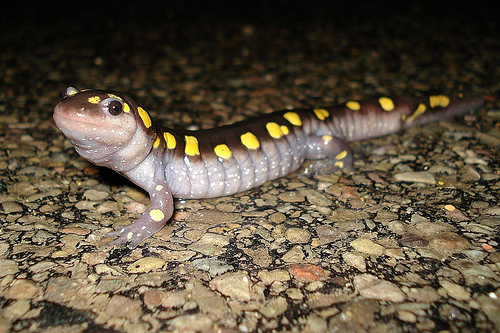
Have a copy of the non-fiction report form to refer to as I give the following explanation. 🙂 Ready? Let’s get started! For the sake of giving you an idea on how to use this, let’s assume I am assigning a paper to be written about a spotted salamander that we observed on the creek walk we took recently.

❍ Green- Group (categories) Here the student writes that a salamander is an amphibian and if you have an older student writing the report they can include more scientific data: Ambystoma maculatum

❍ Blue- Do: “What does it do? What do you do with it? Students write about its life cycle.

☺  Face- Look: What does it look like? Shape, size, texture, color Students describe it and draw a picture or include a photograph.

✎  Wood- What is it made of? Where does it come from? This may or may not pertain to the salamander, but it certainly would apply if you were writing a report about a machine.

❍  Pink- Parts: How does it work? Since it is an animal this would be its internal organs.

❍  White: Where do you find it? Describe its habitat.

❍  Red- What else do I know? Interesting facts  One interesting fact is that it is the official state  amphibian of Ohio. *I didn’t know that when I picked it for this post. I found out when I was researching the scientific name! There was even a spotted salamander festival last year in Birmingham, Alabama. I didn’t know that little critter was so popular!

  Isn’t he cute? Plan on a creek walk in late winter to see him/her for yourself! Just be sure that if you find one of these amazing amphibians you return it to where you found it. It selected that special place for a reason and you want to be sure and allow it to go back to its cozy abode.

*** For younger students I have created an elementary  Non-fiction Report   that can be filled in. Depending upon their level and how much further you’d like to proceed with this, you can either use this as the entire writing project or have them use it as a guide to write a paragraph at the bottom of the worksheet and draw a picture of the topic.

Also, I just read a terrific article about making non-fiction reports fun by creating a mini report book, otherwise known as a lapbook. You can read it yourself by going to the website bravewriter. They are also offering this as an online class if you are interested.

Next week I will have some nature themed resources on my blog for you to enjoy and help with reports.

Teaching Non-fiction to Elementary Students

I wanted to share an idea about writing a non-fiction report, but realized after I started delving into the topic that I needed to cover some foundational aspects of fiction and non-fiction before proceeding to the report! It is essential that students can first distinguish the difference between the two genres.

Pick some children’s stories to read that are both fiction and non-fiction and have the same animal as the topic. Get a piece of paper and divide the paper into two columns. Make the heading of the left hand column be Fiction and the right hand column be Non-fiction. Read both genres paying particular attention to the differences between them such as: make believe versus realistic; a story versus facts; illustrations versus photographs or realistic representations of the animal. Write these differences in the appropriate column. Also note that in the non-fiction column there may be the table of contents, index, additional resources, or a glossary. Do this over a period of two weeks and choose several different animals as examples for your student(s) to see that fiction and non-fiction books are both similar and dissimilar in the material that is covered. Look at the list you have made previously and see if there are other categories to add.  Use this list so your writer can refer back to these as a guide for when (s)he writes the non-fiction report. Not all of these items will be used in the nonfiction report (pictures, glossary, index).

I have chosen the topic of rabbits here as a guide for you. Read The Tale of Peter Rabbit by Beatrix Potter or Tops and Bottoms by Janet Stevens and a non-fiction book (or two) about rabbits. The books may seem too young for a middle school student, but the whole idea is for them to be able to understand the differences between fiction and non-fiction. You want to be able to concentrate on the elements of writing as opposed to figuring out the plot.  It is also a reference point for you to discuss with your child as you teach about writing their own non-fiction report.  As a bonus, if you have little ones they will enjoy the stories as well. If you aren’t that crazy about rabbits here are some other animals to read about for the genres: dogs, cats, pigs, and bears. I have listed some dog books after the rabbits for you below.

Rabbits:

Online resources for Peter Rabbit: Peter Rabbit This is the first printing of the first edition of Peter Rabbit (1902). I love how you can “turn the page” by hovering over the corner of the book and dragging your mouse across to the other side. It looks the page is actually being turned.

The Tale of Peter Rabbit a UTube video that is narrated by a gentleman who has a wonderful United Kingdom accent. There are pictures, but no words from the book.

The Tale of Peter Rabbit a UTube video that is narrated by Meryl Streep. She does a lovely job reading it, but you do not get to see the pages or the words of the book. If you have the book it will be a fantastic addition.

The Tale of Peter Rabbit a UTube video that has pictures and words.

The Tale of Peter Rabbit, Beatrix Potter There were too many fun resources on amazon.com for me to list so I thought you could choose your own!

Tops and Bottoms  A Caldecott Honor winner, this tale will be enjoyed by all as you read about how the clever rabbit outwits the lazy bear.

Non-fiction Books Rabbits, Rabbits, and More Rabbits, Gail Gibbons This book has bright, colorful illustrations and covers topics such as breeds, folk lore, and care of rabbits.

Animal Life Cycles: Rabbits (First Step Non-fiction), Melanie Mitchell This book would be great to use as an introduction into nonfiction.

Rabbits and Hares, Diane Swanson This is a book for older students (ages 8-12) that compares rabbits and hares. Interesting reading material and a terrific example to  show how a non-fiction report comparative report can be done.

Rabbits, Melissa Stewart This book describes the physical characteristics, habitat, behavior, life cycle, and conservation status of the rabbit.

Dogs:

Fiction Books If You Give a Dog a Donut, Laura Numeroff  I always enjoy these books and though they may seem young for older students, they are easy examples of fiction that everyone enjoys.

Dog Breath!: The Horrible Trouble with Hally Tosis, Dav Pilkey Who knew bad breath could save the day?

Non-fiction Books Dogs, Gail Gibbons Informational book about dogs from one of my favorite non-fiction authors.

The Dog Family, Bev Harvey

True Stories of Dogs and Cats free kindle book! There are other free titles of dog stories here as well.

Everything Dog: What Kids Really Want to Know About Dogs, Marty Crisp This non-fiction book is done in a Question and Answer format based on inquiries from children the author has collected over the years.

How about wrapping up this topic with a good ol’ dog movie?  These first two are sad, but are favorites of many people. Old Yeller, Where the Red Fern Grows, Homeward Bound, Cats and Dogs (my favorite!), Otis and Milo, Snoopy Come Home, Because of Winn Dixie, and Shiloh are just a few to get you started. Next week I will discuss writing a non-fiction report.

PBS Online Math Games

Do your children enjoy watching the programming on PBS? There is good news–PBS KIDS  launched over 40 new cross-platform games this month designed to help children ages 2-8 build critical math skills. They include PBS KIDS’ largest offering of interactive math content for preschoolers to date. The games comprise several suites, each of which is centered around a PBS KIDS media property – from CURIOUS GEORGE to THE CAT IN THE HAT KNOWS A LOT ABOUT THAT!. Available for free on the new PBS KIDS Lab website (PBSKIDS.org/lab), each suite links a set of games across platforms – accessible through computers, mobile devices and interactive whiteboards – so that kids engage with the same characters as they move from device to device. The content is also linked by a curricular framework, leveraging games on a variety of platforms to support key math skills. Check it out. It looks like a lot of fun!