Archives

Showcasing your Student’s Work: Writing

Showing student work for a portfolio review in the area of writing can be done in various ways. Whether you have a student who is just beginning to write or a student who is authoring a novel, samples of work can be included in their portfolio review.

Primary Grades

Simple words and/or drawings are ways of writing and communicating so include those as part of your budding author’s portfolio. Can you guess what this is representing? If you guessed the fourth day of Creation you are right!

IMG_1362


If you have a child that is not yet writing, but loves to tell stories, be the scribe and write it down for them. You can read it back to them and they can illustrate parts of it. The important point is that they see themselves as an author, being able to communicate through writing.

Beginning writer’s work can also be samples of writing the alphabet or practicing their name.

Elementary and Middle School

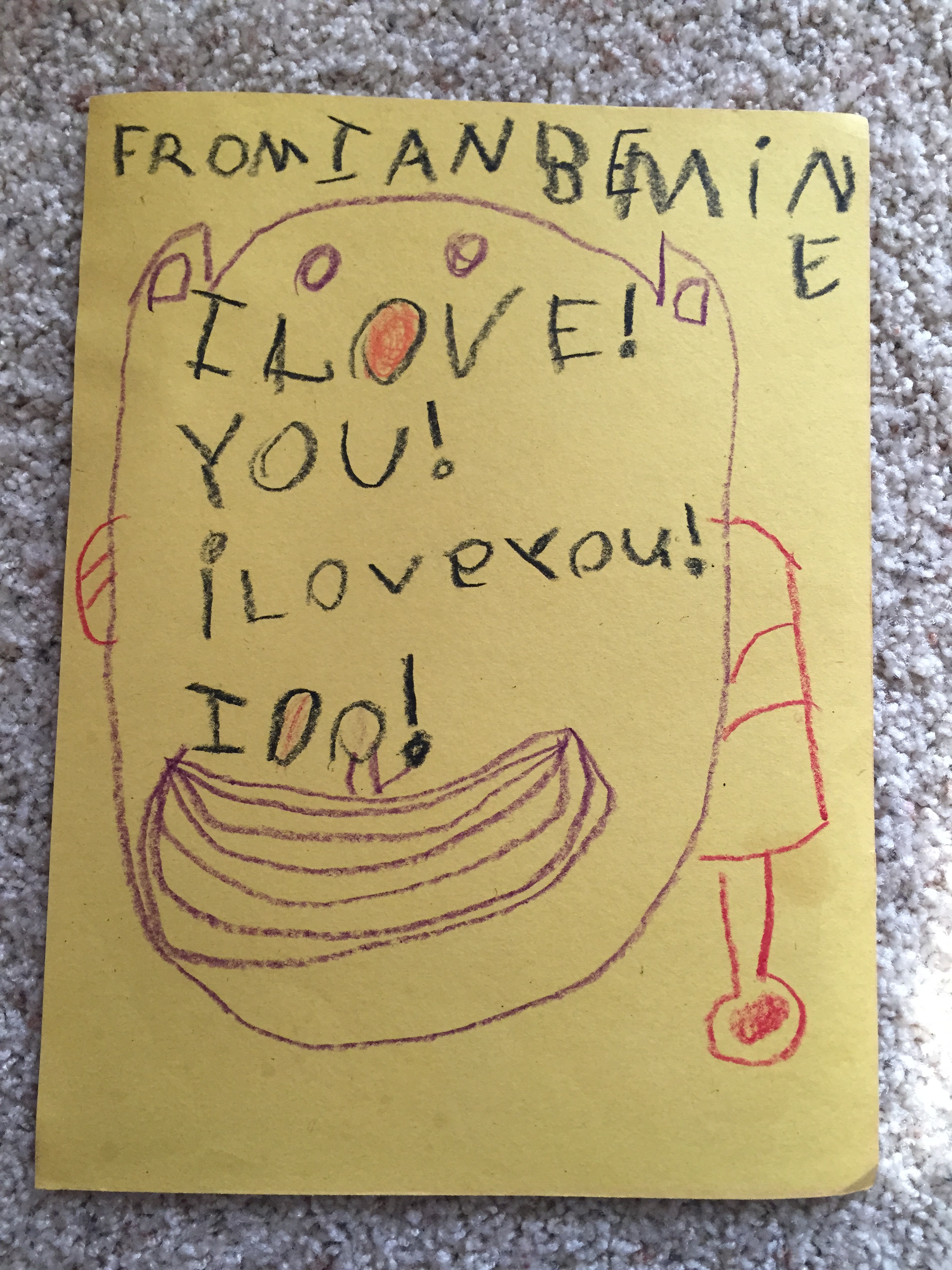
Children love to express their love and, while you may not consider a card  to be “writing”, it is because a thought or idea is being communicated.  Put those in the portfolio as part of language arts.

IMG_1354

What about lists and jokes? Yes, they count too! My son Ian had this eight page book that was nothing more than a list of animals and a name next to it. He had a lot of fun with it and would carry it with him throughout the day. I would see him scribbling something in it and then chuckle to himself as he read back over the list. The funny thing is that I just found that list the other day when I was cleaning out some of his old artwork!

Here are other ideas:

Short stories and chapters of books

How-to do something (play a game)

Writing a letter (take a picture of it before you send it off in the mail)

Book reports

Short research project (1-2 pages on various history or science topics)

For you who have techie children and families

Emails to a grandparent

Blog (Some of your children may be contributors to a blog or have their own.)

Facebook messages


10 Portfolio Organization Ideas

images-1As you begin to collect work samples of your students work the question that may come to mind is, How should I best display the amazing work that my student has completed this year?” It really is a matter of personal choice, but I am listing some organizational ideas to help you.

  • Bring workboooks of the school year that has been completed. This is the most common form of displaying a student’s work if you are using traditional textbooks.
  • Binders are a great way to show looseleaf papers and other work that is not from a workbook. Tabs are helpful to use as headings for individual subjects if you combine them in a notebook. You could have one large binder for all work or several smaller binders for individual subjects.
  • Accordion pleated folders are helpful since you can place wok samples in each of the slots and label each separate subject. For example: Math, Reading, Handwriting, Social Studies, Health, etc.
  • A large box such as one that holds reams of paper works well if you have binders to bring or large items you’d like to show me. (artwork, models, etc.) I am only suggesting, and this is by no means a requirement! 🙂
  • Pictures on your phone are an easy and portable way to show activities and projects if you don’t want to bring them and run the risk of something happening. You may have had your student do a class that was on the computer and have no way of printing off the answers. You can take a picture of the screen with the scores for the year if you like.
  •  Voice recordings on your phone are helpful if you would like to ask questions about progress or want to show progress that is being made in reading.
  • Scrapbooks/yearbooks are a wonderful keepsake and a snapshot of things you have done over the year. They serve a dual role because they help me as an assessor to see what kind of activities you have done, but they are yours to show for years to come.
  • Descriptions of co-op classes your student was a part of help document classes that you did not teach at home. If a syllabus is available for a class you can include that too.
  • Program guides from ballets, music performances, or certificates of completion for a gym class or a babysitting course, etc. help to document what your student has done.
  • Badges from scout programs such as American Heritage Girls or Trail Life are great for showing topics of study that are more difficult to document such as fire safety or first aid.

I realize this is only scratching the surface on how you can organize your student’s portfolio, but I hope this gives you some ideas. As you can see from what I have listed above, there are a variety of ways to document and display work. Use whatever means works best for you and feel free to come up with other ideas.

~Lisa

Free Portfolio Review Giveaway! Winners Announced

confetti_falling_iclip

 Thank you to all you ladies who entered the contest. The winners are Larissa H and Mei Ling! You each receive one free portfolio for the 2014-2015 school year.

With over so many entries for the contest I was glad to use a random number generator.  If you are ever in need of a similar service I recommend random.org   RANDOM.ORG offers true random numbers to anyone on the Internet. The randomness comes from atmospheric noise, which for many purposes is better than the pseudo-random number algorithms typically used in computer programs. People use RANDOM.ORG for holding drawings, lotteries and sweepstakes, to drive online games, for scientific applications and for art and music. The service has existed since 1998 and was built by Dr Mads Haahr of the School of Computer Science and Statistics atTrinity College, Dublin in Ireland. Today, RANDOM.ORG is operated by Randomness and Integrity Services Ltd.

Free Portfolio Review Giveaway! Closed

Woo Hoo! It’s that time of year where I give away two free portfolio reviews! If you are interested in having a chance to win one of the reviews (a $40.00 value) there are six ways to enter.  Each way gives you one chance. I will draw one name for each portfolio review on January 31 and post who won on my blog February 1.

“So, how do I enter a chance for the giveaway?” I am glad you asked! This year there are even more ways to win that last year.

  1. Subscribe to my blog. Write a comment that lets me know!
  2. Like me on Facebook. There is a link to my Facebook on the right side of my blog. Write a comment below to let me know you are following.
  3. Write a comment below about why you like to homeschool.
  4. Direct a friend to my blog. Write a comment below that lets me know you did that.
  5. Sign up for a portfolio appointment (March-July) and let me know you want to enter the giveaway. schoolmarmohio@me.com
  6. Recommend me to a friend and have them mention your name (this month) when they schedule a portfolio review. Of course, I am always appreciative when you recommend a friend to me- THANK YOU!

I hope you win!

Love,

~ Lisa

Showcasing your Student’s Work: Reading

Children-readingAs I am preparing for families to come this spring and summer for portfolio reviews, I am thinking it beneficial to discuss different ways to document what your student has done this year. I am going to break this down into subject areas over the next several weeks so I can provide you with various options for each area. This week I am going to address Language Arts, particularly reading.

Reading

Record oral work. When little ones are just beginning to sound out letters and read, it may be difficult to “show” work that has been done since a large portion of the work is oral. For beginner readers you can record a book that you are reading aloud and the interaction that is taking place. For instance, if you are reading In the Tall, Tall Grass by Denise Fleming and you are having your reader listen and follow along, pointing to certain letters or words, it documents what is being accomplished. You can have a grandparent listen to it as well. Those are button-busting moments for all involved!

You can also have any of your readers create audio books over a period of time to show progress. Modeling this would be helpful to your child, either by listening to a book on CD or by recording one yourself. These can be short books or a chapter book; it just depends upon what you would like to do. Since it is January, you still have several months to do this before a portfolio review. Play it back for your husband at the dinner table and let your student shine!

Keep a book list. Either keep a receipt from the library; record the titles in your lesson planner; or take pictures of the books, or bring three books with you that were read at the beginning, the middle, and the end of the year. This is an amazing way to see the progress your student has made throughout the year.  There are times when I just don’t think I have done anything and if I have someway of looking back to where I began I am encouraged that I actually did more than I thought. Sometimes you see tremendous growth with your child, and much of the time it is slow and steady.  Both of these are great, so don’t be discouraged. 🙂

Keep workbook pages. If you are using a traditional workbook, you can pack it up to show at your assessment, or you can tear out 30 pages or so. These pages would be from the beginning, middle, and end of the year.

Check comprehension of reading passages. This can be done by stopping in certain portions of  the story and ask questions such as, “What do you think will happen next?” “How do you think the story will end?”, “Why did the character act that way?” (motive) If your child is not writing yet, then record their answers and be sure to title the page. For example: Caps For Sale  Why did the seller throw his hat down? Record your child’s response.

Having your student draw a picture of the story as a summary or as a prediction for what will happen is a way to record comprehension too. Many reading programs have comprehension questions at the end of the passage so you can include some of those for the portfolio.

Create a picture collage of activities. Perhaps your children make crafts or do some of their schoolwork on the computer. You can take pictures of your children reading directions, and/or show a picture of the computer screen with the results that are given at the end of the lesson or game.

I hope this has given you ideas of documenting your student’s work. As you can see, there are many ways to do this and you are not limited to just one way to do things. You have unique pupils and not each child learns the same way.

Please leave a comment if you have another idea. I’d love to hear it!

~Lisa


My friend Ann sent me a picture of what they do to celebrate reading at their house. They create a Reading Wall. Every time someone reads a book they write the title and their name on a post-it and stick it to the Reading Wall. I love it! Thank you for sharing, Ann. 🙂photo 1 photo 2


9oo Hours

calendar

When you first read the Home Education Notification Form that you need to provide 900 hours of home education you might have had visions of your precious child sitting at a hard wooden desk for 8 hours. Maybe your thought was, “How are we supposed to do that?”

The good news is that you do not need to spend those 900 hours only doing schoolwork at a desk and reading monotonous textbooks. Although, using an interesting textbook is an excellent way to learn. 🙂 Home Education takes place each day, all day long. You are instructing your children throughout the day.  Discussing the importance of taking a bath, brushing teeth, and eating a well-balanced breakfast all are part of a health curriculum since these are components of hygiene and nutrition. Receiving an allowance; deciding on a plan for saving money to purchase something; tithing; and saving a portion of it are areas of math that are not necessarily covered in a textbook; but are essential to teach our children how to manage their money. Keeping toys picked up, not touching a hot stove, discussing and practicing how to get out of your home in case of a fire or an emergency are all part of a safety curriculum. All of these activities help to reinforce and enhance what you are studying.

One time I was telling the boys about how sound carries better if you cup your hands around your mouth and shout. Well, of course, we had to go outside and prove that idea. I couldn’t just have them go outside and yell, I decided to incorporate stranger safety into the activity as well. One son was on our play set slide while the other son was on a swing, each yelling “help” and kicking their legs with all of their might.  It didn’t occur to me until well into the activity that someone might really think the boys were actually in trouble. Fortunately, no one was around to witness this event except me.

So, how do you go about making sure that you have covered 900 hours of home instruction? If you take a typical school year, which is approximately 180 days and you divide into 900 you will arrive at 5 hours. This means you would provide instruction for your student a schedule of Monday through Friday beginning at 8:00 (if you are an early bird) and finishing at 1:30 with a 30 minute break for lunch.  Of course, you can begin and end school with the schedule that works best for your family.

Many families go on school-related outings on the weekends with things such as park programs with a naturalist (science), participating in sporting events such as a soccer team (physical education), going to a museum (history, art) or going on vacations and identifying birds, wildflowers, seashells (social studies,science), etc.

I created an attendance sheet that was Sunday through Saturday since we had several weekend events and field trips. You can keep track of the number of days you are homeschooling and have a record of that to put in your lesson plan book or school binder. Days add up quickly and you will find you easily meet the required hours of home instruction.

Am I advocating you sit around and watch cartoons, eat 3 bowls of ice cream and call that home education? No, I am not. You need to be purposeful in your home instruction and plan your school year, which includes all of the subjects listed on the Home Education Notification Form. You can watch cartoons and eat one scoop of ice cream in your free time. 🙂 You can, however,  make your school practical and fun while teaching your children; that is one of the benefits of home education. Educating our children doesn’t stop when we put away the school books.

If you are in need of a calendar to plan school and extra curricular activities there are many free printable calendars available. Some you can even edit, which is a nice feature.  I marked the calendar date with a diagonal line through the date if it was just a half day (such as a weekend) or an x for a full day. This is a website I have used over the years and i just type right on the calendar and print it off. Easy! To view, CLICK HERE.

This is not legal advice. It is my opinion. I am not a lawyer, have not studied law, nor do I play the role of an actor in any play or motion picture. 🙂 Please consult your local homeschool group, CHEO, or HSLDA if you are in need of legal advice.