Archives

Unit Studies: Ideas and Benefits

TeepeesshI am a member of an egroup that is for homeschool families here in Cincinnati. A homeschool mom was asking about ideas for unit studies and here is my response to her.

A great place for unit studies is the internet. You can begin with a lapbook. There are wonderful topics of study on homeschool share that can be downloaded for free. They are literature-based and you can use as much or as little of the lapbook as you like. My boys really enjoyed them and I did too. I would call these lapbooks “unit studies” as that applies loosely to the idea of studying topics as a whole. A unit can vary in length from a day to a year.I have a few ideas to help get your creative juices flowing in terms of unit studies…

My oldest son is a wonderful writer and artist. He enjoyed the freedom of being able to write what he wanted in lapbooks instead of being told what to write. He could draw things as well. My youngest enjoyed the fact that there wasn’t a lot of space to write. He wasn’t intimidated by a scary “whole page” that I, on many occasions, put in front of him! He didn’t like to actually “write” so he would dictate facts or ideas sometimes to me, which I thought was fine since the idea was to get him to think and tell me what he knew. I found that when he had to write with a pencil or pen he’d write as little as possible. I am glad my oldest son enjoyed writing- that was a huge blessing to have one who did! He is still a wonderful writer, maybe unit studies help foster that?
I also encouraged drawing and thinking about what I read aloud to the guys by giving them a binder filled with blank paper. As I read to them the boys could draw what they thought was important, such as a battle, an event, a science concept, etc. You can have pictures to help your son if he can’t imagine anything to draw or can’t “picture” it. He can also write a poem, a short summary, or a list if he doesn’t like to draw. You might be able to find coloring sheets to go with the topic being studied or he could create a model or a diorama.I still have my oldest son’s history notebook and I showed it to him the other day (11 years later). He actually remembered drawing some of the pictures and could tell me a little about the stories. He said, “I thought I was really quite good when I did these.” Of course I told him he was and still is  a good artist! 🙂 Quite amazing that he was able to recall some of those events when he saw those pictures as I don’t think I could dredge up much of what I had read to him!

One time the boys and I studied Native Americans and they each made a teepee in our small  living room. It was so fun as I watched both of them “tell stories” through drawings like the Native Americans originally did on their portable homes. Ian drew scenes of baseball, hunting dragons and buffalo and deer (quite the mix!) and Malcolm drew trucks and Indians with bows and arrows shooting at buffalo (also quite the mix of modern and the past).It was great watching them help each other set up and sit inside of their creations. I used washable markers, sheets, and wooden poles that Dale had purchased from the hardware store. lol We did it another time because it was such a big hit and my brother-in-law gave me Tyvek. That was virtually indestructible! I let them wear “war paint” and they had a blast with that too.

You can incorporate any hands-on project into what you are studying. That was the beauty of doing units. I had one extremely bright, creative, slightly mischievous son and another son who couldn’t sit still for more than a few minutes and joined right in on the mischief or created his own special scenarios. This provided a great outlet for both of my very different learner-type sons.

If you want unit ideas KONOS has more than you can imagine. So, if you use the older editions just pick and choose what interests you.  The old books have a million projects and if you happen to use those, don’t try to do everything. It would take you years to get through it! It is a fantastic resource.I checked out her website and she has a lot of options to choose from do-it-yourself to it’s already done for you. I see it says semester long projects, but I bet they could be stretched out to a year as they are a bit pricey.

My advice is to start out with one or two units and ask your son what he’d like to do. I always found the enthusiasm level went up when the unit was chosen by one of the guys. You can set parameters if you want to direct what is being studied. You can also do a google search for free unit studies and you will be able to find quite a few. I always used a traditional math curriculum in conjunction with the units, but incorporated nearly all of the other subjects into the unit.

I am really glad we did unit studies as it gave confidence to my sons and provided a creative outlet . Unit studies also gave me “permission” to do some things that I think I otherwise would have said no to (like the teepee), thinking that doing something like that  wasn’t “school” because it is, it just looks a bit different. 🙂

Portfolio Review Giveaway

imgres

Guess what? I am giving away a free portfolio review!($40.00 value) All you have to do is follow my blog. 🙂 If you are currently following my blog, leave me a message about what you like most about homeschooling. If you are a new follower, leave me a message too! One message entry per person.  If you’d like more chances to win, tell a friend and get them to follow! They will need to mention your name with their message. This portfolio review would be beneficial to you who live in the Cincinnati area as you will meet with me, a current Ohio certified/licensed teacher, to discuss your student’s school year.

The Giveaway ends February 25, 2013. I will announce the winner on February 26 at 5:00 AM.

Online Government, Economics Courses

Capitol Hill

Capitol Hill

Would you like some help teaching Government or Economics? I saw these two live online courses being offered by Founders Academy in January for junior and senior high school students. They can either be taken as an 8 or 16 week course. Government 101 and Economics 101 courses begin on January  14 and you will need to order a textbook for your student.  Each course is $149.00 and if you have more than one student taking the class you get a multiple student discount. There is an Open House on January 7 at 8:30 pm EST that you can see if you would like your student to take one of these classes, but you need to RSVP. Click Here to read the details.

If your student isn’t to the junior or senior high level yet, Founders Academy offers classes for younger students too.

January 17 Martin Luther King Live! class  Ages 5-10  Cost: $7.00 10:00-11:00 am PST Click Here for more details.

January 28 – Live! Medal of Honor Boot Camp | 3 sessions – 1/28, 1/30, 2/01 | 2:30 – 3:30 pm PST | Cost: $27 Best for ages 11-18 Click Here for more details.

Growing a Little Bit O’ Green

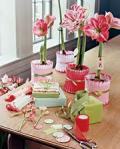
imgres-1I don’t know about you, but living in Ohio during the winter can be particularly dreary and affect my mood. I miss the anticipation of watching the shoots of plants appear and all of the color of the flowers in bloom. However, I found a way to help alleviate some of that dreariness. How about growing flowers from bulbs? You can use it as a science project to watch the development of the flower as well as provide color and beauty in your home. Most bulbs need a time where they are chilled in order to bloom early, but the following bulbs are the easiest to force into bloom because they don’t require a chilling period:

  • Amaryllis Blooms appear six to eight weeks after planting. They are available in many interesting colors and forms: bright reds, as well as white, pink and peach.
  • Paperwhites Blooms appear three to five weeks after planting. Paperwhites offer delicate beauty and an intense fragrance. Buy a couple dozen paperwhite bulbs and store them in a cool, dry place. Start some every few weeks for blooms throughout winter.

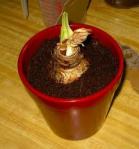
imgres-2Bulbs can be grown in a pot filled with soil, or just place them in a shallow bowl and use pebbles or marbles to hold the bulbs in place. Add several inches of water  and they’ll usually bloom just four weeks after “planting”. You can plant in a container similar to the photo on the left or you can be as  fancy as putting your bulb  in a glass container with decorative pebbles of rocks that you can purchase at a craft supply store such as Hobby Lobby. The picture shown here is an amaryllis bulb and as you can see they are quite large.

To help keep stems short and sturdy, start them out with indirect light and temperatures of about 50 degrees F. for the first two weeks, then warmer, brighter conditions after that. You can add thin bamboo stakes as they grow taller if you cannot do as previously suggested. If you’re growing your bulbs in a bowl with pebbles or marbles, the water should cover no more than the bottom quarter to third of the bulb.

Of course, this is an opportunity to incorporate learning with the beautiful project. 🙂 I have listed some ideas and subject content areas that apply to your garden. As with any project, adjust the activity to meet the needs of your student(s). My thoughts on how you can use this fun on-going activity include:

  • Deciding which bulbs to plant.  Are you going to plant an amaryllis or paper whites? Do you want to plant both? How many do you want and what is the cost? Here are links to help you decide: amaryllis bulbs or paperwhite bulbs (Language Arts- researching bulbs; Math- decision making, cost)
  • Allowing the children decide what container and rocks would be best. (Math- sorting)
  • Decorating the container. (Art)
  • Planting the flower bulbs. Record the steps on a A Little Bit O’ Green Lab Report. (Language Arts- following directions, writing down steps; Science- lab report)
  • Making predictions about the growth of the plant. (Science- How tall will it get? How big will the flower be? How long will it take to grow? How much do you think it will grow in a week? Math- measurement)
  • Recording and graphing the growth of the bulbs and later the flowers. (Math- How much has it grown in a week? Science- Measuring the parts of a flower; bulb, roots, stem;  Discussing photosynthesis, care of plants; Language Arts- vocabulary)
  • Labeling and defining the parts of the flower. Here are some great, up close pictures of each part of the flower (Science- parts of the flower, pollination; Language Arts- researching, vocabulary)
  • Drawing the flower and all of its parts A Little Bit O’ Green Drawing Activity (Art- drawing)
  • Determining direction for optimal growth of the flower with using a compass. (Math- reading a compass; Social Studies- direction)

Have fun and let me know if you do it. I’d love to hear about your garden!

~Lisa

CHRISTmas Resources

Christ-in-Christmas1With Christmas just around the corner I thought I better get these Advent and Christ-focused resources to you.

I found a cute ebook called Truth in the Tinsel that is designed for little ones. It looks like a great resource and I hope you enjoy it with your little ones! It also has advent activities that you can do with your preschoolers.

At this website you can create paper ornaments with the The Names of Jesus.

I love this activity! You can make a beautiful Advent calendar with cookie sheets and scrapbooking paper.

Here is an Advent devotional and unit study. This can be used for all ages; modify to meet your family’s needs.

I have used this next unit in the past with my family and found it to be a wonderful resource that we liked. I believe you will enjoy it as well. A Blessed Christmas has an Advent section at the beginning of the unit and 25 symbols of Christmas afterwards. Each representation begins with a short explanation of its meaning, a scripture, discussion questions, crafts, recipes, and a service activity. Here is a sample of one of the symbols. It is much longer than this, but will give you an idea.

ORNAMENTS–The very first tree ornaments were a display of God’s provision to his people. Apples, cookies,and  candles were several items used to remind us that Jesus is the light of the world.
Bible: Read James1:17
Discuss: What good gifts God has given you.
Do: Make ornaments that represent God’s blessings. Or, make a small Christmas notebook that shows pictures of what God has given you, or make a Christmas banner that displays God’s blessings to you.

Have you ever wondered what the history was behind the Christmas hymns we sing?  Check out this unit study of 15 songs! Good Christian Men Rejoice

Have a wonderful Advent and Christ-filled Christmas.

Lisa