Archives

Lesson Plans Part 2 (using textbooks)

Nuts and Bolts

Now that you have gathered your curriculum and have given some thought to your academic year you are ready to begin the actual lesson planning.  Each of you is unique and what I have found to work when I am planning for the school year may not be helpful to you, but it can give you an idea of how it can be done. I will give you a few examples of lesson planning based upon whether you are using textbooks or using other modalities to teach your students. Most of the planning is the same, but each is a bit different when it comes to organizing your year. This article deals specifically about planning with textbooks.This is going to take some time so don’t be overwhelmed and take it in small portions. One thing at a time….

Set up an area, if at all possible, that you can spread out all of your books and resources. Perhaps find a place that won’t be disturbed (study, dining room table, my house- I am renting out space this year, gotta help pay for my missionary son’s living expenses somehow! Just teasing about my house.)

Before I even open up a book or unit study I stop and pray. I can use all the help I can get, right? 🙂 I dedicate the year to the Lord and ask for His guidance.

The first thing I do in planning the year is write down some character issues my husband and I have seen that need addressing and see how I can incorporate training in these areas while we are doing school. I also look at the academic goals I have set for the year and make a tentative month-by-month outline of what I want to accomplish so that we can meet those goals by the end of the year. I stick to this as much as possible, but things happen and I readjust as necessary.

Lesson Plans with Textbooks

When I use textbooks the first thing I do is see how many chapters or lessons there are in the book. I then adjust my overview of the year so that I am half-way through the book by Christmas since I am planning on finishing in May. I have a sample of what that looks like with two subject areas, click Overview of Year to view the document. As you can see, December is light so that I do not feel overwhelmed with trying to complete a lot with all of the extra curricular activities and vacation that occurs that month. I have only shown you 2 subjects, but I do this with all of the areas that I teach in one year.

Your months are basically mapped out at this point so you can begin to plan each week. I only plan a week at a time, but keep in mind what has to be accomplished in order to complete the monthly plan.

Look at your textbook and see how many pages are in each chapter. This will determine how much your student will do each day. For instance, if your spelling lesson has 4 pages, you can do a pre-test and overview of the lesson on Monday and assign a workbook page for Tuesday- Thursday and have Friday as a test day. Do that for each subject and write this in your lesson plan book or make a lesson plan that you create on your computer.

I chose to do my weekly overview on the computer since it made it so easy to update each week (or as needed if something unexpected came up). I also printed off each week’s assignments and placed them in a binder. I referred to this daily so I knew what we were doing and if I needed to gather supplies for science, art, etc. Here are some other ways to organize: Month at a Glance- Elem (getting more specific as you create a weekly plan), Adventure Log (a weekly plan). Notice the name, corny I know, but it made it more fun for me and hopefully the kids!

Things to Consider when Planning for the Year:

  • Allow time off when things are hectic (Christmas, a new baby) or are not a part of your curriculum. (park program, field trip)
  • Incorporate outside activities into your daily plans. (co-ops, community classes, sports, etc.) Frustration will set in if you don’t plan for this- I know from experience! 🙂
  • Will you do school 4 or 5 days a week? If you do a 4 day school week be sure that you will finish your textbook by the time frame you have planned. Most textbooks are arranged for a 5 day school program.

Part 3: Planning with Other Curricula/ Modalities

Lesson Plans: How do you do that?! Part 1

One of the biggest areas that I have found my teaching experience has helped me with home schooling is lesson planning. In my perfect world I wouldn’t necessarily bother with a schedule, but we wouldn’t get much done either! I believe making lesson plans helps to give you a framework for your school day. This can be done either with a structured format such a lesson plan or a less structured format such as a journal. You can plan for each day, week, month, and before you know it, the whole year is done! I will be addressing the “how-to” of lesson plans for several posts since the explanation is fairly lengthy.

Do I sit down and plan out the whole year at one time? No, I think that it would be an overwhelming task, and besides I don’t have the stamina or time to do that- neither do you!  Set aside a few hours one week to lay out an overview of your year. (See part 2) After that has been accomplished, set aside one day a week to plan for the upcoming week. I usually spent 1-2 hours on Saturday morning writing out lessons and figuring out what materials were needed (science, art supplies).

Things to Consider before Diving into the Planning:

  • In what direction do you want to go for the school year? Take some time to pray for wisdom and guidance.
  • Have you discussed the upcoming school year with your husband? Have you considered receiving suggestions from your children? I have asked my children before what topics they would be interested in studying and have added units and/or resources accordingly (if the ideas were legitimate). I just discovered a resource about having a planning weekend with your whole family. If if doen’t work out for all of you to be involved, perhaps just you and your hubby can go. I think that sounds like a wonderful idea!
  • Do you have all your curriculum and/or resources ready so you can start to plan? Have your supplies and materials (textbooks, library books and movies, etc.) available for easy reference. Don’t begin if you are missing the majority of your resources or are going to be using a certain curriculum  based on hearsay. One time I bought a curriculum via the internet and website recommendations that I planned on using for the entire year. I had already loosely organized my year around that curriculum, but didn’t like it once it arrived. That was hours of wasted time! 😦
  • How long are you planning on being in session? Will you go year-round and take several breaks (school for 6 weeks- off for 2 weeks) or do something more traditional like begin in August and finish in May?
  • Plan for breaks, holidays, vacations and the unexpected. How can you plan for the unexpected? Have a few “free” days throughout the year and if something would come up (winning an all-expense paid vacation to Tahiti) you won’t be stressed out if you have to send your children to grandma’s without schoolwork. If nothing occurs, you can either finish early or take the days off! 🙂
  • Are you going to be utilizing other classes or programs outside your school for some of the coursework? Be sure to have those dates and times handy so you can plug those into your schedule.
  • Don’t over commit! Do not plan on doing a great amount of extra curricular activities. While there are plenty of wonderful opportunities for you and your family, consider what you want to achieve by participating. Too many activities can lead to stress and not accomplishing what you set out to do. After all, it is called home schooling for a reason. 🙂
  • Time of Day- When are you planning on being in school? Do you have toddlers, teens, aging parents or a lot of  orthodontist visits that you need to consider when setting your schedule? Plan for that as it will alleviate the stress of not planning and feeling like you are behind on what you had in mind for the school year.

Part 2 will be about writing lesson plans for textbooks and more traditional curriculum.


Educational Cooperatives: Do I Join?

As a home school mom I found that I needed a community of people with whom I could share this amazing adventure called home schooling. I found that being a part of a  co-op was a lifeline for me and my children; it not only helped with academics, but the support I received from the women there was a blessing. Our family has developed lifelong friendships as a result of our  involvement.

My reasons for joining were:

  • having my children take classes from those who had an interest,excitement, and expertise in offered classes
  • preferring not to teach certain classes
  • that some classes are better in a group setting
  • opportunities for my children to be exposed to different teachers and teaching styles
  • having my children be accountable to teachers for assignments and deadlines (especially during jr/sr high years)
  • interaction with other home school children (Dare I say- socializing?!)
  • friendships for my children and me

I must say that while every class was not exactly what we wanted, many exceeded my expectations. I truly believe that the classes were more than they would have experienced had they stayed at home (art in particular!). This also provided me with an outlet for me to teach more than just my two children- once a teacher, always a teacher! 🙂

Should you join a co-op? I canna’ say, (Scottish for cannot) but here are some things to consider:

  • What are my reasons for wanting to join a co-op?
  • Does it fit our schedule?
  • How much preparation will it involve? (teaching class, getting ready, making lunches,etc.)
  • What are the costs? (classes, gas, lunches, extra fees for supplies, etc.)
  • How many weeks does the co-op meet?
  • Will I be able to honor the time commitment that I will make to this co-op?

I can tell you from our experience that my children and I enjoyed being a part of a large home school community. I enjoyed meeting weekly and hanging out with home school moms in our Chew N’ Chat room.

If you are unsure of whether you should join, call the contact person and speak with them; they can help you with questions you may have about joining. Also, stop by for a visit. This will give you an idea of how things are run and whether it will be a good fit for you and your family.

A word of caution- don’t over commit. The idea of a co-op is in its name; you will be required to help in some manner. Many co-ops have a half-day option. Guard your time and plan out your schedule if you decide to join. Your own school takes precedence over any other activities.

Filling out the Notification Form-Part 2

Now that you are finished with the notification form you are ready to send it to your school superintendent. Most homeschool families send their paperwork in 2 weeks before school begins.

If you live in a school district that says Local School District in the title, you must send it to the county board of education. For instance, Southwest Local School District would be sent to Hamilton County Board of Education. If the title of your school district includes the word city in it you send it to the city’s superintendent. If you lived in Mason City School District you would send it the Mason school superintendent. If you do not know call your local school; they will be glad to help you.

It is advisable to take a couple of precautions before mailing your paperwork. Make a copy of all of your paperwork that you submit to the school in the event that it is lost or misplaced. It has happened! Consider sending it registered mail with a receipt. This service costs about $6.00, but it is worth the peace of mind to me. Things get hectic at the superintendent’s office as school is beginning and if  your paperwork would happen to get misplaced you have proof that it was delivered and received.

I would also mail it instead of dropping it off at the superintendent office. I have had friends drop off paperwork and then not receive their excuse from compulsory education.  As I stated previously, things are pretty crazy in August and paperwork could accidentally be misplaced. The school has ten business days to respond to your notification paperwork upon receipt. After that, it is assumed your student has been excused. I personally would not feel comfortable without receiving something in writing. If this happens to you call the office to inquire about it.

Once you receive your excusal letter make a copy once you receive it. Doing this is for a number of reasons.  First of all, I feel “official”! Second, in Cincinnati we have all kinds of perks for home schooling and the letter proves we are educators. Our library system has a teacher collection card and we can use our letter to also get this special card. Many places of business offer teacher discounts on books and educational supplies so your letter will act as proof of that for you. Last, if your student happens to be out during school hours  (babysitting, a part-time job, etc.) and is questioned by a police officer they can show the excusal letter. This never happened to my children, but I’d err on the side of caution.

Mail that paperwork in with confidence and have a great year!

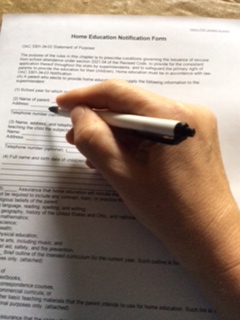
Filling out the Home Education Notification Form

photoIt’s getting close to the beginning of school!

In order to home school here in the great state of Ohio, you must submit the necessary paperwork in order for your child(ren) to be excused from compulsory attendance. The notification form can seem a bit intimidating, but once you have gone through this step-by-step explanation you will realize it wasn’t too difficult afterall. Please have the Ohio Home Education Notification form in front of you for reference. This is not legal advice- please contact HSLDA or a state/local home school organization if you have questions.

A. This is just the introduction- no need to put anything here.

(1) Fill in the upcoming school year- for example if you are going to teach your child in the fall you would write the current school year.

(2) Write your name and address. There is no need for you to fill in your telephone number.

(3) If you are not going to be teaching your child the majority of their school work, then you will need to list the person’s name here. For instance, if you work and your mother is going to do the teaching, you would list her name and address. The phone number is not needed.

(4) Full name and birthdate of your student(s) is listed here. Grade level is not necessary.

(5) Put a check mark on the line that shows you will be providing an education in each of these subject areas.

(6) Place a check mark on the line for the outline of intended curriculum.You have the freedom to change your mind once school begins. The school just wants to see that you have planned what you will be doing. You want to have a list of the concepts/ topics you intend to cover for the year. Please see an example of what I have submitted in years past  Each person’s list may look different based upon what you have planned. Each academic year will most likely look different. I suggest you have broad categories as this will give you the freedom to choose several types of curriculum should one not work out as you had planned. Here are examples for you to see: Elementary Intended Course of Study  High School Intended Couse of Study

(7) Check this line. Be sure to include a list of books, DVD’s and other curriculum that you intend to use for the year.  Titles of library books that I intend to use are listed here because I know that we will be using those for school.  Again, if the curriculum is not working out, you may choose something different during your school year. Here are two examples of what I have sent in previous years. Elementary Intended Curriculum   High School Intended Curriculum . I also have another blog post that gives you more specific details if you need clarification for lines 6 and 7.  outline of topics and curriculum

(8) Check this line with confidence! We all educate our children beyond the 900 hours the state requires. Education is not only limited to sit-down-at-the-table time and bookwork. This includes co-ops, playing outside (physical education), helping watch brothers and sisters (health- family life, safety), going to a library program (language arts, science, social studies, etc.), going grocery shopping (math, health), participating in a local park program (science), symphonies and plays (fine arts),etc. I documented these activities in my lesson plans by writing what we did.

(9) Check this line because you are qualified to educate your child(ren), but read this section to make sure you do meet the  qualifications to be able to home educate your child(ren).

(10) Lastly, sign your form that signifies that you have completed it and will abide by the requirements that were stated on the notification form.

Many people include a cover letter stating their intention to home school and a list of all the paperwork that is being included. If this is your first year to home school you do not need any type of evaluation (portfolio assessment or standardized test). This will be added after your first year is completed.

Congratulations! You have completed the form you and are that much closer to officially home schooling!