Archives

Hear a Tale of a Missing Tail: homophones

The other day as my husband and I were returning through the park just on the other side of our neighborhood we saw a young lady calling, “Here, Bud!”

She was banging on the metal railing that leads to a bridge,which crosses over our neighborhood creek. We figured she was calling for some type of animal to respond to her melodious voice.

“You haven’t seen a cat have you?” she asked us as she turned with a popsicle stick full of goo in her hand. “You can’t miss him. He has one ear, is missing a tail, and he has a big hole in the side of his face. I am trying to give him his medicine.”

Huh?! Dale and I looked at each other and couldn’t believe what we had just heard. We didn’t even ask what color Bud was; I don’t think we would have needed to based upon the description of his unique physical characteristics.

“No, but we will be sure and let you know if we see him,” we responded.

As we walked away Dale looked at me and said, “Of all the things I thought I might hear today, I didn’t expect to hear a tale of a cat with a missing tail [and half of a face].” I didn’t either for that matter.
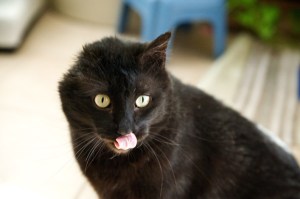
I didn’t think I’d find a picture of a one-eared cat, but you’d be surprised that there were several on the internet. This cutie is called Moose (courtesy of Pet Haven in Minnesota).

I am sure you caught the clever use of homophones I used in my unusual encounter. 🙂 What is the precise definition of a homophone?  1 : one of two or more words pronounced alike but different in meaning or derivation or spelling (as the words to, too, and two)  courtesy of http://www.Webster.com

Why not have your children write a story using homophones? Perhaps writing a story is a bit of a stretch, what about sentences? For instance, how much hair does a hare have ?  or I just don’t think it is fair that we have to pay an exorbitant fare.  Did you know there is a children’s book that has all kinds of plays-on-words?  It is called The Phantom Tollbooth. Here is an example of a homophone from the book: “for after all it’s more important to know whether there will be weather than what the weather will be.”

I have created some homophone worksheets for your student to practice. Homophone worksheet 1  Homophone worksheet 2

Would you like to create your own worksheets? This Homophones List has a compilation of 2000 words that can be downloaded if you like.

This is an online game with pictures to practice more homophones. click here

Now that you are on your way with homophones, why not work on synonyms? No, not cinnamon! I have a blog post that will help you. click here

I’m Falling! A unit on autumn

I am a fan of teaching units as I feel there is a connection to various subjects that students can see rather than learning information as individual subjects. I get excited about taking a topic and exploring it- anything from literature to science, to history, to art, and beyond. I thought that if you were like me you’d appreciate someone else coming up with ideas and you could go from there. I have various resources for different age levels.  I hope this will be beneficial to you.

Seasons: It’s important to lay some groundwork when doing a unit. Create a KWL list or chart. Have your students fold papers into thirds vertically.  At the beginning of a lesson or concept unit, have them fill out the first column and head it “What I Know”. The second column will have the heading  and “What I Want to Know” and have them fill that out.  At this point just put the title “What I Learned”  since you haven’t begun your unit.

As your student learns throughout the unit, revisit the second and third column and continue to add to the “What I Want to Know” and fill in the “What I Learned” . If you would like to create one here is a website to do just that! click here  This helps you to see what information is already known by your scholars, (Know about subject)  what misconceptions they may have about the topic, (Know) and what direction your unit may go toward when planning your unit. (Want to Learn) You may not change your plans, but I have found the enthusiasm for learning to be far greater when my children were asked what they wanted to learn about that topic.

Gather resources: This is time consuming, and so I want to help you with some of these ideas so you can order library books, click on websites, and download worksheets. See the resources listed below to help you get started. If you find other resources that were helpful please leave a comment so others can benefit from your expertise.

Explore topic: If at all possible, allow your pupil(s) to explore the topic of autumn before you start with your lessons. I have listed some ideas  for you to consider:

  • Go on a nature walk and observe the change that is occurring with life. What changes do you notice with the leaves? flowers? Do you notice any insects? (wooly caterpillars, cicadas, new broods of white cabbage moths,increase of Monarch butterflies, migrating birds, are some of the animals in our area). This would be a great time to work in your nature journals.
  • Gather leaves in various stages of changing color
  • Observe and record the time the sun sets each day for two weeks. You can go to the following websites and see how much daylight we have each day. weatherbugwundergroundweather.com
  • Research the autumnal equinox.
  • Check out this Equinox Myth

Teach:

  • Read books,discuss why leaves change color, why are squirrels burying acorns,watch a video
  • Look at temperature changes in your area or across a region weatherbug, wundergroundweather.com
  • Older students: What weather systems do we see in autumn? Research hurricanes, tropical storms
  • Create a weather station and record your findings for two weeks. Older students can reate this and the whole family can participate.
Resources:
Hurricanes- videos (for older students)
Katrina: South Mississippi’s Story This is a documentary showing a broader area that was affected rather than just focusing on New Orleans. Produced by WLOX-TV, Biloxi, MS.
Websites: Be sure to check the websites before you have your pupil visit. There are some ads that can be clicked on, taking you to other websites. Parental supervision is always advised when students are on the internet.
Books:
Poetry
Leaf by Leaf, Barbara Rogasky This book has poetry and photos! It has a variety of fall poems by Whitman, Yeats, Browning, and Poe.
Poems for Autumn, Robert Hull  This is an anthology of poems for fall.
Autumnblings,Douglas Florian A book in a series about the seasons that is whimsical and creative.
Nonfiction (easy):
Autumn Leaves, Gail Saunders- Smith
Websites for Autumn:
Mathwire What a find! This has terrific ideas that integrate a variety of subjects, this page being about fall.
Here is a website that lists many of the books I was going to tell you about, plus one or two more. Fall Fun Kids Books
Preschool/ Kindergarten Math worksheets
Acorn Multiplication Worksheet
Fall themed worksheets for preschool through 6th grade that include using scissors, tracing and shapes for the younger crowd. Kidszone
Fall Worksheets These are for language arts with word scrambles, creative writing prompts, and mini books.
ABC Teach has a variety of worksheets to download, anything from bingo with autumn vocabulary to fall crafts.
 Multigrade level worksheets are available for downloading at Kidszone and here are some word problems for grade 1-5: kidszone   Autumn short stories
Fall Themed worksheets for Grades 1-4, Fall Coloring Sheets, More Coloring Sheets 
Elementary Fall Center– great for your student to do some fun activities on their own.
How about a lap book? This site has a finished lap book for you to see to get an idea of how to make your own.

How can I Say that? synonyms

When working with your student in regards to writing it can be difficult to think of a word to replace the overused ones such as nice, pretty, and said. When this choice of words is used, sentences are not as powerful and don’t convey the meaning as well as specific, imaginative words do for a sentence. Here is an example: I fell off my bike and cried because I got hurt.  This does not convey much of a word picture for the reader. How about this instead? I was catapulted off my bike and screamed  loudly because I was in pain (replacement words are in italics). Don’t you have more sympathy and can “see” the accident better in the second sentence than in the first one?

I have found some resources that will help you and your student. Isn’t it wonderful  terrific, amazing, stupendous, that we have resources available to us? I love, adore, admire, appreciate websites that do this for me.

Lay the groundwork first

Does your scholar even know what synonyms and antonyms are before you go looking for replacements? Here are some websites that have worksheets that cover this topic.

Cut and Glue Synonyms click here

Here is a basic list of synonyms for young writers. click here

Synonyms for commonly used words in student’s writing has a list that will prove helpful. This can be used for younger writers with some help from you or you can have your older students use it on their own.

Practice

Play a game where you practice using synonyms and then play a game practicing antonyms. Be sure you have a thesaurus, or an online resource , or use a downloaded list such as this one: Make three columns on a piece of notebook paper or if you prefer, a whiteboard. In the first column heading write Word, the middle column write Synonym, and the last column write Antonym. With younger students have them come up with just one synonym and one antonym. With older students set the number you want (3-5 or more).

Here are some words to help you get started:

pretty, said, ask, nice,every, great, like, hate, get, take, buy, see, ugly

If you wanted more reinforcement by practicing here is a website that has synonym/antonym games for grade levels 3-12.

Find a paragraph or create your own in which your scholar replaces words to make powerful sentences. Here are some simple sentences to use for reinforcement. synonym sentences elementary and synonym sentences (middle school students) I have also written a story for middle school students and older for you to use. synonym story You may use this for both synonyms and antonyms. Since you are currently teaching synonyms do it that way first and then retell the story using antonyms.

Write!

Now that you have had practice it’s time to have your student(s) write a story using their own powerful words. Start small, choosing a few words to replace. As they progress in their writing you can increase the number of words.

Labor Day

Researching national holidays when we celebrate them seems more pertinent than just learning about them all at once. So what is Labor Day? It was celebrated in 1882 in New York by the Central Labor Union and became known as the “workingman’s holiday”. Unions helped give workers rights and protected them from conditions such as long hours and low pay.

Here is a link if you would like to read more about the history of the holiday and also has a variety of activities from which to choose. I think you will enjoy this resource. kidskonnect

This would be a terrific segue about Community Helpers that is taught in the lower elementary grades. Here are some educational pages that can be downloaded:

Community Helpers Alphabetizing worksheet  answer key

Community Helpers Word Jumble worksheet   answer key

Library book list on Community Helpers

Have a great holiday and enjoy spending the day with your family.

Cowboy standing next to his horse

Jesus said, “Come unto me, all ye that labour and are heavy laden, and I will give you rest”   ~Matthew 11:28~

Art: A Picture is Worth a Thousand Words

unless you have skills like me, then you will need 1,000 words to explain what you created! I come from a family of artists, all of them have a career pertaining to art. In my family we have a toy designer, home designers- both interior and exterior, and a jewelry maker. All of them can paint and  draw well too. Then there’s me… let’s just say I appreciate art and those who can make it.  I am not just being modest here either!

One time my dad offered to have a painting class for me and my sisters and two older nieces in my parents’ home. All of us came with various-sized canvases. I bought a 5″x7″ and was wishing I had bought a 4″x6″ canvas as we began painting. I chose paint a bouquet of sunflowers and tried to make it realistic. I should have gone for abstract.

It took several weeks to paint it and then we had an “art show”. Various-sized canvases (all large) were displayed proudly around the room and, while I wish I could have hidden it behind my back, I timidly put my painting on a small easel as was required for the show and went to join my family. We oohed and awed, and offered impressions and remarks on each that had been done as we walked around the room. Some of the girls were talking about getting their pictures framed.

Then we came to my sunflower painting. There was a long pause as my family tried to think of kind words to say about “It”. “Oh. That’s nice, Lis!”  and ” I like the colors you chose,” was about all that they could say. I don’t blame them. I was embarrassed for them and for me. At least I tried. If you are wondering if I kept the painting, absolutely not! I sold it on ebay! (not really!) 😉

Knowing my artistic limitations I found other more capable people to help me. I asked my dad to teach my sons some art classes when they were young and my older sister did some art projects with them one year, but I primarily depended upon art classes at a local co-op to help me with this area. I know not everyone has the same opportunities that I did for my children so I am posting some websites that have lesson plans to help you. I also have some books listed that I found to be a great help in exposing my budding artists to famous works of art without going to an art gallery or museum every week.

Internet

Art Lessons and Lesson Plans This is a terrific resource since it has lessons according to grade level, medium, artists, just to name a few of the categories.

Crayola When I think of crayola, I think of coloring sheets. Not so with this website. There are lessons and background information about the projects that I found informative.There are lessons for preschool through high school.

Artsonia You are required to sign up for the website, but after you do, there are over 3,000 lesson plans to peruse.

Art Projects for Kids This website is for ages K-5th grade, but I can see it being adaptable for older students as well. You can purchase lessons, all within the comfort of your home.

Books

The Usborne Book of Art Skills, Fiona Watt This has a great variety of art lessons for elementary students.

Oxford First Book of Art, Gillian Wolfe An introduction for children to art around the world.

A Child’s Book of Art, Lucy Micklethwaite This book has over 100 paintings to study, whether it would be color, form, style, or something else, this is a great book to begin with. Look for more of Lucy’s titles. She is one of my favorite authors for art studies.

Come Look With Me:Enjoying Art with Children, Gladys Blizzard I love her books and have recommended these to home school families over the years. These are a wonderful way to discuss art and give children the opportunity to study a picture rather than just hurriedly glance at it. She has more books to enjoy, so don’t stop there!

How to Draw What You See, Rudy De Reyna This looks like a great book to help an older student begin drawing. The important point is to practice, practice, practice!

Have fun, get messy, and do a project or two yourself. The main thing is to expose your artists to the world of art. Who knows? Maybe you have a famous artist in the making. 🙂