Archive by Author | Lisa McAfee

National Jelly Bean Day

Screen Shot 2019-04-22 at 8.20.55 AM

Happy Jelly Bean Day! Making jelly beans is much more involved than I realized. Jelly beans were first made popular during the Civil War and were the first candies to be sold by the pound.

I think your student will find this video very interesting.

Here are some fun things for school that you can do when working with jelly beans.

  • Create a graph to determine what is everyone’s favorite traditional flavor.
  • Guess how many jelly beans are in a pound. (400)
  • Write a story that begins with the following: If I were a jelly bean, I would..
  • There is a fun science experiment to do with the picture shown below. Click HERE to go to the website. A science lab sheet is included as well.

Have a  great week! ~Lisa~


Homeschooling with Real Books

Homeschooling with real books (library/trade books) is much more interesting than exclusively using a textbook. The use of literature can be used to introduce, develop, or reinforce a concept that you are teaching. You may totally agree with me and are getting excited about doing this, but then comes the next thought, “Where do I begin? What books would I use?”

Screen Shot 2019-03-24 at 9.05.54 AM

Serious Fun: Homeschooling with Real Books by Kristin Draeger is just such a resource you need! Kristin shares her personal homeschool experience of how she created this 120+ page list of books, games, puzzles, videos, and music.  I appreciate that she has created such a fantastic open-and-go reference guide. She has taken the time to do this so that you can do other things! Kristin has categorized the books into the subjects of math, science, history/ geography, literature, grammar, and art history. She has also created subcategories of books for students K-3 and 4th-8th grade.

I love that Kristin has included extras for your student like this CD (or streaming option) that is about addition, skip counting, and money, but also includes some art, history, and information about space.

Screen Shot 2019-03-24 at 8.42.15 AM

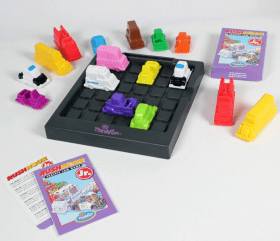
Math games are a terrific way to practice what has been taught without the use of yet another worksheet. Kristin recommends this logic game and I second it as my sons had this when they were young. It is compact and comes with a travel bag so that it can be played in the car or taken to doctor’s appointments. If you’d rather not take it out, it can be used as a culminating activity after your math lessons. If you click on the picture, you not only see the game, but you can watch a short video on the webpage on how it is played.

Screen Shot 2019-03-24 at 8.55.11 AM

Serious Fun: Homeschooling with Real Books is a great deal at just $10.00. This is one book that I think you would return to time and again for ideas for your library trips or stock your own library shelves with real books.

  • Note- Kristin mentions the Kratt brothers  Zoboomafoo series. You can click on the highlighted link to watch these science programs for your K-3 grader since they were not released onto DVD.

Have a great week! ~Lisa~ 

I received a free review copy of this book from the author/publisher in exchange for an honest review. All thoughts and opinions are my own.

To Assess or Not

Screen Shot 2019-03-26 at 5.42.42 PM

Spring is finally here and that means we as home school parents in Ohio must have some type of academic evaluation done for each of our children if we are going to continue to homeschool for next year.

“Should  I have my student assessed or should I have them take a standardized test ?” is a question I hear quite often from home school mothers. There are many advantages to a portfolio review (also known as a narrative assessment). Here are some reasons to consider:

  • This is a terrific way of reflecting on all the work you and your student did over the course of the academic year. It causes you to evaluate your curriculum and your schedule and decide what worked well and what needs to be changed for the upcoming year.
  • It is a marvelous option for younger and older students alike. Younger students may not be reading at an independent level that is required for testing, while older students just don’t want to take one-more-test!
  • Alternate studies You may have used a curriculum that would not be covered on the standardized test such as in the area of history. You may have used a curriculum that concentrated upon ancient history instead of doing American history like all the rest of the children on your block. That is the beauty of homeschooling!
  • Your child is an individual. Nationally normed tests do not allow for any differences. Questions may be interpreted differently by your child and because they did not what was being asked they get it wrong. It’s difficult to watch a student ask you about a test question and knowing you could clarify their misinterpretation of it, but not being allowed to do so under the testing conditions. 
  • Feedback from a certified teacher Test results only confirm what you know are strengths and weaknesses of your student. You might have a question or concern about your child. Narrative assessments can provide you with an opportunity to ask me, a certified teacher, for ideas and resources to help your student. I can also provide encouragement with areas of strength and progress your child has made. We can also discuss areas where we see your student will want to pursue for the coming year. 

If you are a resident of Ohio this fulfills the requirement in order to continue to school your children for the upcoming year.

I believe in you and your role as a teacher. I  believe in homeschooling and the opportunities we each have to teach our children according to their unique ability and gifting. Please contact me if you are in need of a teacher to review your student’s work. 

Have a great week! ~Lisa~

April Fools’ Day

download April Fools’ Day


Here is a little bit of history about the day we call April Fools’ Day. I found some interesting details on the website, history.com, for you to share with your children today when studying Social Studies.

Although April Fools’ Day, also called All Fools’ Day, has been celebrated for several centuries by different cultures, its exact origins remain a mystery. Some historians speculate that April Fools’ Day dates back to 1582, when France switched from the Julian calendar to the Gregorian calendar, as called for by the Council of Trent in 1563.

People who were slow to get the news or failed to recognize that the start of the new year had moved to January 1 and continued to celebrate it during the last week of March through April 1 became the butt of jokes and hoaxes. These pranks included having paper fish placed on their backs and being referred to as “poisson d’avril” (April fish), said to symbolize a young, easily caught fish and a gullible person.

Historians have also linked April Fools’ Day to festivals such as Hilaria, which was celebrated in ancient Rome at the end of March and involved people dressing up in disguises. There’s also speculation that April Fools’ Day was tied to the first day of spring in the Northern Hemisphere, when Mother Nature fooled people with changing, unpredictable weather. (Sounds like Ohio, doesn’t it? lol)

April Fools’ Day spread throughout Britain during the 18th century. In Scotland, the tradition became a two-day event, with “hunting the gowk,” in which people were sent on phony errands (gowk is a word for cuckoo bird, a symbol for fool) as one of the events.

In modern times, people have gone to great lengths to create elaborate April Fools’ Day hoaxes. Newspapers, radio and TV stations and Web sites have participated in the April 1 tradition of reporting outrageous fictional claims that have fooled their audiences. In 1957, the BBC reported that Swiss farmers were experiencing a record spaghetti crop and showed footage of people harvesting noodles from trees; numerous viewers were fooled. In 1985, Sports Illustrated tricked many of its readers when it ran a made-up article about a rookie pitcher named Sidd Finch who could throw a fastball over 168 miles per hour. In 1996, Taco Bell, the fast-food restaurant chain, duped people when it announced it had agreed to purchase Philadelphia’s Liberty Bell and intended to rename it the Taco Liberty Bell. In 1998, after Burger King advertised a “Left-Handed Whopper,” scores of clueless customers requested the fake sandwich.


Investigating Ohio

Screen Shot 2019-03-20 at 4.25.49 AM.png

Looking for things to do in Ohio? Check out this website.  ONLY IN YOUR STATE Here you will find categories of attractions, food, and life that feature a variety of places to visit. I looked at the sites close to where I live and have found quite a few places I want to go and visit. What a great way to experience Ohio! You can also check out their historical sites to see and study for the state history requirement we have for homeschooling.

If you are going on vacation you can go to the home page for the listing of other states. There are the common places you may have already been to or seen, but there are also interesting and unusual places to visit.

Have fun exploring! ~ Lisa ~